
Calcium Carbonate for Plastics: Uses, Benefits and Grade Selection
Calcium carbonate is one of the most widely evaluated mineral fillers in plastic manufacturing, but selecting a suitable grade involves considerably more than choosing a mesh size. Particle size distribution, D50, D97, surface treatment, moisture, purity, dispersion behavior and compatibility with the polymer matrix can all influence processing and finished-product performance.
Thank you for reading this post, don't forget to subscribe!In PVC, polyethylene, polypropylene, filler masterbatch and other polymer compounds, ground calcium carbonate may be used to modify formulation economics, mineral loading, dimensional characteristics, processing behavior and selected physical properties. Its actual effect, however, depends on the polymer, formulation, processing equipment and characteristics of the calcium carbonate itself.
As a direct calcium carbonate manufacturer and mine-owning supplier , Arosha Powder supplies coated and uncoated ground calcium carbonate for industrial evaluation across polymer applications. Technical qualification should always begin with the buyer's target polymer, processing method and approved material specification rather than with a universal grade recommendation.
This guide explains how calcium carbonate functions in plastics, what coated and uncoated GCC mean for polymer processing, which technical parameters manufacturers should compare, and how to build a practical grade-selection process for different plastic applications.
Omya's polymer technical literature highlights that tailored particle size distribution and surface treatment are used to improve mineral dispersion and compatibility within polymer matrices. This reinforces why calcium carbonate selection for plastics should be based on the complete technical specification rather than fineness alone.
View Omya Polymer Technical ReferenceWhat Does Calcium Carbonate Do in Plastics?
Calcium carbonate can perform several functions inside a plastic compound. Although it is commonly described as a mineral filler, that description alone does not explain its full role. Depending on the polymer system, particle characteristics, surface treatment and formulation, ground calcium carbonate can influence compound economics, stiffness, dimensional behavior, processing characteristics, appearance and other properties of the finished product.
The important point is that these effects are interconnected. Changing the calcium carbonate grade, particle size distribution or surface condition can influence more than one part of the formulation at the same time. For this reason, a grade that performs well in one plastic application should not automatically be assumed to perform the same way in another.
Mineral Filling
Calcium carbonate introduces a controlled mineral phase into the polymer compound. This allows formulators to modify the composition of the material while balancing technical requirements and formulation economics.
Stiffness Modification
In suitable formulations, calcium carbonate can contribute to changes in rigidity and modulus. The actual result depends on factors such as polymer type, mineral concentration, particle characteristics, dispersion and interfacial interaction.
Dimensional Behavior
The mineral phase can influence dimensional characteristics such as shrinkage and stability in selected polymer systems. The magnitude of the effect must be evaluated in the specific manufacturing process and final product geometry.
Processing Behavior
Surface treatment, moisture, particle size distribution and dispersion quality can affect how calcium carbonate interacts with the polymer during compounding and conversion. Poor mineral selection can create processing problems instead of improving the formulation.
Surface and Appearance
Whiteness, mineral purity, particle characteristics and dispersion can contribute to the visual and surface properties of certain plastic products. Their importance varies considerably according to the application and pigmentation system.
Formulation Economics
Calcium carbonate may help optimize raw-material economics when it replaces part of a more expensive polymer fraction, but cost per kilogram alone is not a sufficient selection criterion. Processing stability, reject rate and finished-product performance must also be considered.
Filler Is Not the Same as Inert Material
Calling calcium carbonate a filler can create the impression that it simply occupies volume inside the plastic. In practice, industrial formulators must treat it as a formulation component whose physical characteristics can alter the behavior of the compound.
For example, two calcium carbonate products may have a similar nominal mesh designation while having different particle size distributions. Their D50 values, coarse-particle tails, moisture levels, surface treatment quality and dispersion behavior may also differ. Those differences can become significant during compounding and in the finished plastic product.
Do not compare calcium carbonate grades for plastics using price per ton and mesh size alone. Compare the complete specification and then verify the selected material under the intended formulation and processing conditions.
Parameters That Can Change the Role of CaCO₃ in a Plastic Compound
These parameters will be examined individually later in this guide.
| Parameter | Why It Matters | Why Buyers Should Check It |
|---|---|---|
| Particle Size Distribution | Describes the distribution of fine and coarse particles, not only a single nominal size. | Different distributions can influence dispersion, processing and finished-product behavior. |
| D50 | Represents the median particle size of the measured distribution. | Useful for comparing central particle size between grades, but insufficient when used alone. |
| D97 | Helps describe the coarse end of the particle size distribution. | Important where oversized particles may affect processing, surface quality or thin sections. |
| Surface Treatment | Alters the mineral surface and its interaction with the surrounding polymer system. | Particularly relevant when dispersion and compatibility with hydrophobic polymer matrices are important. |
| Moisture | Excess moisture can become undesirable during storage, compounding or high-temperature processing. | Moisture specification should be reviewed against the sensitivity of the intended process. |
| Purity | Indicates the mineral composition and consistency of the calcium carbonate source. | Relevant to quality control, repeatability and application requirements. |
| Whiteness / Brightness | Can influence appearance where visual characteristics are important. | Especially relevant for white, light-colored or appearance-sensitive compounds. |
| Oil Absorption | Provides useful comparative information about how a mineral grade interacts with liquid components. | It can support grade comparison, but should be interpreted together with particle characteristics and formulation trials. |
Why Is Calcium Carbonate Used in Plastic Compounds?
Plastic manufacturers use calcium carbonate for a combination of technical and economic reasons. Depending on the polymer, formulation and manufacturing process, a properly selected GCC grade can help modify stiffness, dimensional behavior, appearance, processing characteristics and overall formulation cost. These benefits are not automatic, and they should always be evaluated against the performance requirements of the finished product.
The practical objective is to identify a technically acceptable mineral grade and formulation window that meet the required product performance, processing stability and commercial targets.
Formulation Cost Optimization
One of the commercial reasons for incorporating calcium carbonate into plastics is the possibility of replacing part of the polymer fraction with a mineral component. When technically appropriate, this can contribute to a more economical formulation.
Cost per finished acceptable product, not simply cost per kilogram of compound. Rejects, processing stability and required mechanical properties can change the real economic result.
Modification of Stiffness and Rigidity
Mineral incorporation can modify the stiffness and modulus of certain polymer compounds. This is particularly relevant where dimensional rigidity forms part of the product specification.
Increasing stiffness may involve trade-offs in other properties. Polymer type, loading level, dispersion, particle characteristics and interfacial behavior must therefore be considered together.
Dimensional Control
Calcium carbonate can influence shrinkage and dimensional behavior in selected plastic systems. This can be useful in applications where dimensional consistency is important during or after conversion.
Results depend on the polymer, part geometry, processing method, formulation and mineral characteristics. Validation should be performed on the actual manufacturing process.
Processing and Dispersion Behavior
A suitable calcium carbonate grade can be incorporated efficiently into a polymer system when its particle characteristics, surface condition and moisture are compatible with the formulation and compounding process.
Poor dispersion, inappropriate surface treatment, excessive moisture or unsuitable particle distribution can create processing difficulties and inconsistent compound quality.
Appearance and Surface Characteristics
Mineral whiteness, brightness, particle characteristics and dispersion may contribute to the appearance of white and light-colored plastic compounds and can influence the surface characteristics of selected finished products.
Visual performance cannot be predicted from whiteness alone. Pigments, polymer color, dispersion, processing conditions and final product thickness can all affect the observed result.
Compound Property Engineering
Calcium carbonate gives compounders another formulation variable that can be adjusted alongside resin, additives, pigments, stabilizers and processing aids to work toward the target balance of properties and economics.
GCC should be treated as part of the complete formulation. Changing the mineral grade without reviewing the surrounding formulation can produce unexpected processing or performance changes.
Evaluate Cost per Acceptable Finished Product, Not Filler Price Alone
Comparing two calcium carbonate suppliers only by price per ton can hide differences that become important during production. Consistency between batches, dispersion, moisture, coarse particles and suitability for the intended polymer system may influence production efficiency and final product quality.
A universal calcium carbonate loading recommendation would ignore major differences between PVC, polyethylene, polypropylene and other polymer systems, as well as differences in finished-product requirements, additives, equipment and processing conditions.
Even within the same polymer family, a pipe, profile, film, molded part or masterbatch can require a different formulation strategy. Loading should therefore be established through formulation design, technical data review and production trials rather than copied from a generic percentage published online.
Does the same calcium carbonate work equally well in PVC, PE and PP?
No. Polymer chemistry, processing method and finished-product requirements change the selection criteria. The next section compares the role of calcium carbonate across major polymer systems.
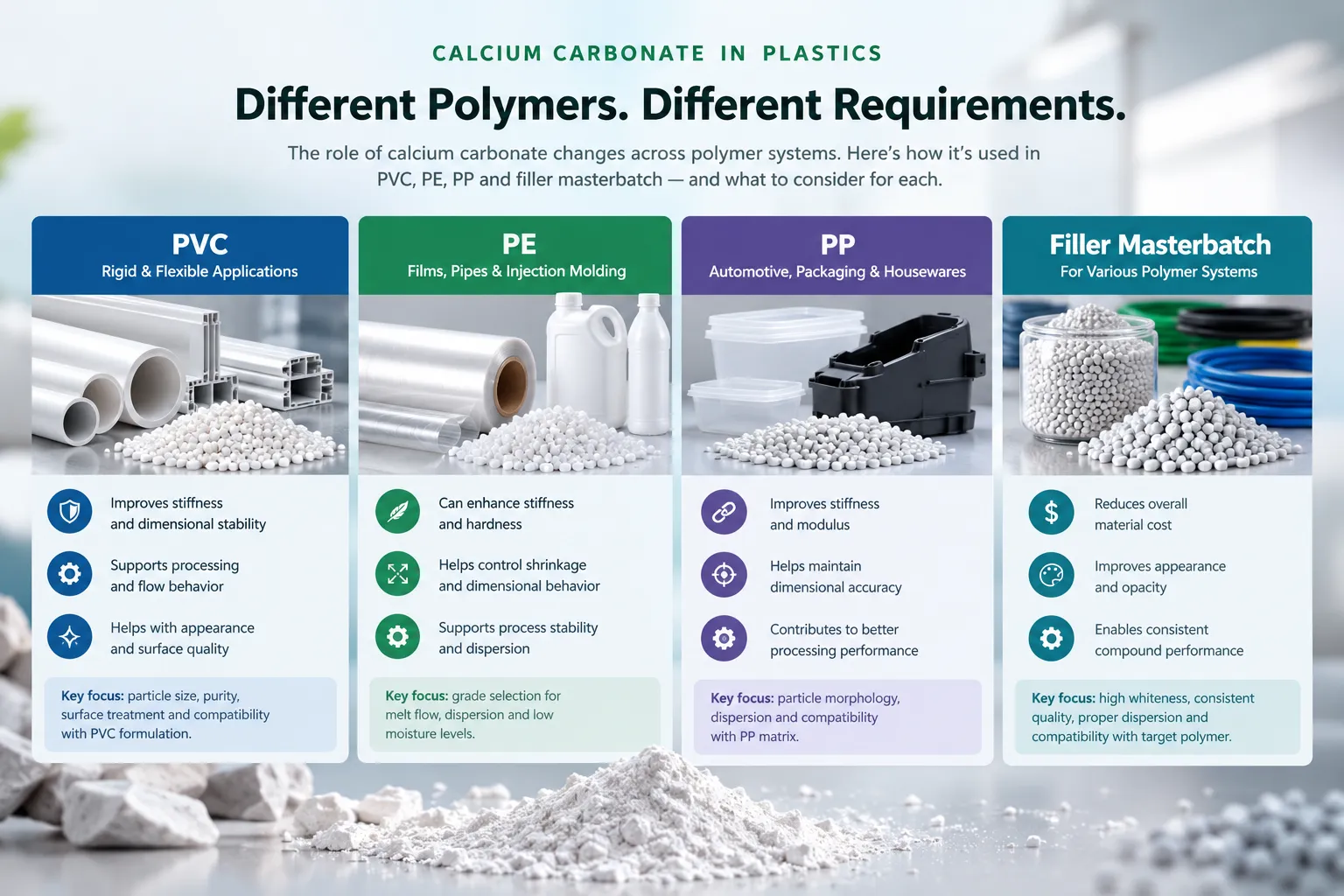
Calcium Carbonate in Different Polymer Systems
There is no single calcium carbonate grade that can be considered optimal for every plastic. PVC, polyethylene and polypropylene differ in polymer chemistry, formulation structure and processing behavior. Filler masterbatch introduces another requirement because the mineral must first be incorporated into a concentrated carrier system and then dispersed effectively when the masterbatch is used by the converter.
This means that calcium carbonate selection should begin with the polymer system and final manufacturing process. Particle size distribution, surface treatment, moisture, purity and dispersion requirements can then be evaluated in the context of that application.
Calcium Carbonate for PVC Compounds
Calcium carbonate is used across a broad range of rigid and flexible PVC formulations. Applications can include pipes, profiles, fittings, sheets, flooring, cable compounds and other extruded or molded PVC products.
In PVC, mineral selection has to be considered as part of a larger formulation containing resin, stabilizers, processing aids, lubricants, pigments and other additives. Particle characteristics and surface condition can therefore affect more than the mineral fraction alone.
Calcium Carbonate for Polyethylene
Polyethylene is used in applications ranging from films and bags to pipes, containers and molded products. The requirements imposed on the mineral can therefore vary substantially even when the base polymer belongs to the same general PE family.
Because polyethylene is hydrophobic, mineral surface characteristics and dispersion become particularly relevant. The appropriate calcium carbonate should be evaluated together with the carrier, additives, processing temperature and intended conversion process.
Calcium Carbonate for Polypropylene
Polypropylene compounds are widely used in injection-molded, extruded and other converted products. Calcium carbonate may be incorporated where the formulation requires a controlled balance between mineral content, stiffness, dimensional characteristics, processability and economics.
As with polyethylene, compatibility between the mineral surface and the hydrophobic polymer environment is an important consideration. The effect of GCC should ultimately be evaluated against the mechanical and processing targets of the finished PP compound.
Calcium Carbonate for Filler Masterbatch
Filler masterbatch concentrates calcium carbonate in a polymer carrier so that downstream manufacturers can introduce the mineral into their plastic formulations in pelletized form.
This places strong emphasis on mineral consistency and dispersion. Particle agglomeration, moisture, inconsistent surface treatment or an unsuitable particle distribution can affect masterbatch production and subsequent dilution into the final polymer.
Why Polymer Type Changes Calcium Carbonate Selection
| System | Typical Application Context | Selection Priorities | Qualification Approach |
|---|---|---|---|
| PVC | Pipes, profiles, fittings, sheets and flexible compounds | PSD, coarse-particle control, moisture, surface treatment and formulation compatibility | Evaluate within the complete PVC additive package and actual conversion process |
| PE | Film, extrusion, containers, pipes and molded products | Dispersion, mineral surface, moisture, PSD and polymer compatibility | Test against the specific PE grade, process and final product requirement |
| PP | Injection molding, extrusion and compounded products | Dispersion, surface condition, PSD and required property balance | Validate mechanical and processing behavior in the target PP formulation |
| Filler Masterbatch | Concentrated mineral masterbatch for downstream polymer processing | Dispersion, coating consistency, moisture, PSD and batch-to-batch repeatability | Evaluate both masterbatch production and subsequent dilution in the target polymer |
Do Not Transfer a Successful Grade Between Applications Without Testing
A calcium carbonate that performs successfully in a rigid PVC profile should not automatically be specified for polyethylene film, polypropylene injection molding or filler masterbatch. Even when the nominal particle size appears similar, the required surface characteristics, particle distribution and processing behavior may be different.
Start With the Final Plastic Product
Calcium carbonate selection becomes more precise when the final product and manufacturing process are defined first. A pipe manufacturer, masterbatch compounder, film producer and injection molder may all use calcium carbonate, but they are not necessarily buying the same technical solution.
Explore Industrial Calcium Carbonate ApplicationsCoated vs Uncoated Calcium Carbonate for Plastics
One of the most important decisions when selecting calcium carbonate for plastics is whether the formulation should begin its evaluation with a surface-treated or an uncoated GCC grade. The difference is not simply a commercial product label. Surface treatment changes the outer characteristics of the mineral particle and therefore can change how it interacts with the surrounding polymer system.
Natural calcium carbonate has a relatively hydrophilic and polar mineral surface, while common plastics such as polyethylene and polypropylene are hydrophobic. In coated GCC, the calcium carbonate surface is intentionally modified, commonly using stearic acid in industrial grades, to change the interaction between the mineral and organic matrix.
Coated Calcium Carbonate
Coated GCC has an intentionally modified particle surface. In many polymer applications, stearic acid treatment is used to make the mineral surface more compatible with hydrophobic organic systems.
Why Plastic Compounders Evaluate It
- To improve mineral wetting and dispersion in suitable polymer matrices.
- To modify interaction between the calcium carbonate surface and the surrounding organic phase.
- To support processing where an untreated hydrophilic mineral surface is undesirable.
- To help manage moisture-related and dispersion-related behavior in appropriate formulations.
Coated GCC is frequently evaluated for PVC compounds, filler masterbatch, polyethylene, polypropylene, cable compounds and other polymer systems where mineral-polymer compatibility and dispersion are important.
Uncoated Calcium Carbonate
Uncoated GCC retains the natural calcium carbonate particle surface. It has not undergone the intentional fatty-acid surface treatment used to manufacture coated grades.
Can Uncoated GCC Be Used in Plastics?
- Yes, selected plastic formulations can evaluate uncoated GCC when an untreated mineral surface is technically acceptable.
- Suitability depends on the polymer, additives, mineral loading, processing method and required finished-product properties.
- Particle size distribution, moisture and dispersion remain important even when surface treatment is not required.
- An uncoated grade should not be rejected solely because another application commonly uses coated GCC.
Treat uncoated GCC as a formulation-dependent option rather than a universal alternative to coated material. Its suitability must be established in the actual plastic compound.
What Actually Changes When the Mineral Surface Is Treated?
| Selection Factor | Uncoated GCC | Coated GCC | What the Plastic Manufacturer Should Verify |
|---|---|---|---|
| Particle Surface | Natural mineral surface remains exposed | Surface intentionally modified | Whether the surface condition is compatible with the polymer and additive package |
| Hydrophobic Polymer Compatibility | Formulation dependent | Often evaluated where improved interaction with hydrophobic systems is required | Actual dispersion and processing behavior in the target formulation |
| Dispersion | Depends strongly on formulation and processing | Suitable treatment can support dispersion in many polymer systems | Agglomeration, mixing behavior and dispersion quality after processing |
| Moisture Interaction | Natural mineral surface remains relatively hydrophilic | Appropriate treatment can reduce interaction with moisture | Supplier moisture specification and behavior under actual storage and processing conditions |
| Particle Size | Remains critical | Remains critical | Coating cannot compensate for an unsuitable D50, D97 or coarse-particle distribution |
| Technical Approval | Requires formulation testing | Requires formulation testing | Neither surface condition should be approved from the product name alone |
A coated calcium carbonate can still be unsuitable for a plastic formulation if its particle size distribution, coarse-particle content, moisture, treatment characteristics or consistency do not meet the application's requirements.
Likewise, two coated GCC products should not be considered equivalent simply because both suppliers describe them as stearic-acid treated. The complete specification and actual processing behavior still need to be compared.
How Should a Plastics Buyer Start the Selection?
PVC, PE, PP or another polymer system.
Extrusion, compounding, molding or masterbatch production.
Determine whether surface treatment provides a technical benefit.
Review PSD, D50, D97, moisture, purity and treatment data.
Approve the material based on actual processing and product results.
This Article Focuses Only on the Plastics Selection Decision
For a deeper comparison of particle surface chemistry, treatment mechanisms, industrial applications and the broader differences between both GCC families, use our dedicated coated versus uncoated technical guide.
Arosha Powder manufactures both coated and uncoated ground calcium carbonate grades. Buyers should compare the relevant technical specification and select a starting grade according to their polymer, formulation and processing requirements.
Compare Calcium Carbonate GradesParticle Size, D50 and D97 in Calcium Carbonate for Plastics
Particle size is one of the most important technical characteristics of calcium carbonate used in plastic compounds. However, industrial buyers should not reduce particle size selection to a single commercial mesh number. A real calcium carbonate powder contains a distribution of particle sizes, and that distribution can influence dispersion, surface quality, processing behavior and the performance of the finished compound.
This is why two calcium carbonate products sold under the same nominal mesh designation may not behave identically in a plastic formulation. Their median particle size, coarse particle population, distribution width, surface condition and measurement method may be different.
Mesh
Mesh terminology originates from sieve classification and is widely used in commercial calcium carbonate markets. It can provide a useful initial indication of relative fineness, but it does not describe the complete population of particles inside a fine GCC powder.
D50
D50 describes the median of the measured particle size distribution. When reported on a volume basis, half of the measured particle volume lies below the stated particle diameter and half lies above it.
D97
D97 provides information toward the coarse end of the measured particle size distribution. When reported on a volume basis, approximately 97 percent of the measured particle volume lies below the stated diameter.
Why D50 Alone Still Does Not Tell the Whole Story
Consider two hypothetical calcium carbonate powders that report the same D50. One may have a relatively concentrated particle population around the median, while the other may contain a broader distribution with a larger coarse fraction. Their D50 values can therefore look similar even though their complete particle distributions are different.
More of the particle population is concentrated around the central region.
A wider spread of fine and coarse particles may exist around the same median value.
Why Can the Coarse Particle Region Matter in Plastics?
Larger particles or agglomerates may behave differently during compounding and can make uniform mineral dispersion more difficult in sensitive formulations.
Products with demanding surface appearance or thin sections can be more sensitive to the coarse portion of a particle distribution.
A stable particle distribution can support more consistent material behavior when other formulation and process conditions remain controlled.
A particle distribution acceptable for a thick rigid product may not necessarily be appropriate for a thin film, smooth profile or another appearance sensitive application.
What Should a Plastics Buyer Compare?
| Data Point | What It Tells You | Can It Be Used Alone? | Recommended Buyer Action |
|---|---|---|---|
| Mesh | Commercial indication of relative fineness | No | Use only for initial grade classification |
| D50 | Median point of the measured distribution | No | Compare together with D97 and the complete PSD |
| D97 | Information toward the coarse region | No | Review where larger particles may affect the application |
| Complete PSD | Shows how particles are distributed across size ranges | More informative, but still application dependent | Compare distributions measured under equivalent conditions |
| Measurement Method | Explains how the reported data were generated | Essential context | Do not compare values generated by incompatible methods without technical review |
| Production Trial | Shows actual behavior in the target formulation | Essential for final approval | Validate the selected grade under real processing conditions |
Always Ask How Particle Size Was Measured
Particle size data are meaningful only when the measurement method, distribution basis and relevant test conditions are understood. Results from different laboratories or analytical methods may not be directly comparable simply because both reports contain a D50 or D97 value.
Need a Deeper Explanation of Mesh, Micron, D50 and D97?
Our dedicated particle size guide explains mesh terminology, micron measurements, particle size distributions, D50, D97, measurement methods and common mistakes when comparing industrial calcium carbonate grades.
Do Not Ask Only: “Which Mesh Is Best for Plastics?”
A better purchasing question is: which particle size distribution, surface condition and quality specification should be evaluated for this specific polymer, product geometry and processing method?
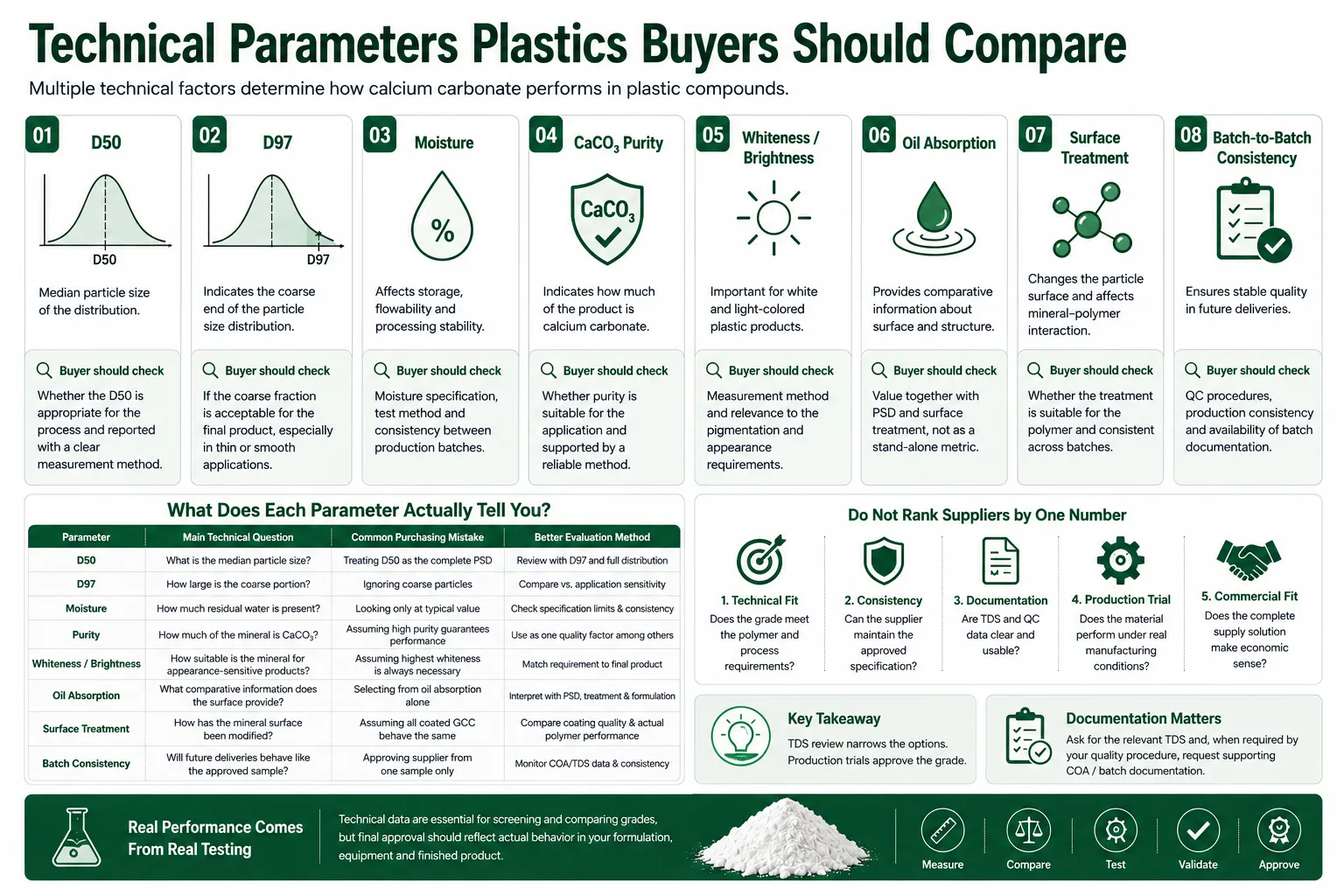
Technical Parameters Plastics Buyers Should Compare
Selecting calcium carbonate for plastics requires more than checking whether the powder is coated, uncoated or described by a certain mesh size. Industrial buyers should compare a group of technical parameters together because each one describes a different part of the mineral's behavior.
The relative importance of these parameters changes with the polymer, processing method and finished-product requirement. For example, a profile manufacturer may focus heavily on surface quality and coarse-particle control, while a filler masterbatch producer may place greater emphasis on dispersion, moisture, treatment consistency and repeatability between batches.
D50
D50 describes the median point of the measured particle size distribution and is useful for comparing the central particle size of different GCC grades.
D97
D97 provides information toward the coarse end of the particle size distribution and can help identify whether a grade contains a significant larger-particle fraction.
Moisture
Moisture can affect storage behavior, mineral flow, compounding and processing stability in polymer systems that are sensitive to water or volatile content.
CaCO₃ Purity
Purity describes how much of the mineral product is calcium carbonate and can provide useful information about source consistency and unwanted mineral components.
Whiteness and Brightness
Whiteness and brightness can be important for white and light-colored plastic products where mineral appearance contributes to the visual characteristics of the final compound.
Oil Absorption
Oil absorption can provide comparative information about the mineral surface and particle structure. It may help formulators understand how one grade differs from another.
Surface Treatment
For coated GCC, the treatment system changes the particle surface and can influence mineral-polymer interaction, wetting, dispersion and handling behavior.
Batch-to-Batch Consistency
A technically acceptable sample is not enough if subsequent deliveries vary significantly in particle distribution, moisture, purity or surface treatment.
What Does Each Parameter Actually Tell You?
| Parameter | Main Technical Question | Common Purchasing Mistake | Better Evaluation Method |
|---|---|---|---|
| D50 | What is the median particle size? | Treating D50 as the complete PSD | Review D50 together with D97 and the full distribution |
| D97 | How large is the coarse portion? | Ignoring coarse particles because the mesh looks fine | Compare against the sensitivity of the final plastic product |
| Moisture | How much residual water is present? | Looking only at the supplier's typical value | Check specification limits and consistency |
| Purity | How much of the mineral is CaCO₃? | Assuming a high value guarantees plastic performance | Use purity as one quality parameter among several |
| Whiteness / Brightness | How suitable is the mineral for appearance-sensitive products? | Assuming the highest whiteness is always necessary | Match the requirement to the final product and pigment system |
| Oil Absorption | What comparative information does the mineral surface provide? | Selecting a grade from oil absorption alone | Interpret together with PSD, treatment and formulation |
| Surface Treatment | How has the mineral surface been modified? | Assuming every coated GCC behaves the same | Compare coating consistency and actual polymer performance |
| Batch Consistency | Will future deliveries behave like the approved sample? | Approving the supplier from one sample only | Monitor COA/TDS data and validate production consistency |
Ask for More Than a Product Name
Before approving a calcium carbonate grade for plastics, request the relevant technical data sheet and compare the reported values with your internal specification. For commercial qualification, buyers may also require supporting batch documentation such as a certificate of analysis according to their quality-control procedure.
A Better Calcium Carbonate Supplier Comparison
Does the grade meet the polymer and process requirements?
Can the supplier maintain the approved specification?
Are TDS and quality-control data clear and usable?
Does the material perform under real manufacturing conditions?
Does the complete supply solution make economic sense?
TDS Review Narrows the Options. Production Trials Approve the Grade.
Technical data are essential for screening and comparing calcium carbonate grades, but the final approval decision should reflect actual behavior in the buyer's formulation, equipment and finished product.
Calcium Carbonate by Plastic Application
The final plastic product should be defined before a calcium carbonate grade is selected. A grade used successfully in a rigid PVC pipe, for example, should not automatically be transferred to a thin film, injection-molded component or filler masterbatch formulation.
Each application places different demands on particle size distribution, coarse-particle control, surface treatment, dispersion, moisture, appearance and mechanical-property balance. The following application map shows how purchasing priorities can change across major plastic-processing sectors.
PVC Pipes & Fittings
Calcium carbonate is commonly evaluated as part of rigid PVC pipe and fitting formulations. The mineral must work together with the PVC resin, stabilizer system, lubricants, processing aids and other formulation components.
- Particle size distribution and coarse-particle control
- Moisture and processing consistency
- Surface treatment where technically required
- Dispersion in the complete PVC formulation
- Required mechanical and dimensional performance
PVC Profiles
Window profiles, construction profiles and other rigid extruded PVC products can place significant emphasis on extrusion stability, dimensional characteristics and surface appearance.
- Controlled PSD and coarse-particle population
- Surface quality requirements
- Whiteness where appearance is important
- Dispersion and extrusion behavior
- Batch-to-batch mineral consistency
Flexible PVC & Cable Compounds
Flexible PVC systems contain plasticizers and other additives that change the formulation environment compared with rigid PVC. Mineral selection therefore needs to reflect the complete compound rather than relying on a rigid-PVC specification.
- Interaction with the complete additive package
- Dispersion quality
- Surface condition
- Moisture control
- Required flexibility and compound properties
Filler Masterbatch
Filler masterbatch production requires calcium carbonate to be incorporated at concentrated levels into a carrier system before the pellets are subsequently diluted into downstream plastic products.
- Mineral dispersion and agglomeration control
- Surface treatment consistency
- Moisture
- Particle size distribution
- Carrier compatibility
- Repeatability between batches
PE Film & Film-Based Products
Film applications can be more sensitive to mineral dispersion and coarse particles because the converted product may have a relatively small thickness and demanding surface requirements.
- Fine and controlled particle distribution
- Coarse-particle and agglomerate control
- Surface treatment and compatibility
- Dispersion quality
- Film-specific processing and appearance requirements
PP Injection Molding
In polypropylene injection-molding compounds, calcium carbonate may be evaluated where formulators need to balance mineral content, stiffness, dimensional characteristics, processability and economics.
- Particle distribution and dispersion
- Surface compatibility
- Required stiffness and mechanical-property balance
- Dimensional requirements
- Molding and finished-part performance
Plastic Sheets & Extruded Products
Sheet and general extrusion applications can vary significantly in thickness, surface finish, polymer type and mechanical requirements. This makes application-specific mineral qualification important.
- PSD and surface finish requirements
- Dispersion
- Moisture
- Dimensional behavior
- Extrusion stability
Engineered Plastic Compounds
Compounders may use calcium carbonate as one component within a more complex formulation designed around specific processing, mechanical, dimensional, appearance or commercial objectives.
- Compatibility with the complete formulation
- Particle engineering
- Surface treatment
- Quality consistency
- Application-specific performance testing
The Same Parameter Can Have Different Importance by Application
This matrix is a selection framework, not a universal product specification. The final importance of each parameter depends on the formulation and performance target.
| Application | PSD / D97 | Dispersion | Surface Treatment | Moisture | Appearance |
|---|---|---|---|---|---|
| PVC Pipe | Important | Important | Formulation Dependent | Important | Application Dependent |
| PVC Profile | Important | Important | Formulation Dependent | Important | Often Important |
| Filler Masterbatch | Important | High Priority | High Priority in Many Systems | High Priority | Product Dependent |
| PE Film | High Priority | High Priority | Often Important | Important | Often Important |
| PP Injection | Important | Important | Often Important | Application Dependent | Application Dependent |
Application Name Alone Is Still Not Enough
Two manufacturers producing the same general type of plastic product can use different resins, additives, equipment, production speeds and quality specifications. A calcium carbonate grade should therefore be qualified against the individual manufacturer's process rather than approved solely because it is marketed for that application.
Calcium Carbonate Is Used Beyond Plastics
Arosha Powder's application hub covers calcium carbonate use across plastics, paints and coatings, paper, rubber, construction and other industrial sectors.
How to Select the Right Calcium Carbonate Grade for Plastics
Calcium carbonate grade selection should follow a structured qualification process. Starting with a mesh number or supplier price can lead to unnecessary trials because neither value defines how the mineral will behave in the buyer's polymer system.
A more reliable approach begins with the final plastic product, then works backward through the polymer, processing method and required properties. Technical data can then be used to shortlist suitable GCC grades before laboratory and production trials are performed.
Start With the Final Plastic Product
Tell the supplier what you manufacture rather than asking only for a calcium carbonate mesh size. A PVC pipe, profile, film, injection-molded part and filler masterbatch can require different mineral characteristics.
- Final plastic product
- Rigid, flexible, thin or thick section
- Appearance requirements
- Mechanical and dimensional targets
Define the Resin and Formulation Environment
Specify whether the mineral will be incorporated into PVC, polyethylene, polypropylene or another polymer system. Where possible, provide information about the resin family and relevant additives because the mineral interacts with the complete formulation.
- Polymer type
- Rigid or flexible formulation
- Carrier resin where masterbatch is involved
- Relevant additives and processing aids
Explain How the Compound Will Be Processed
Extrusion, compounding, injection molding and masterbatch production do not expose the mineral to identical processing conditions. Equipment configuration and process sensitivity can influence which GCC characteristics deserve the greatest attention.
- Processing method
- Compounding or direct addition
- Critical processing limitations
- Known dispersion or moisture sensitivity
Compare More Than Mesh Size
Once the application is understood, compare the parameters that can influence the target process. Mesh may remain useful as a commercial grade reference, but it should be supported by particle size distribution and other relevant technical data.
Evaluate Coated and Uncoated Options Where Relevant
Surface treatment should be selected according to polymer compatibility, dispersion requirements and processing behavior. Coated GCC can be advantageous in many polymer systems, but the word coated should never replace a review of the complete specification.
Review the TDS Before Ordering a Production Quantity
Compare the supplier's technical data against the internal specification or against the characteristics of an already approved material. Measurement methods should also be reviewed when comparing particle size, whiteness, moisture or other reported values.
View Calcium Carbonate Technical Data SheetsTest a Representative Sample
A technically promising data sheet should lead to sample evaluation rather than immediate full-scale approval. The sample can be checked against the buyer's laboratory and formulation requirements before moving to a larger production trial.
- Incoming material inspection
- Particle and moisture verification where required
- Dispersion evaluation
- Laboratory compound preparation
- Comparison with an approved reference grade
Run the Material Under Real Processing Conditions
Laboratory screening cannot reproduce every production variable. Before final approval, the selected calcium carbonate should be evaluated under representative manufacturing conditions using the intended formulation and equipment.
- Feeding and handling behavior
- Dispersion and compound uniformity
- Processing stability
- Surface and appearance
- Required mechanical properties
- Rejects and overall production efficiency
Confirm Consistency, Documentation and Supply Capability
A successful production trial confirms the evaluated material, but industrial procurement also requires confidence that future shipments can maintain the approved characteristics. Supplier qualification should therefore include consistency, documentation and supply reliability.
- Batch-to-batch consistency
- Quality-control capability
- TDS and batch documentation
- Packaging suitability
- Production and supply capacity
- Commercial and logistics requirements
What Information Should You Send to a Calcium Carbonate Supplier?
A technically useful request allows the supplier to shortlist a relevant grade instead of guessing from a mesh number.
PVC pipe, profile, film, masterbatch, injection molding or other.
PVC, PE, PP or another resin system.
Existing TDS or required technical limits where available.
Coated, uncoated or open to technical recommendation.
Trial quantity, monthly consumption and expected annual demand.
Country, destination port and preferred packaging.
“Send your best price for 1250 mesh calcium carbonate.”
The supplier still does not know the polymer, application, specification or whether surface treatment is required.“We manufacture filler masterbatch for PE applications and are evaluating a coated GCC grade. Please provide suitable TDS options with particle size, moisture, purity and surface-treatment data for technical review.”
This gives the supplier enough context to begin a meaningful technical discussion.Why This Guide Does Not Name One “Best Grade for Plastics”
A universal recommendation would ignore the differences between polymers, products, equipment and formulations. The technically correct grade is the material that meets the required specification and demonstrates acceptable performance in the buyer's actual process.
Common Calcium Carbonate Selection and Processing Problems in Plastics
When a calcium carbonate grade creates problems in a plastic compound, the mineral itself may be only one part of the cause. Processing conditions, polymer compatibility, additive interactions, moisture, dispersion and supplier consistency can all contribute to the observed result.
For this reason, troubleshooting should begin with the actual symptom and then work backward through the formulation, technical data and process conditions instead of assuming that one parameter is responsible.
Poor Dispersion
Poor dispersion can appear as visible mineral clusters, inconsistent compound quality or non-uniform behavior during processing.
- Unsuitable surface treatment
- Agglomeration
- Inadequate mixing or shear
- Moisture
- Carrier or polymer incompatibility
- Surface condition
- PSD and coarse fraction
- Compounding conditions
- Moisture data
- Formulation compatibility
Agglomerates or Coarse Particles
Oversized mineral particles or agglomerates may become especially noticeable in thin, smooth or appearance-sensitive plastic products.
- Broad coarse-particle distribution
- Insufficient deagglomeration
- Poor storage conditions
- Moisture-related caking
- D97 and full PSD
- Incoming material condition
- Storage and handling
- Dispersion efficiency
Surface Defects
Surface roughness, visible specks or inconsistent finish can sometimes be associated with mineral dispersion, coarse particles or other formulation and processing variables.
- Coarse particles
- Poor dispersion
- Contamination
- Process instability
- Incompatible additives
- PSD and incoming inspection
- Mineral cleanliness
- Mixing quality
- Extrusion or molding conditions
Moisture-Related Processing Instability
Excess moisture can become undesirable in polymer processing, particularly where the formulation or process is sensitive to water or volatile content.
- High incoming moisture
- Humid storage conditions
- Damaged packaging
- Long storage before use
- Moisture specification
- Packaging integrity
- Warehouse conditions
- Incoming QC results
Inconsistent Processing Between Batches
If one delivery processes differently from another, the problem may involve variation in particle size, moisture, surface treatment, mineral composition or another formulation component.
- Batch-to-batch PSD variation
- Moisture variation
- Coating inconsistency
- Raw mineral variation
- Changes elsewhere in the formulation
- COA and TDS comparison
- Retained reference samples
- Incoming QC history
- Formulation and process records
Unexpected Mechanical Property Changes
Changes in stiffness, impact behavior, strength or other mechanical properties can occur when the mineral grade, loading, dispersion or surrounding formulation changes.
- Changed particle characteristics
- Different surface treatment
- Dispersion differences
- Changed mineral loading
- Resin or additive variation
- Approved vs current formulation
- Mineral specification
- Dispersion quality
- Mechanical test results
Coated Grade Still Performs Poorly
Surface treatment can support compatibility and dispersion, but a coated label does not guarantee that every other mineral property is appropriate for the formulation.
- Unsuitable PSD
- Inconsistent coating
- Excess moisture
- Inadequate process conditions
- Incorrect polymer match
- Complete TDS
- Surface-treatment data
- PSD and moisture
- Actual formulation trial
TDS Values Do Not Match Between Suppliers
Two suppliers may report technically similar parameters using different test methods, instruments or reporting bases, making direct comparison unreliable.
- Different particle-size methods
- Different whiteness standards
- Different moisture test conditions
- Typical values vs specification limits
- Test method
- Reporting basis
- Specification limits
- Independent verification if necessary
A Practical Way to Investigate a Problem
Describe exactly what changed in the process or product.
Review resin, additives, GCC batch and process settings.
Review PSD, moisture, treatment and relevant QC values.
Change one relevant variable at a time where practical.
Approve corrective action only after evidence supports it.
Retained Samples and Batch Records Make Troubleshooting Easier
For recurring industrial purchases, retaining samples from approved and problematic batches can help buyers compare mineral behavior alongside COA data, processing records and finished-product test results.
Calcium Carbonate Supplier Qualification Checklist for Plastics
Approving a calcium carbonate supplier for plastic production requires more than finding a technically suitable sample. Industrial buyers also need confidence that the approved material can be reproduced consistently, documented clearly and supplied in the required quantity and packaging.
A technically strong supplier should therefore be evaluated across several dimensions at the same time: mineral quality, production control, testing, documentation, consistency, supply capability and commercial logistics.
Raw Material Source
Understand where the calcium carbonate originates and whether the supplier has stable access to its mineral source.
- Source consistency
- Mineral quality control
- Ability to support long-term supply
Production Capability
The supplier should be able to produce the selected grade at a consistent specification and at the volume required by the buyer.
- Grinding and classification capability
- Coating capability where relevant
- Monthly production capacity
Laboratory and Quality Control
A reliable industrial supplier should be able to monitor the technical parameters that define the approved calcium carbonate grade.
- Particle size testing
- Moisture control
- Purity testing
- Whiteness or brightness testing where relevant
Batch-to-Batch Consistency
Reproducibility is essential for plastic manufacturers because inconsistent mineral properties can lead to changes in processing and final product quality.
- Specification control
- Production records
- Batch documentation
- Retention or reference samples where applicable
Technical Documentation
Technical data should be clear enough for the buyer to compare the material against internal requirements and approved reference grades.
- Current TDS availability
- SDS availability
- COA availability when required
- Clear test methods and specifications
Packaging and Handling
Packaging should protect the mineral during transport and storage while matching the handling requirements of the buyer's plant.
- Bag or bulk packaging options
- Moisture protection
- Pallet or loading configuration
- Warehouse compatibility
Export and Logistics Capability
For international buyers, the technical grade is only one part of the transaction. Export documentation, packaging, route and delivery terms must also fit the destination market.
- Export experience
- Incoterms capability
- Destination port handling
- Commercial documentation
Technical Communication
Industrial buyers benefit from suppliers that can discuss the application technically instead of responding only with price and mesh size.
- Ability to review buyer specifications
- Support for sample qualification
- Clear response to technical questions
Evaluate the Complete Supply Risk
Evaluate Arosha Powder Against Your Own Qualification Process
Arosha Powder manufactures coated and uncoated ground calcium carbonate and supports industrial buyers with technical documentation, sample evaluation and export supply. Buyers should still qualify every grade against their own formulation, specification and production process before commercial approval.
Lowest Price Is Not the Same as Lowest Production Cost
The most economical calcium carbonate supply is the one that meets the required technical specification, performs consistently in production and can be delivered reliably. A lower raw-material price can lose its advantage if variability, rejects or processing problems increase the buyer's total manufacturing cost.
Frequently Asked Questions About Calcium Carbonate for Plastics
The following questions address some of the most common technical and purchasing concerns raised by plastic manufacturers, compounders and masterbatch producers when evaluating calcium carbonate.
What is calcium carbonate used for in plastics?
Calcium carbonate is used as a mineral component in many plastic formulations to help modify formulation economics, stiffness, dimensional behavior, appearance and selected processing characteristics. Its actual effect depends on the polymer, particle characteristics, surface treatment, loading level, additives and processing conditions.
Which calcium carbonate grade is best for plastics?
There is no single calcium carbonate grade that is best for every plastic application. PVC pipe, filler masterbatch, PE film, polypropylene injection molding and flexible PVC can require different particle size distributions, surface conditions, moisture levels and other technical characteristics.
A suitable grade should be shortlisted from technical data and then approved through formulation and production trials.
Is coated or uncoated calcium carbonate better for plastics?
Neither option is universally better. Coated calcium carbonate is often evaluated in hydrophobic polymer systems because surface treatment can improve mineral-polymer interaction and dispersion. Uncoated GCC can also be suitable in formulations where an untreated mineral surface performs acceptably.
The decision should be based on the polymer, process, formulation and production trial rather than the product label alone.
Is 1250 mesh calcium carbonate suitable for plastics?
A nominal 1250 mesh designation may be used commercially for fine calcium carbonate grades, but mesh alone cannot determine whether a product is suitable for a particular plastic formulation.
Buyers should also review D50, D97, full particle size distribution, moisture, surface treatment, purity and actual dispersion behavior before approving the material.
Why are D50 and D97 important in calcium carbonate for plastics?
D50 describes the median region of the measured particle size distribution, while D97 provides information toward the coarse end. Together with the complete particle size distribution, these values provide more useful technical information than a nominal mesh number alone.
Their importance increases in applications that are sensitive to dispersion, coarse particles, thin sections or surface finish.
Does finer calcium carbonate always perform better in plastics?
No. Finer particle size can change surface area, dispersion demand and interaction with the formulation. The optimal particle distribution depends on the polymer, processing method, finished product requirements and overall formulation.
Selecting the finest available powder without testing can increase cost or create processing challenges without delivering a useful performance benefit.
How much calcium carbonate can be added to a plastic compound?
There is no universal calcium carbonate loading percentage for plastics. The acceptable level depends on the polymer, target properties, mineral grade, surface treatment, additives, processing equipment and final product.
Loading should be determined through formulation development and trials rather than copied from a generic recommendation.
Why is moisture important in calcium carbonate for plastics?
Excess moisture can affect mineral handling, storage, dispersion and processing stability in formulations that are sensitive to water or volatile content.
Buyers should review both the supplier's moisture specification and consistency between batches, as well as storage and packaging conditions after delivery.
Can the same calcium carbonate be used in PVC, PE and PP?
Sometimes the same grade may be technically evaluated across more than one polymer system, but suitability should never be assumed. PVC, polyethylene and polypropylene differ in chemistry, formulation structure and processing behavior.
Each application should therefore be qualified independently.
What should I request from a calcium carbonate supplier before buying?
At minimum, industrial buyers should review the relevant technical data sheet and compare important parameters such as particle size distribution, D50, D97, moisture, purity, whiteness or brightness, oil absorption and surface treatment where applicable.
Buyers may also request SDS, batch documentation, samples, packaging information and commercial or export details as part of their qualification process.
Should I approve a calcium carbonate grade from the TDS alone?
No. A TDS is essential for screening and comparing grades, but it cannot fully predict how the mineral will behave in a specific formulation and production line.
Final approval should include representative sample testing and, where appropriate, a production trial under the intended manufacturing conditions.
Compare the Relevant Grade Before Starting a Trial
Review the available calcium carbonate technical data sheets and use the values as a starting point for your own formulation qualification.
Need to Evaluate a Calcium Carbonate Grade for Your Plastic Application?
Send us your polymer type, application, current specification and required quantity. Arosha Powder can review your requirements and provide relevant technical data for coated or uncoated ground calcium carbonate grades before you begin sample qualification.
Tell us what plastic product you manufacture and which polymer system you use.
Send your required mesh, PSD, D50, D97, moisture, purity or existing TDS where available.
Compare the relevant calcium carbonate data against your formulation requirements.
Test the selected material in your own formulation and production process before commercial approval.
Include These Details in Your Inquiry
Review the Material Before You Buy
Explore available product information and technical documentation before selecting a calcium carbonate grade for testing.