
Send Your Request

Fill in the form below and our team will get back to you shortly.

This site is protected by reCAPTCHA and the Google Privacy Policy and Terms of Service apply.

Your message has been received.
Our team will respond to your request as soon as possible.

Calcium Carbonate for PVC Pipe Manufacturing: Grade Selection, Particle Size and Performance

Table of Contents

4.5
(2)
Industrial PVC Pipe Guide

Selecting Calcium Carbonate for a Real PVC Pipe Formulation

A PVC pipe manufacturer does not simply purchase a mesh number. The manufacturer qualifies a mineral raw material that must work inside a specific compound, on a specific extrusion line and within the performance requirements of the finished pipe. For industrial buyers seeking direct access to production and export support, Arosha Powder operates as a calcium carbonate supplier, exporter and mine owner serving manufacturers across regional and international markets.

Particle Size Distribution Surface Treatment Moisture Control Extrusion Stability Pipe Qualification

Calcium Carbonate Selection Begins with the Pipe Requirement

PVC pipe manufacturing is one of the major industrial applications of calcium carbonate, but it requires a dedicated qualification process because the selected mineral must match the pipe design, compound formulation, extrusion conditions and finished product requirements.

Calcium carbonate is widely used in rigid PVC compounds, but its function cannot be evaluated independently from the rest of the formulation. PVC resin, heat stabilizers, lubricants, processing aids, impact modifiers, pigments and operating conditions all influence how the mineral behaves during mixing, fusion and extrusion.

This is why a calcium carbonate grade that performs successfully in one factory may deliver a different result on another line. Changes in resin characteristics, screw design, mixing sequence, melt temperature, output rate or additive balance may alter the response of the same mineral powder.

The intended pipe application also changes the selection process. Pressure pipe, drainage pipe, sewer pipe, electrical conduit, solid wall pipe and foam core pipe do not share the same mechanical priorities. A pressure rated pipe places greater emphasis on long term strength and compound qualification, while a nonpressure system may place more emphasis on stiffness, dimensional control and processing economics.

The distinction between pipe types is also highlighted by extrusion specialists such as Rollepaal, which discusses different calcium carbonate considerations for pressure, nonpressure and foam core pipe production.

01

Finished Pipe Requirement

Begin with the pipe standard, pressure class, wall design, impact requirement, surface target, color and expected service conditions.

02

Mineral Specification

Review D50, D97, coarse residue, moisture, purity, chemical impurities, oil absorption, surface treatment and batch consistency.

03

Production Trial

Evaluate dry blend flow, feeding, fusion behavior, torque, extrusion pressure, output stability, surface quality and final pipe test results.

“Substitutions may be made within a group but not from one group to the other.”
Plastics Pipe Institute, PPI TR-2, Calcium Carbonate Guidelines

Why Generic Calcium Carbonate Recommendations Fail

Recommendations based only on mesh size or a universal addition rate overlook the variables that control real production performance. Mesh describes separation through a sieve system. It does not provide a complete picture of the particle size distribution, the coarse particle tail or the behavior of the powder inside a PVC compound.

Buyers who need a more detailed explanation of these measurements can review the calcium carbonate particle size guide covering mesh, micron, D50 and D97. These values should be reviewed together because no single number can fully describe the particle profile of an industrial mineral powder.

Two products sold under the same commercial mesh designation may have different D50 and D97 values, different coarse residue, different moisture levels and different surface treatment quality. These differences may contribute to changes in dispersion, dry blend behavior, fusion, surface appearance and mechanical performance.

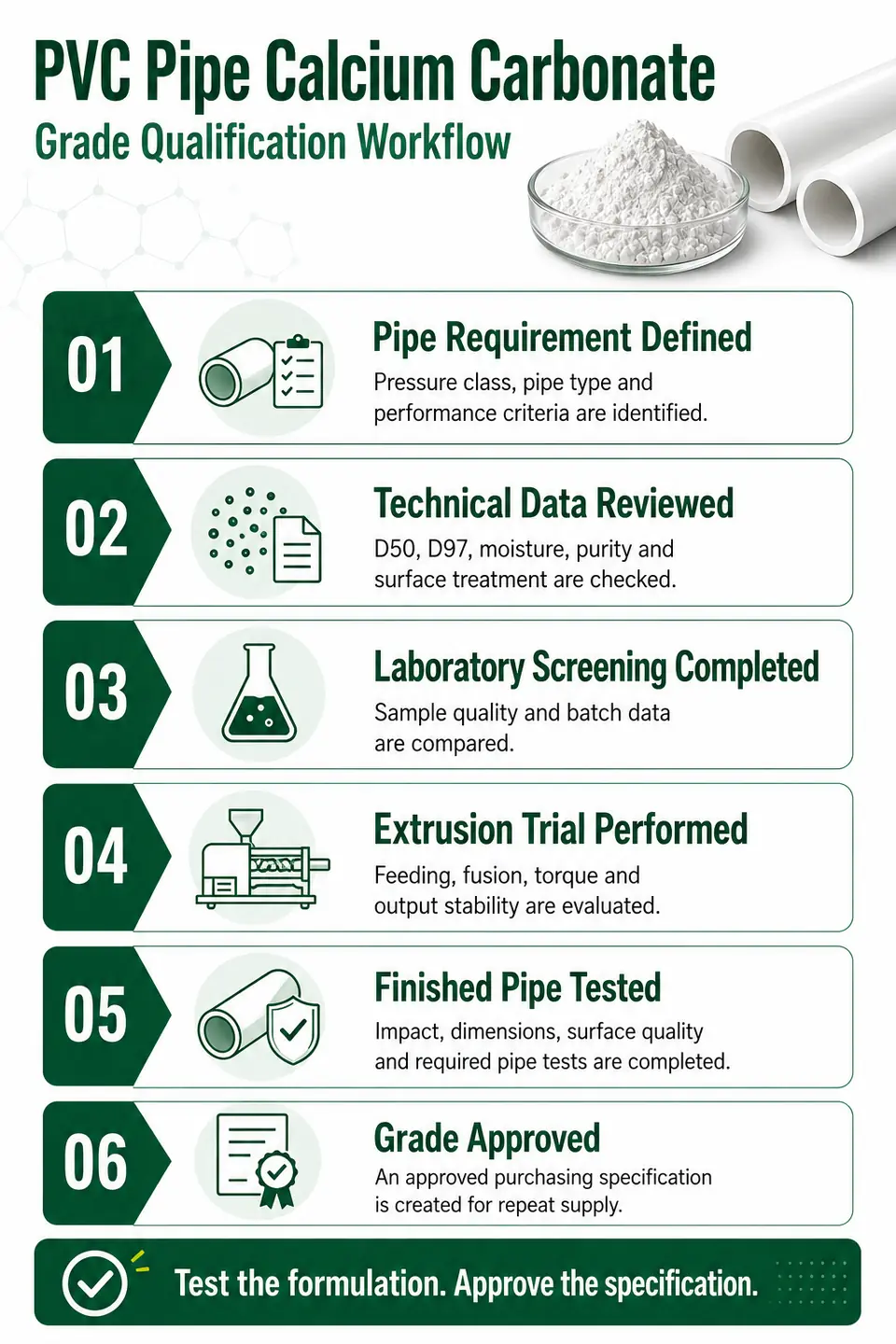
A reliable selection process therefore begins with the technical requirements of the finished pipe, continues through laboratory and production trials and ends with an approved purchasing specification. The objective is not to identify the finest or cheapest powder. It is to qualify the grade that provides the required processing behavior and finished pipe performance with acceptable batch consistency.

Key selection principle

Select calcium carbonate through particle size distribution, surface condition, moisture, chemical quality and verified production performance, not through mesh terminology alone.

Six step calcium carbonate grade qualification workflow for PVC pipe manufacturing
Formulation and Processing

What Calcium Carbonate Can Change in PVC Pipe Processing

Although calcium carbonate is commonly described as a mineral filler, it is not neutral from a processing perspective. Its particle size distribution, coarse particle content, moisture, surface condition, bulk behavior and level of addition can interact with the PVC resin, stabilizer system, lubricants and processing aids.

The result depends on the complete formulation and the extrusion conditions. A calcium carbonate grade may contribute to stable production in one compound but require changes in lubrication, mixing or processing conditions in another. For this reason, its effect should be described as formulation dependent rather than as a universal improvement or reduction in performance.

01

Dry Blend Flow and Feeding

Moisture, agglomeration, bulk density and surface condition can influence powder flow, dosing consistency, hopper behavior and the distribution of the mineral throughout the dry blend.

02

Fusion and Extrusion Behavior

Particle characteristics, surface condition and filler level can interact with the lubricant balance and influence fusion behavior, torque, melt pressure, output stability and the operating window of the extrusion line.

03

Pipe Surface and Dimensions

Coarse particles, agglomerates or incomplete dispersion may contribute to surface defects or inconsistent appearance. Dimensional behavior must still be confirmed under stable production conditions.

04

Finished Pipe Performance

Stiffness, impact resistance, pressure performance and long term behavior cannot be predicted from a mineral data sheet alone. These properties belong to the finished pipe and must be tested accordingly.

Technical Documentation

Which Parameters Should Be Reviewed in the TDS and COA?

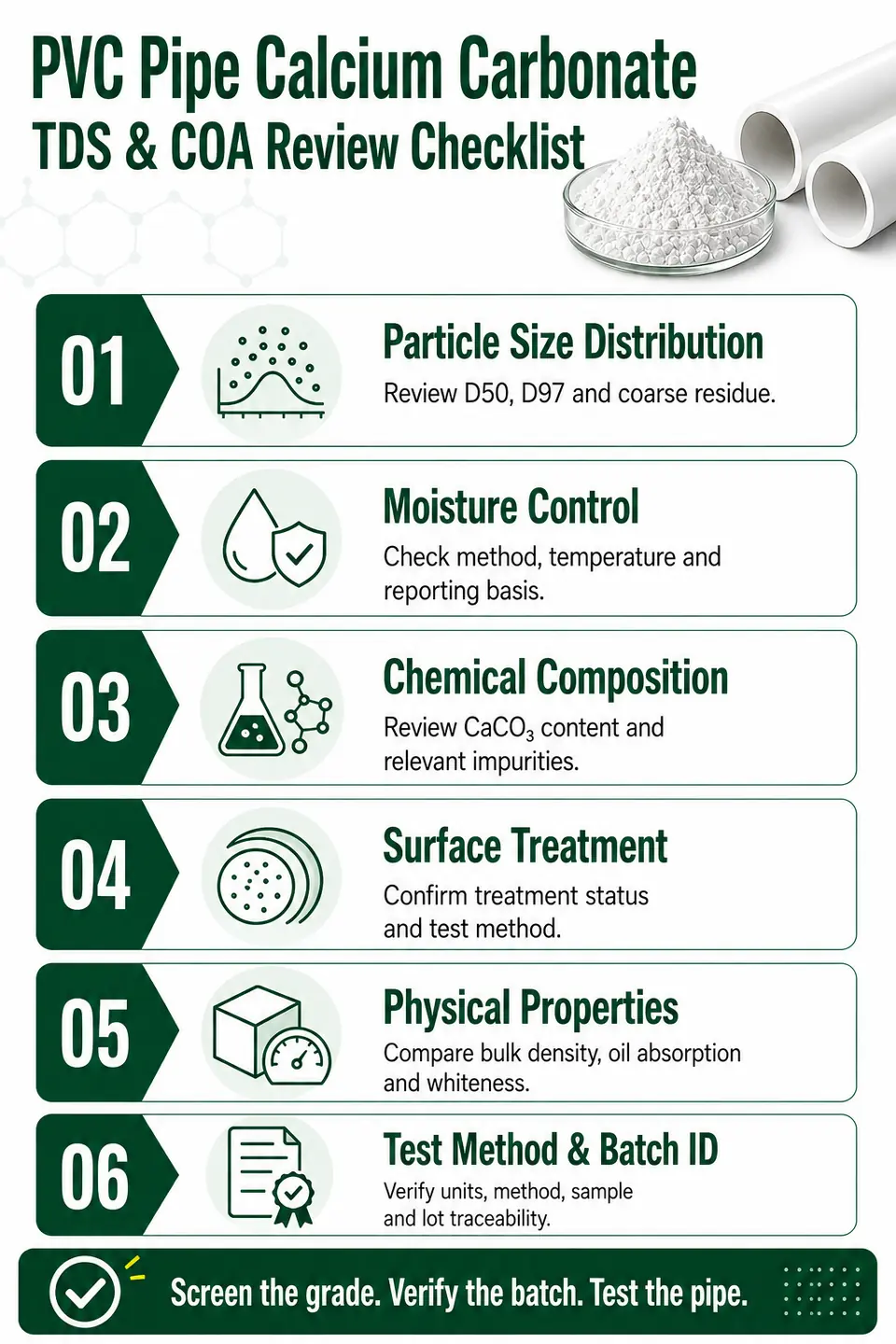
Technical documentation should be used to determine whether a calcium carbonate grade is suitable for initial screening. Buyers can review the available calcium carbonate technical data sheets before requesting samples or planning a controlled production trial.

A useful comparison requires more than placing two values beside one another. The reporting basis, analytical method, sample preparation procedure, units and acceptance limits must also be checked. Results generated by different methods should not automatically be treated as equivalent.

Documentation is the first filter, not the final approval

The TDS helps identify a candidate grade. The COA connects analytical results to an identified production batch. Neither document replaces extrusion trials or finished pipe testing.

ParameterWhy It MattersWhat the Buyer Should Verify
D50 and D97 D50 describes the central region of the reported particle size distribution, while D97 helps describe its upper particle size region. Together they provide more information than a mesh designation alone. Confirm the measurement method, dispersion procedure, reporting basis and units. Compare values generated under equivalent test conditions.
Coarse Residue Coarse particles or agglomerates may be relevant to dispersion, surface appearance, filtration and processing consistency. Check the sieve size, test procedure and reported basis. Do not compare residue values measured through different sieve systems as though they are identical.
Moisture or Weight Loss Excess water or volatile material may influence storage, powder flow, dispersion and processing stability. Verify the test temperature, duration and reporting method. Moisture and weight loss at a stated temperature should not be assumed to represent the same measurement.
Calcium Carbonate Content Mineral composition helps define the chemical character of the grade and supports comparison with the approved raw material specification. Review the analytical method and any reported impurities such as silica or iron compounds when these are relevant to the formulation.
Surface Treatment Surface treatment changes the interaction between the mineral and the polymer system and may influence dispersion, flow and formulation behavior. Confirm whether the material is treated or untreated and review the declared treatment information or analytical method. Do not infer treatment quality from the product name alone.
Bulk Density Bulk behavior can affect feeding, storage, conveying and the apparent volume of material handled during production. Confirm whether the value represents loose or tapped bulk density and verify that the same method is used for supplier comparisons.
Oil Absorption Oil absorption provides information related to the surface and packing behavior of the powder, but it does not directly predict PVC pipe performance. Compare only results produced through the same analytical method and use the value as one part of the formulation review.
Whiteness or Brightness Optical properties may be relevant to pipe appearance, color control and pigment planning. Verify the instrument, measurement standard and reporting scale. Whiteness and brightness are not automatically interchangeable values.
Test Method A technical value without its method may be difficult to reproduce or compare reliably. Require clear units, methods, reporting basis and acceptance limits for every parameter included in the approved purchasing specification.
Supplier Qualification

TDS, COA and Production Trials Serve Different Purposes

A reliable purchasing decision uses technical documents in sequence. The grade level data sheet supports initial comparison, the batch certificate supports incoming quality review and the production trial confirms whether the material performs acceptably in the manufacturer’s compound and extrusion process.

TDS

Grade Screening

Used to review the stated specification, relevant physical and chemical properties, test methods and suitability for initial sampling.

COA

Batch Verification

Used to connect reported analytical results to an identified production batch or commercial lot before acceptance and use.

TRIAL

Performance Approval

Used to evaluate mixing, feeding, fusion, extrusion stability, pipe appearance and the required finished product tests under controlled conditions.

Recommended Technical Approval Sequence

  1. 01
    Define the purchasing specification Establish the required properties, methods, units, limits and documentation before comparing suppliers.
  2. 02
    Review the grade level TDS Select only candidate grades that match the initial technical and documentation requirements.
  3. 03
    Test an identified sample Record the sample code, batch information, storage condition, formulation and processing settings used during the trial.
  4. 04
    Approve through finished pipe testing Complete the tests required by the pipe application and applicable standard before commercial approval.
  5. 05
    Control future deliveries Use batch documentation and incoming quality checks to monitor consistency against the approved purchasing specification.
Practical purchasing rule

Approve a calcium carbonate grade through defined limits, documented test methods and verified pipe performance. Do not approve it only because the mesh name, price or one laboratory value appears acceptable.

TDS and COA review checklist for calcium carbonate used in PVC pipe manufacturing
Surface Treatment Selection

Coated or Uncoated Calcium Carbonate for PVC Pipe?

The choice between coated and uncoated calcium carbonate should begin with the approved PVC formulation, not with a general assumption that one type is always better. Surface treatment changes the condition of the mineral surface, but it does not independently determine particle size, purity, dispersion quality or finished pipe performance.

In many PVC formulations, surface treated calcium carbonate is evaluated because the modified mineral surface can interact differently with the organic polymer system. Uncoated calcium carbonate can also be evaluated where the formulation and approval procedure are designed for an untreated mineral surface.

Buyers who require a broader explanation of these differences can review the complete guide to coated and uncoated calcium carbonate selection . For PVC pipe production, the decision must still be confirmed through the actual compound, extrusion line and required pipe tests.

01

Coated Calcium Carbonate

Coated GCC has an intentionally modified mineral surface, commonly through a fatty acid or related treatment system. It can be evaluated when surface compatibility and controlled dispersion within the PVC compound are important parts of the approved formulation.

  • Confirm the declared surface treatment
  • Review D50, D97 and coarse residue
  • Check moisture and treatment consistency
  • Evaluate interaction with the lubricant system
  • Confirm suitability through pipe testing
Explore Coated Calcium Carbonate Grades
02

Uncoated Calcium Carbonate

Uncoated GCC retains the natural mineral surface without an intentional fatty acid treatment. It can be evaluated where the existing compound, specification and qualification procedure are designed for an untreated calcium carbonate.

  • Confirm that no surface treatment is required
  • Review D50, D97 and coarse residue
  • Check moisture and chemical composition
  • Observe wetting and dispersion in the compound
  • Confirm suitability through pipe testing
Explore Uncoated Calcium Carbonate Grades
Technical Comparison

How Should PVC Pipe Manufacturers Compare Both Options?

A technically meaningful comparison should separate the effect of surface treatment from other differences between the materials. If the coated and uncoated samples also have different particle size distributions, moisture levels, purity or coarse residue, the result cannot be attributed to surface treatment alone.

Selection FactorCoated GCC ReviewUncoated GCC Review
Mineral Surface Confirm the type of intentional surface treatment and the applicable supplier test or declaration. Confirm that the material has no intentional surface treatment and matches the required untreated grade specification.
Particle Size Review D50, D97, distribution and coarse residue independently from the coating designation. Review the same particle size parameters using comparable methods and reporting conditions.
Moisture Confirm the reported value, method and consistency. Surface treatment does not remove the need for moisture control. Evaluate moisture against the compound requirement and the manufacturer’s handling and storage conditions.
Formulation Interaction Observe feeding, dispersion, fusion, torque and lubricant balance during controlled trials. Observe the same processing variables and determine whether the untreated surface is acceptable in the complete formulation.
Finished Pipe Test dimensions, appearance, impact behavior and all properties required by the applicable pipe standard. Apply the same finished pipe test plan and acceptance criteria without reducing the qualification scope.
Supplier Change Compare with the currently approved coated grade, including treatment status and complete technical specification. Compare with the currently approved uncoated grade rather than relying only on a shared mesh name.
Selection Error

Coated Does Not Automatically Mean Finer

Surface treatment and particle size are separate characteristics. A coated product should still be evaluated through D50, D97, coarse residue and the complete particle size distribution.

Selection Error

Uncoated Does Not Mean Lower Quality

An uncoated grade may be the technically correct material when an untreated mineral surface is required by the approved compound. Quality depends on specification compliance and verified performance.

Controlled Comparison

A Practical Method for Selecting the Surface Condition

When changing treatment status or evaluating a new supplier, the trial should be designed so that technical teams can identify the source of any change in processing or pipe performance. Comparing several uncontrolled variables at the same time makes the result difficult to interpret.

Recommended Comparison Sequence

  1. 01
    Document the approved baseline Record the current calcium carbonate specification, treatment status, loading level, formulation, processing settings and finished pipe results.
  2. 02
    Confirm the candidate treatment status Identify whether the proposed grade is coated or uncoated and verify how the supplier reports the surface condition.
  3. 03
    Compare the complete mineral specification Review particle size distribution, coarse residue, moisture, composition, density and other parameters relevant to the approved compound.
  4. 04
    Run a controlled extrusion trial Record mixing, feeding, fusion, torque, extrusion pressure, output, surface condition and every formulation adjustment made during the trial.
  5. 05
    Test and approve the finished pipe Complete the required dimensional, physical, mechanical and pressure related tests before adding the material to the approved purchasing specification.
Surface treatment selection rule

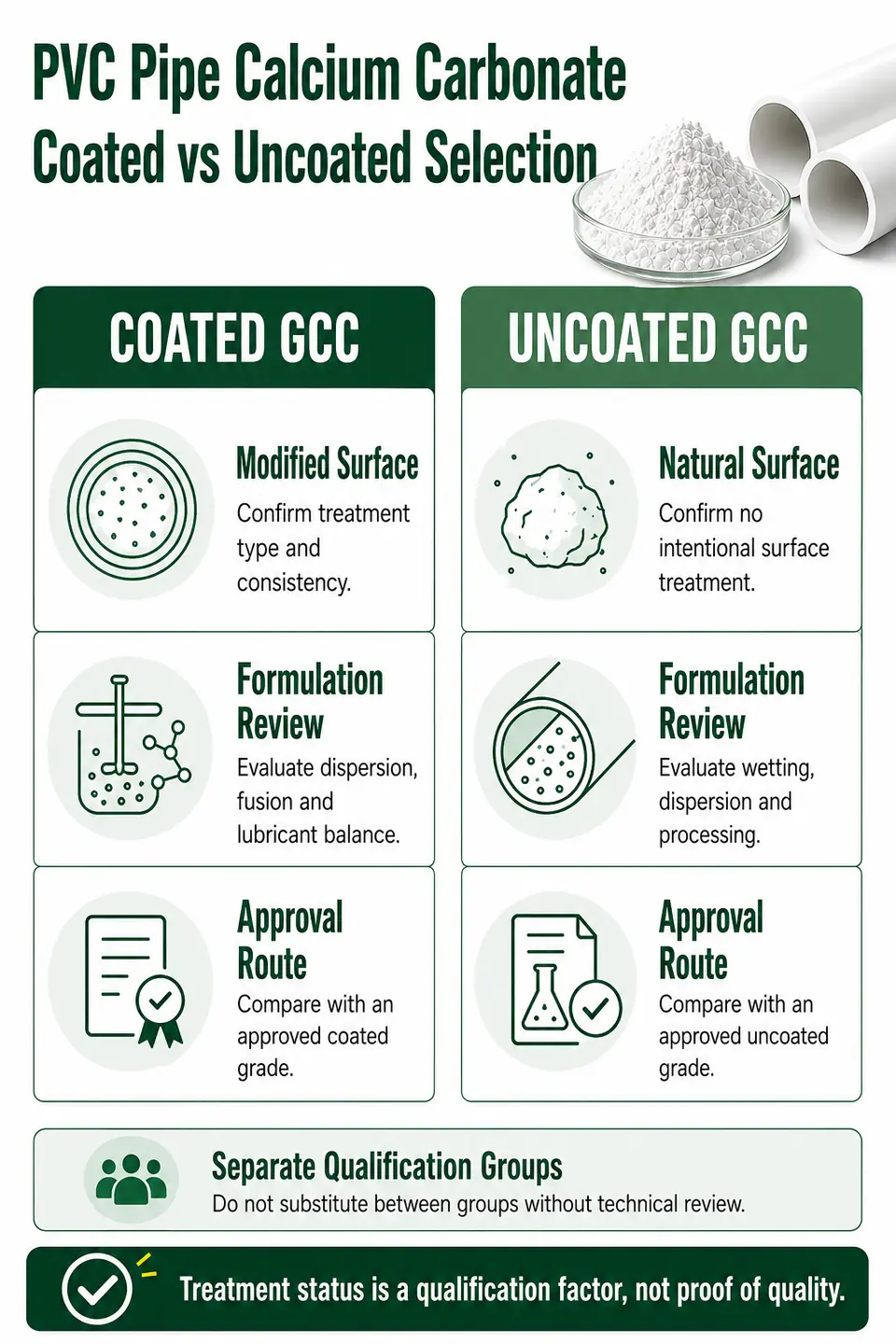
Choose coated or uncoated calcium carbonate according to the approved compound, measurable mineral properties and verified pipe performance. Treatment status is a qualification factor, not proof of quality by itself.

Coated and uncoated calcium carbonate selection comparison for PVC pipe manufacturing
Production Qualification

How to Design a Calcium Carbonate Extrusion Trial

A production trial should determine whether a candidate calcium carbonate grade can operate within the PVC pipe manufacturer’s processing window and still produce pipe that meets the required specification. It should not be treated as a short visual test or a simple check of whether material passes through the extruder.

The trial must begin with a documented baseline. The existing approved calcium carbonate, PVC resin, additive package, formulation, mixing procedure, extrusion line and finished pipe results should be recorded before the candidate material is introduced.

Without this baseline, differences in torque, pressure, output, surface quality or pipe performance may be incorrectly attributed to calcium carbonate when they were actually caused by changes in resin, additives, operating conditions or equipment.

Change one defined material variable at a time

When the objective is to compare calcium carbonate grades, the formulation and production conditions should remain controlled as far as practical. Any necessary adjustment must be recorded so that the technical team can explain why the result changed.

01

Material Variables

Record the supplier, product code, treatment status, batch number, D50, D97, moisture, composition and relevant specification values.

02

Formulation Variables

Record the resin batch, stabilizer system, lubricants, processing aids, impact modifiers, pigments and calcium carbonate loading.

03

Production Variables

Record the mixer, extruder, screw configuration, die, temperatures, line speed, cooling conditions and production output.

Trial Sequence

Five Stages of a Controlled PVC Pipe Trial

A structured trial follows the material from incoming verification to finished pipe testing. Each stage answers a different question and provides evidence that can be reviewed after production.

Recommended Production Trial Workflow

  1. 01
    Verify the incoming trial material Confirm the product identity, treatment status, batch code, packaging condition, technical data and sample connection to the supplied documentation.
  2. 02
    Prepare and observe the dry blend Record the formulation, addition sequence, mixing time, material temperatures, visible agglomeration, powder flow and discharge behavior.
  3. 03
    Introduce the candidate grade Separate the transition period from the stable trial period and record any purge, adjustment or material loss associated with the change.
  4. 04
    Monitor steady production Track torque, motor load, pressure, temperatures, output, line speed, surface appearance, dimensional control and the frequency of production adjustments.
  5. 05
    Identify and test the produced pipe Mark trial samples with the material batch, production time and operating condition before completing the required finished pipe tests.
Process Monitoring

What Should Be Recorded During Extrusion?

The most useful trial report combines numerical production data with clearly defined observations. General comments such as the material ran well or the pipe looked good are not sufficient for supplier approval because they cannot be reproduced or compared later.

Trial StageVariables to RecordWhy the Information Matters
Dry Blend Mixing sequence, mixing time, material temperatures, powder flow, visible agglomeration and discharge behavior. These observations help determine whether the candidate mineral can be incorporated consistently before extrusion begins.
Feeding Hopper behavior, feeding stability, bridging, fluctuation, material loss and visible segregation. Inconsistent feeding can create changes in output, compound composition and pipe dimensions.
Fusion Torque, motor load, pressure response, temperature profile and any required lubricant or processing adjustment. These values show how the complete compound responds to the candidate calcium carbonate under the selected processing conditions.
Stable Extrusion Output rate, line speed, head pressure, temperature stability, adjustment frequency and duration of stable operation. A material that produces an acceptable short sample may still create instability during continuous production.
Pipe Appearance Surface smoothness, visible particles, color, streaking, die lines, defects and visual consistency. Appearance can reveal dispersion problems, coarse material or unstable processing, but it does not replace mechanical testing.
Dimensions Outside diameter, wall thickness, ovality, mass per unit length and dimensional variation over time. Dimensional stability helps show whether feeding, output and downstream control remained consistent during the trial.
Production Loss Start up waste, transition waste, rejected pipe, cleaning requirements, interruptions and total material loss. Purchase price alone does not represent the full economic effect of a calcium carbonate grade.

Build a Traceable Trial Record

Every collected sample and every reported result should be connected to the material, formulation, production period and operating condition used to create it.

  • Calcium carbonate product code
  • Calcium carbonate batch number
  • PVC resin and additive batches
  • Approved formulation revision
  • Extrusion line identification
  • Production date and time
  • Operating condition record
  • Finished pipe sample code
Approval Decision

From a Successful Trial to Routine Supply

Passing one production trial does not automatically demonstrate long term supply consistency. The approved trial grade must be translated into a purchasing specification with defined parameters, methods, limits and batch documentation requirements.

Connect Trial Approval to Supplier Quality Control

After a candidate grade is approved, future deliveries should be compared with the same technical baseline. A consistent calcium carbonate quality control process helps connect raw material selection, grinding, classification, production monitoring and batch verification to the approved purchasing specification.

Incoming inspection should confirm that the commercial material remains connected to the approved product identity and agreed quality limits. A successful sample cannot compensate for uncontrolled variation in routine supply.

Approve

Meets the Defined Requirements

Processing remained controlled and the produced pipe passed the required specification and finished product tests.

Investigate

Result Requires Further Work

The material may require a controlled formulation adjustment, another trial or clarification of the supplier specification.

Reject

Creates an Unacceptable Result

The material does not meet the defined processing, consistency or finished pipe acceptance requirements.

Production trial rule

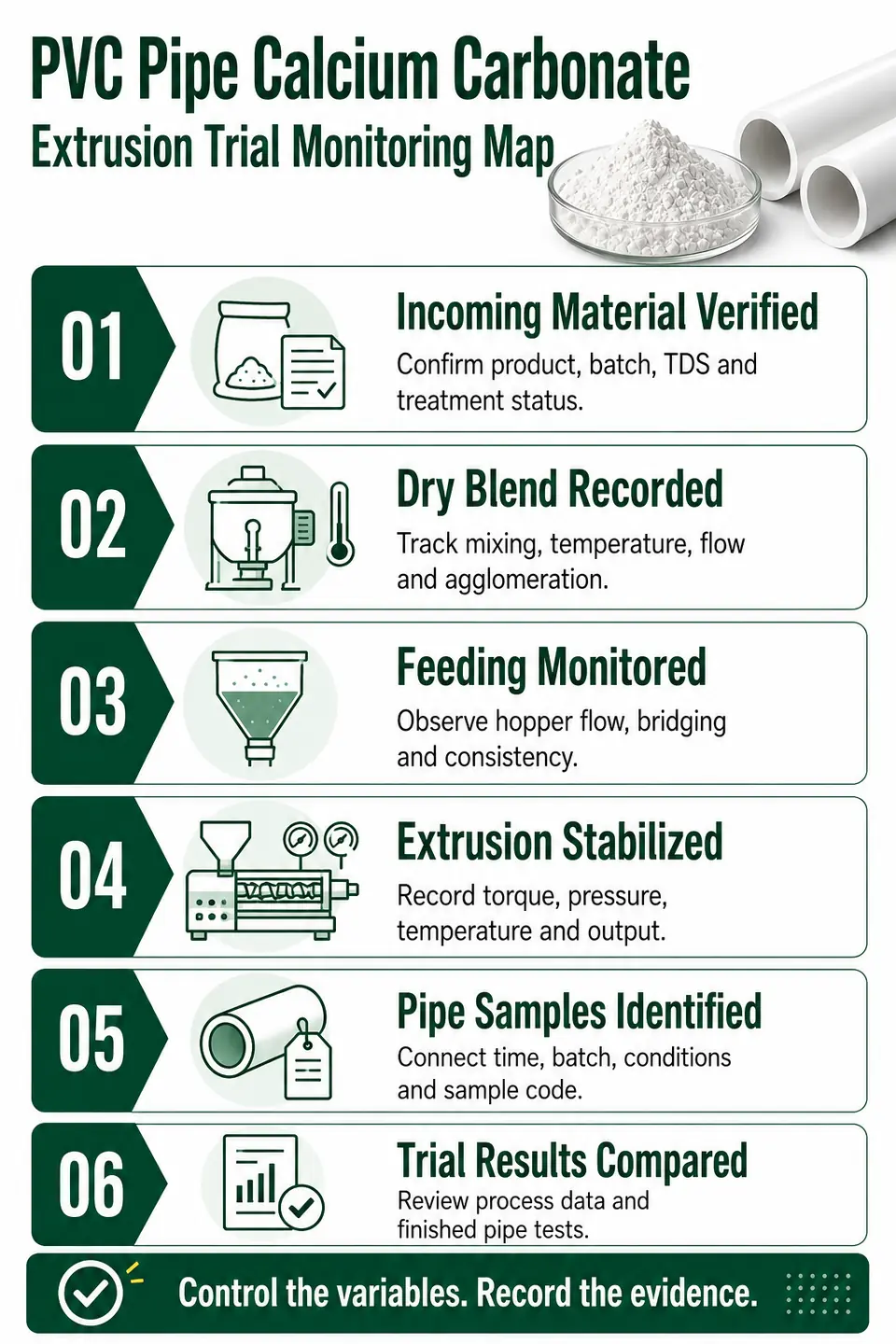
Record the baseline, control the variables, separate start up from steady production and connect every finished pipe result to an identified calcium carbonate batch.

Six step calcium carbonate extrusion trial monitoring map for PVC pipe manufacturing
Finished Pipe Qualification

Finished Pipe Tests Define the Final Acceptance Decision

A calcium carbonate TDS describes the mineral raw material. It does not demonstrate that a finished PVC pipe complies with its product standard. Final approval requires tests performed on pipe produced from the complete formulation under controlled manufacturing conditions.

The test plan must be selected before the production trial begins. It should identify the pipe application, material designation, pressure class where applicable, dimensions, intended service conditions, market requirements and the exact standard used for acceptance.

Pressure pipe, underground nonpressure drainage pipe, internal soil and waste pipe, electrical conduit and foam core pipe may require different tests and acceptance limits. Passing a test plan created for one pipe family does not prove compliance with another.

Pipe Application

Pressure and Nonpressure Pipe Require Different Test Plans

The first step is to classify the finished product correctly. Standards define their own scopes, product characteristics and referenced test methods. The examples below demonstrate why the application must be identified before calcium carbonate qualification begins.

01

Pressure Pipe

Solid wall PVC U pipe for water supply and pressure drainage requires evaluation against the applicable pressure pipe standard and its referenced test methods.

Review ISO 1452 Part 2
02

Underground Nonpressure Pipe

PVC U systems intended for nonpressure underground drainage and sewerage are evaluated under requirements specific to that application and installation environment.

Review ISO 4435
03

Soil and Waste Pipe

PVC U pipe used for soil, waste, ventilation and rainwater systems inside buildings has a different product scope from pressure and buried drainage pipe.

Review ISO 3633
A standard reference is not a decorative citation

The manufacturer must obtain and use the applicable standard, referenced test methods and current national requirements. Reading only the public abstract of a standard is not sufficient for certification or production release.

Test Families

Which Finished Pipe Properties May Need Evaluation?

The following test families are commonly relevant to PVC pipe qualification. They are presented as a planning framework rather than as a universal mandatory list. The applicable product standard determines which tests, conditions, sample quantities and limits must be used.

Test FamilyWhat It EvaluatesHow It Relates to Grade Qualification
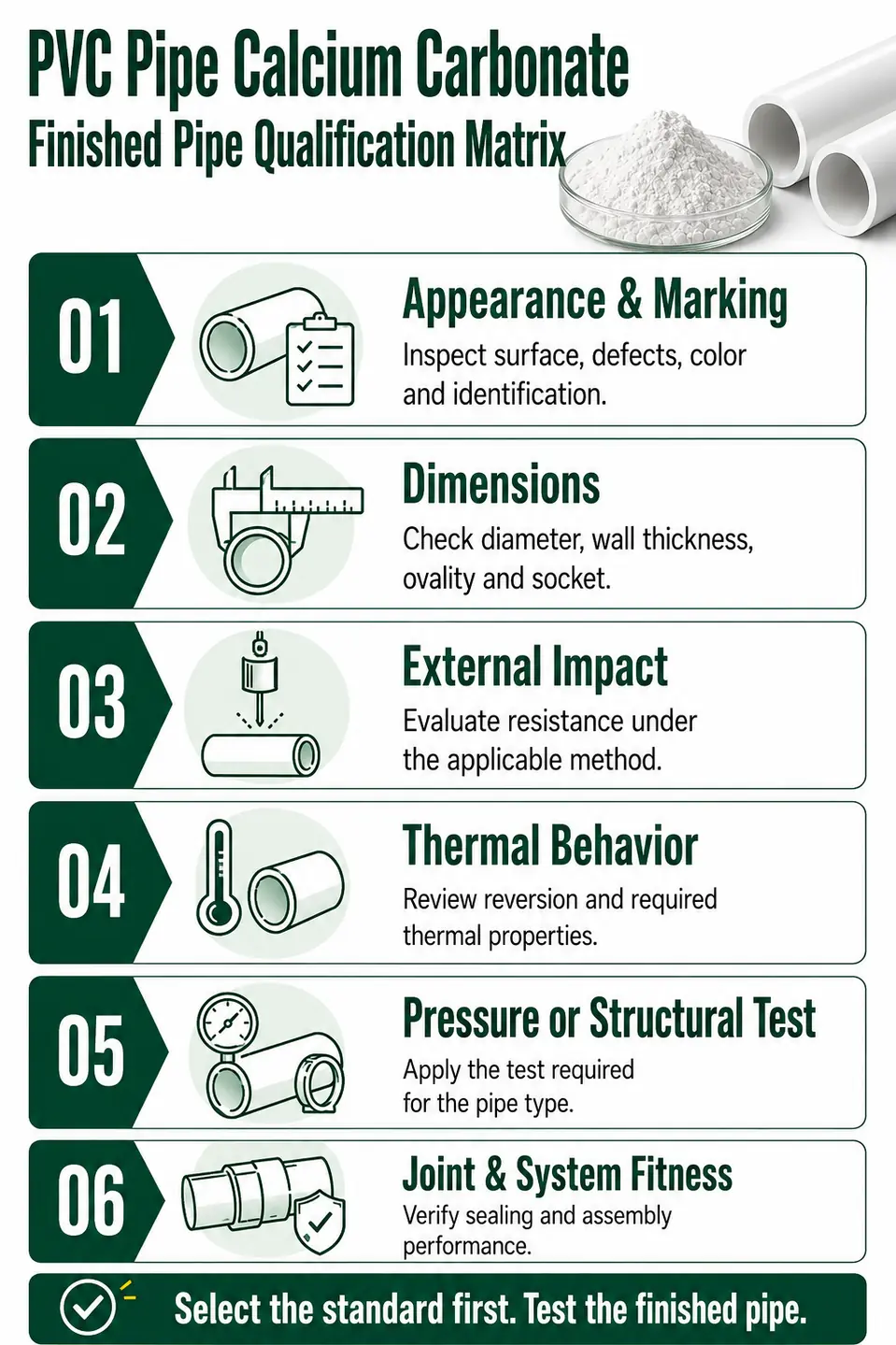
Appearance and Marking Surface condition, visible defects, color, cleanliness, identification and required product marking. Visible particles, streaking or surface defects may indicate dispersion, coarse material or processing problems that require investigation.
Dimensions Outside diameter, wall thickness, ovality, socket dimensions and other product geometry required by the standard. Dimensional variation may reflect changes in feeding, output, melt behavior, cooling or process control.
Resistance to External Blows The response of the pipe to defined external impact conditions using the applicable test method. The result belongs to the complete pipe formulation and processing history. It should not be attributed to one raw material without investigation.
Longitudinal Reversion Dimensional change after exposure to the temperature and conditions defined by the applicable method. The result may help identify the effect of material condition and processing history on dimensional stability.
Thermal Behavior Temperature related characteristics required for the selected PVC pipe family and product standard. The complete formulation, fusion and manufacturing process should be considered when interpreting the result.
Hydrostatic Pressure The response of pressure pipe specimens under defined internal pressure, temperature and test duration. This is a critical acceptance area for pressure pipe. A mineral substitution must not be approved only from appearance or short extrusion observations.
Ring or Structural Behavior Structural response under the loading conditions specified for the applicable nonpressure pipe design. The required evaluation depends on pipe construction, wall design, application and the governing standard.
Joint and System Fitness Joint integrity, sealing behavior and system performance under conditions defined for the pipe and fitting assembly. A pipe material trial should not ignore socket, joining or system performance when these are part of the product approval.
Failure Investigation

A Failed Pipe Test Does Not Identify the Cause by Itself

A finished pipe failure confirms that the tested product did not satisfy the defined requirement. It does not automatically prove that calcium carbonate was the only cause. The complete material, formulation, processing and test record must be investigated.

Surface Failure

Visible Particles or Roughness

Review coarse residue, D97, agglomeration, dispersion, material contamination, die condition and extrusion stability.

Dimensional Failure

Unstable Wall or Diameter

Review feeding consistency, output, melt pressure, cooling, haul off control, formulation and the timing of sample collection.

Impact Failure

Unacceptable External Blow Result

Review resin, impact modifier, filler characteristics, loading, fusion, processing history, specimen conditioning and test execution.

Pressure Failure

Unacceptable Hydrostatic Result

Stop technical approval and investigate the complete formulation, raw material change, manufacturing record, specimen preparation and test conditions.

Root Cause Investigation Sequence

  1. 01
    Verify the test Confirm specimen identity, conditioning, equipment, procedure, test conditions and result calculation.
  2. 02
    Review the production record Check the formulation, raw material batches, mixing, extrusion conditions and sample collection time.
  3. 03
    Compare with the approved baseline Identify every material, formulation and process difference between the candidate trial and the accepted reference production.
  4. 04
    Retest through a defined plan Repeat only after the suspected cause and the controlled corrective action have been documented.

What Constitutes Technical Approval?

Approval requires more than successful extrusion. The candidate calcium carbonate must meet its agreed raw material specification, remain traceable to the tested batch and produce pipe that satisfies every applicable acceptance requirement.

The approved record should identify the exact grade, treatment status, formulation revision, permitted loading, production route, finished pipe test plan and incoming quality controls.

Finished pipe approval rule

Select the pipe standard first, define the test plan before the trial and approve the calcium carbonate only after the finished pipe meets every applicable requirement.

Finished PVC pipe qualification test matrix after calcium carbonate production trials
Industrial Purchasing

How Should PVC Pipe Manufacturers Request a Calcium Carbonate Grade?

A useful calcium carbonate inquiry should describe the technical requirement rather than asking only for a mesh number and price. Better information allows the supplier to compare the request with available grades and helps the buyer avoid testing a material that does not match the intended pipe formulation.

When an approved calcium carbonate is already in use, its TDS, treatment status and critical specification limits provide the most useful starting point. The objective is not to request an identical product name. It is to identify a technically comparable candidate for controlled evaluation.

01

Pipe Application

Identify pressure pipe, drainage pipe, sewer pipe, conduit, solid wall pipe, foam core pipe or another defined product.

02

Product Standard

Provide the applicable standard, pressure class, market requirement and finished pipe acceptance criteria.

03

Current Specification

Share the current TDS, approved limits and known information about D50, D97, moisture, purity and surface treatment.

04

Formulation Direction

Identify coated or uncoated status, current calcium carbonate loading and any critical processing requirements.

05

Purchasing Volume

State the trial quantity, expected monthly consumption, annual demand and preferred packaging format.

06

Delivery Requirement

Provide the country, destination port, delivery location, requested commercial term and unloading conditions.

Supplier Comparison

What Should Be Compared Between Calcium Carbonate Suppliers?

Supplier evaluation should combine the proposed product specification, analytical methods, sample traceability, production performance, routine batch control and commercial supply conditions. A lower quotation does not create value if the material causes unstable production or unacceptable pipe.

Comparison AreaEvidence to RequestPurchasing Question
Product Identity Exact grade name, product code, coated or uncoated status and applicable technical data sheet. Is the quoted product the same grade that will be sampled, tested and supplied commercially?
Particle Size D50, D97, coarse residue, test method and sample preparation information where available. Are values from competing suppliers technically comparable or only presented under similar mesh names?
Chemical and Physical Data Calcium carbonate content, relevant impurities, moisture, density, oil absorption and optical values where required. Do the specification, units and methods match the approved purchasing requirement?
Batch Traceability Sample code, production batch, commercial lot, certificate connection and identification procedure. Can the trial sample be connected to the material proposed for routine supply?
Production Consistency Agreed limits, quality control route, batch documentation and incoming inspection plan. How will future deliveries be controlled against the grade approved during the production trial?
Change Control Procedure for communicating changes in raw material, production route, specification or surface treatment. Will the buyer be informed before a material change that could affect the approved formulation?
Packaging and Storage Bag type, net weight, pallet or jumbo bag details, protection from moisture and storage guidance. Can the packaging preserve the approved material condition through transport and factory storage?
Commercial Supply Trial quantity, minimum order, production lead time, shipping terms, destination and quotation validity. Can the supplier maintain both technical compliance and the required delivery program?

Compare Total Production Cost, Not Only Price per Ton

The commercial result of a calcium carbonate grade may be influenced by more than its purchase price. Trial performance, formulation changes, production output, rejected pipe, cleaning, laboratory testing and logistics can all affect the real cost of approval and routine use.

Material Cost Delivered mineral cost and required loading
Processing Cost Output, energy, adjustments and interruptions
Quality Cost Testing, rejected pipe and investigation
Supply Cost Packaging, transport, storage and availability
Technical Grade Matching

Send Your PVC Pipe Calcium Carbonate Requirement

Industrial buyers can provide their current TDS, approved specification or target parameters for comparison with available Arosha Powder grades. The proposed material must still be confirmed through the buyer’s own formulation, extrusion trial and finished pipe tests.

  • Pipe Application
  • Current TDS
  • D50 and D97
  • Surface Treatment
  • Required Volume
  • Destination
Technical FAQ

Frequently Asked Questions About Calcium Carbonate for PVC Pipe

What is the best calcium carbonate grade for PVC pipe?

There is no universal best grade for every PVC pipe. The correct material depends on pipe type, product standard, formulation, surface treatment, particle size distribution, loading, extrusion conditions and finished pipe requirements.

Is coated calcium carbonate always better for PVC pipe?

No. Coated calcium carbonate is commonly evaluated in PVC compounds because surface treatment changes the mineral surface. However, treatment status alone does not prove suitability. Uncoated GCC may also be evaluated where the approved formulation is designed for it.

Is mesh size enough to select calcium carbonate?

No. Mesh is a useful commercial grade reference, but it does not describe the complete particle size distribution. Buyers should also compare D50, D97, coarse residue, test methods, moisture, composition and surface treatment.

What do D50 and D97 mean in grade comparison?

D50 describes the central region of the reported particle size distribution, while D97 provides information about its upper particle size region. Both values should be interpreted with the complete distribution and measurement method.

How much calcium carbonate can be added to PVC pipe?

A universal addition rate should not be used. The permitted and practical level depends on the pipe standard, formulation, pressure requirement, calcium carbonate characteristics, processing equipment and finished pipe test results.

Can a supplier TDS prove that a grade is suitable?

No. A TDS supports initial screening and comparison. Final suitability must be demonstrated through controlled formulation testing, extrusion trials and the applicable finished pipe tests.

Can a PVC pipe manufacturer change calcium carbonate suppliers?

A second supplier can be evaluated, but the proposed material should be compared with the approved specification and tested according to the manufacturer’s change control procedure. Coated and uncoated grades should not be treated as automatic substitutes.

Which documents should a PVC pipe buyer request?

Buyers may request the applicable TDS, SDS, batch COA, particle size information, surface treatment status, test methods, sample identification and packaging details. Required documents should be connected to the exact grade being evaluated.

Do pressure and nonpressure PVC pipe use the same test plan?

No. Pressure pipe, underground drainage pipe, internal soil and waste pipe, conduit and other pipe families have different product scopes and acceptance requirements. The applicable standard must be identified before the calcium carbonate trial begins.

Final Calcium Carbonate Selection Principle

Calcium carbonate for PVC pipe should be selected as part of a complete manufacturing and qualification system. Mesh name, price, treatment status or a single laboratory value cannot establish final suitability.

Begin with the finished pipe requirement. Define the approved mineral specification, compare particle size distribution and surface condition, verify the technical documents, run a controlled extrusion trial and complete every required finished pipe test.

The correct grade is the material that can be supplied consistently, processed within the manufacturer’s operating window and used to produce compliant pipe at an acceptable total production cost.

Prof. Dr. Ali Ihsan Arol scientific reviewer
Scientific Review

Prof. Dr. Ali Ihsan Arol

Mining Engineering and Mineral Processing, Middle East Technical University

The technical structure of this article was reviewed from the perspective of mineral characteristics, particle evaluation and industrial raw material qualification.

View Academic Profile at METU

Technical References

How useful was this post?

Click on a star to rate it!

Average rating 4.5 / 5. Vote count: 2

No votes so far! Be the first to rate this post.