Mine Based Raw Material Control
Direct access to limestone resources allows Arosha Powder to evaluate raw material before processing and maintain greater visibility over the mineral source used for industrial calcium carbonate production.
Send Your Request
Fill in the form below and our team will get back to you shortly.
Your message has been received.
Our team will respond to your request as soon as possible.
Arosha Powder supplies coated and uncoated calcium carbonate to manufacturers, compounders, distributors and industrial raw material buyers in Oman. As a direct calcium carbonate manufacturer with mine based production , we support industrial procurement with grade selection based on particle size, surface treatment, production requirements and commercial specifications.
Calcium carbonate selected according to the technical and commercial requirements of industrial buyers.
Specify mesh, D50, D97, surface treatment and application requirements.
Industrial sourcing requires more than comparing a product name or mesh number. Buyers need confidence in raw material control, technical communication, product qualification and the supplier's ability to coordinate commercial orders for export.
Direct access to limestone resources allows Arosha Powder to evaluate raw material before processing and maintain greater visibility over the mineral source used for industrial calcium carbonate production.
Grade selection can begin with the buyer's application and production requirements. Mesh, particle size distribution, surface treatment and relevant quality parameters can then be considered during technical evaluation.
Industrial purchasing teams can evaluate the relevant technical information for the selected grade before commercial supply. Documentation requirements can be reviewed according to the buyer's qualification process.
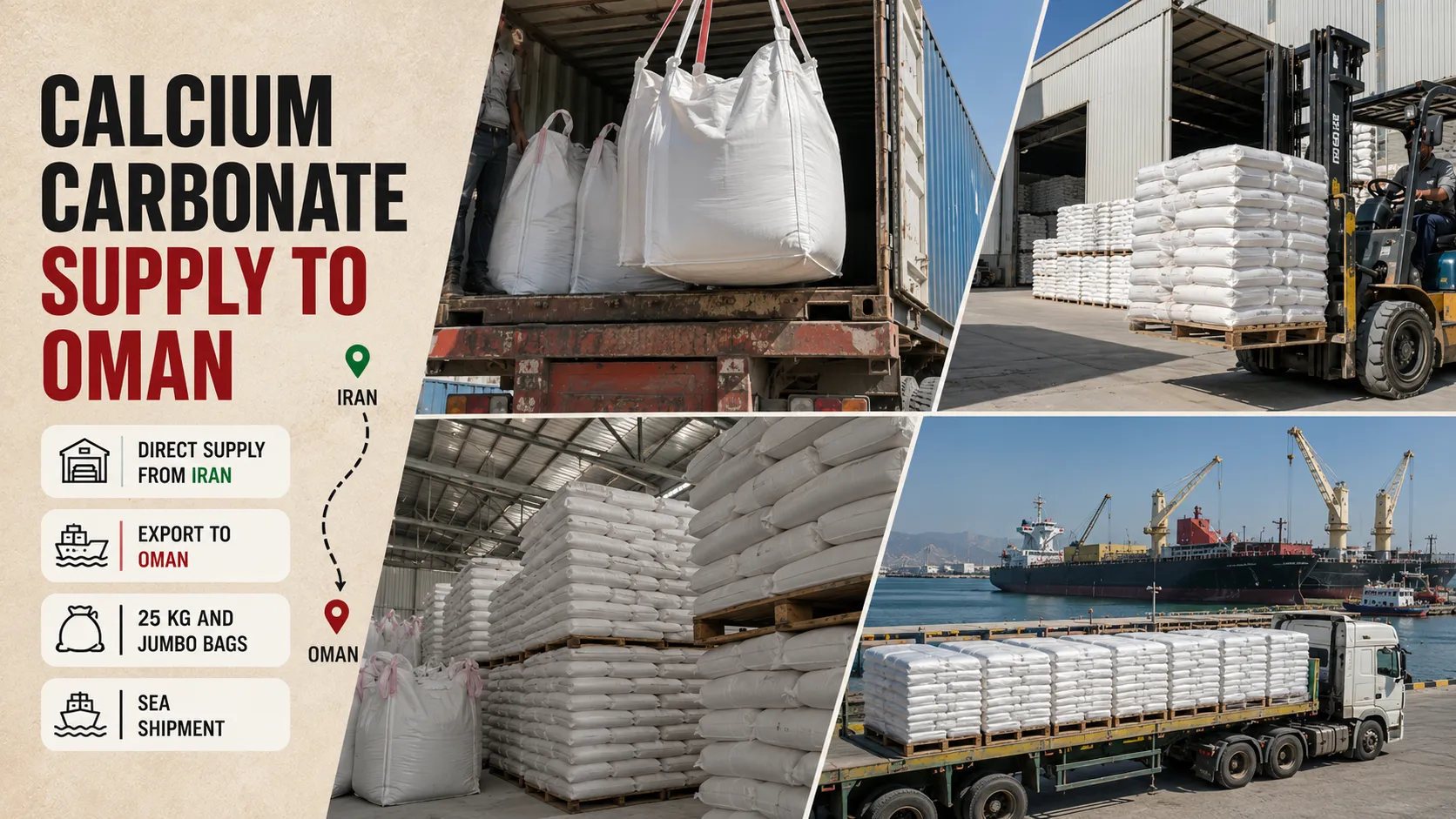
Commercial planning can be aligned with the selected product, required quantity, packaging, destination and applicable delivery requirements for industrial buyers sourcing calcium carbonate for Oman.
Start with the application and production requirements. The relevant particle characteristics, surface treatment and technical parameters can then be evaluated during the grade selection process.

Arosha Powder supplies coated and uncoated calcium carbonate in multiple particle size ranges for industrial buyers in Oman. Mesh size can be used as an initial reference, while final product qualification should also consider particle size distribution, D50, D97, surface treatment and the technical requirements of the buyer's production process.
Buyers evaluating polymer and compound formulations can review the coated calcium carbonate product family and then refine the selection according to particle size, surface treatment and the requirements of the production process.
Industrial buyers requiring untreated mineral filler can review the uncoated calcium carbonate product family across coarse and fine particle size ranges before matching the final grade to the application and required technical parameters.
Mesh is useful for initial comparison, but industrial qualification should consider the complete particle and quality specification.
Final grade selection should be based on the buyer's application, formulation and production conditions. Relevant technical data can then be reviewed before commercial product selection.
Calcium carbonate can serve different functions depending on the formulation, particle size distribution and surface treatment. Industrial buyers can review the broader industrial applications of calcium carbonate before narrowing the appropriate grade according to their production process and final product requirements.
Calcium carbonate grades can be evaluated for rigid PVC pipe and profile formulations according to particle size distribution, surface treatment, dispersion behavior and the requirements of the production process.
For a deeper technical comparison, review the PVC pipe grade selection guide .
Calcium carbonate can be evaluated as a mineral filler in masterbatch and plastic compounds where dispersion, surface compatibility, particle characteristics and processing behavior need to be aligned with the carrier resin and final formulation.
Calcium carbonate can function as a mineral extender in primers, putties, decorative paints, textured coatings and selected industrial coating systems. The appropriate grade depends on the desired formulation and finished surface.
Calcium carbonate may be evaluated as a mineral filler in rubber formulations. Grade selection should consider dispersion, particle characteristics, surface treatment and compatibility with the specific compound and processing conditions.
Ground calcium carbonate can be evaluated in putties, dry mixtures, construction compounds and related mineral formulations where particle size, purity, moisture and processing characteristics influence the final product.
Calcium carbonate can be considered in adhesive and sealant formulations as a mineral filler where particle distribution, oil absorption, moisture and compatibility with the binder system need to be technically evaluated.
Industrial grade selection should consider the complete specification, including particle size distribution, surface treatment, purity, whiteness, moisture and other application relevant parameters together with the buyer's own formulation and processing conditions.
Industrial grade selection should begin with the production application, not with a mesh number alone. Buyers can narrow the appropriate calcium carbonate specification by reviewing the formulation, required surface treatment, particle size distribution, quality parameters and commercial requirements together.
Start by identifying where the calcium carbonate will be used. PVC, masterbatch, paints, rubber and construction formulations can require different particle and surface characteristics.
Surface treatment should be selected according to compatibility with the formulation and processing conditions. Polymer applications may require a different approach from water based or mineral based systems.
Mesh provides a useful commercial reference, but particle size distribution gives a more complete technical picture of the powder. Buyers who need a deeper comparison can review our guide to calcium carbonate particle size, mesh, D50 and D97 before confirming the required specification.
Depending on the application, buyers may need to review calcium carbonate purity, whiteness or brightness, moisture, oil absorption and other relevant technical characteristics.
The final purchasing discussion should include required quantity, packaging, destination and applicable delivery terms so technical qualification and commercial planning can be reviewed together.
If the exact grade is not known, an industrial buyer can begin with the application and available production requirements. Technical parameters can then be compared during product qualification.
Once the required calcium carbonate grade is defined, commercial planning can be aligned with order quantity, packaging, destination and delivery requirements. Export arrangements are reviewed according to the confirmed order rather than applying the same logistics structure to every industrial shipment.
Buyers requiring broader information about shipment terms, documentation and international purchasing can review Arosha Powder's calcium carbonate export supply services. For Oman orders, the commercial quotation can then be prepared according to the selected grade, order volume, packaging, destination and applicable delivery requirements.
Packaging can be selected according to order volume, warehouse handling and purchasing requirements. Standard bag and larger industrial packaging formats can be confirmed during commercial planning.
Technical and commercial documentation can be reviewed according to the selected product, buyer requirements and the documentation required for the confirmed shipment.
Applicable delivery terms such as FOB, CFR or CIF can be discussed according to the shipment structure, required destination and final commercial quotation.
Packaging is part of commercial planning because loading method, purchasing volume, warehouse handling and final destination can influence the most suitable configuration for an industrial order.
The next section explains how technical documents and batch information can support industrial product qualification.
Industrial calcium carbonate qualification requires more than confirming a product name or mesh number. Purchasing and quality teams can review the relevant technical specification, safety information and batch documentation before approving a grade for commercial supply.
The relevant quality parameters depend on the industrial application. A technical review should therefore compare the selected calcium carbonate grade with the buyer's own formulation, processing conditions and purchasing specification.
Used during technical evaluation to review the declared characteristics and relevant specification of a defined calcium carbonate grade.
Provides relevant handling, storage, safety and material information for purchasing, HSE and workplace documentation requirements.
A batch specific COA can be used to review analytical results associated with the identified production batch when required for the confirmed supply.
Not every buyer needs to prioritize the same specification. The relevant parameters should be selected according to the production process and final product requirements.
Industrial buyers can review the available calcium carbonate technical data sheets for coated and uncoated grades and identify the relevant documentation for their technical purchasing process.
The TDS is used as the technical reference for a product grade, while the COA is associated with an identified production batch. Buyers should compare batch results with the approved purchasing specification when batch verification is required.

A useful quotation starts with clear technical and commercial information. Industrial buyers in Oman can begin with the application and available purchasing requirements, even when the exact calcium carbonate grade has not yet been selected.
You do not need to know every technical parameter before making an inquiry. Start with the information already available from your production, quality control or purchasing team.
The application, required product, quantity and commercial information are collected.
Available calcium carbonate grades are evaluated against the stated production requirements.
Pricing, packaging, quantity and applicable delivery terms can be prepared for the defined inquiry.
Product, packaging, documentation and commercial requirements are confirmed.
The confirmed order proceeds to production and export shipment planning.
Existing product specifications, TDS documents or required quality parameters can be shared during the inquiry. This allows technical evaluation to begin from the buyer's actual requirements instead of relying only on a general product name or mesh designation.
These questions cover the points industrial buyers commonly need to clarify before selecting a calcium carbonate grade, reviewing technical documentation and requesting a commercial quotation for supply to Oman.
Buyers do not need to know every technical parameter before contacting Arosha Powder. The production application, expected quantity and available specification are enough to begin the technical discussion.
Arosha Powder supplies coated and uncoated calcium carbonate in multiple mesh ranges. The appropriate grade should be selected according to the application, particle size requirements, surface treatment and relevant technical parameters rather than mesh number alone.
The choice depends on the formulation and production process. Coated grades are commonly evaluated where surface treatment and compatibility with polymer systems are important, while uncoated grades are suitable for applications where untreated mineral filler is required. The final selection should be confirmed against the buyer's production requirements.
Yes. Buyers can begin by providing the application, current production requirements, expected quantity and any available specification. The technical discussion can then be used to narrow the suitable calcium carbonate grade before the commercial quotation is finalized.
Technical evaluation can include the relevant Technical Data Sheet and Safety Data Sheet for the selected grade. Batch specific analysis documentation can also be reviewed when required for the confirmed commercial supply.
The most useful information includes the industrial application, required grade or known specification, coated or uncoated preference when defined, required quantity, preferred packaging and delivery destination in Oman.
Packaging requirements can be reviewed during commercial planning. The final configuration should be confirmed according to the selected grade, order volume, handling requirements and shipment arrangement.
The required destination should be provided during the inquiry so the commercial and logistics arrangement can be reviewed accordingly. Shipment planning depends on the confirmed order, delivery terms and final destination requirements.
Yes. Buyers can provide an existing TDS, required quality parameters or current product specification as a technical reference. This allows the evaluation to focus on the actual production requirements rather than relying only on a general product name or mesh designation.
The next step is to send the purchasing requirements for technical and commercial review.
Share your application, required grade, expected quantity and destination in Oman. Arosha Powder can review the technical and commercial requirements of your inquiry before preparing the relevant supply proposal.
Providing these details helps the technical and commercial review start with the right information.
If the exact technical grade is not yet defined, send the application and available production requirements as the starting point.