01
PVC Pipes, Profiles & Fittings
Grade Direction
Coated GCC is commonly evaluated for polymer
formulations where dispersion and compatibility
are important.
Parameters
Send Your Request
Fill in the form below and our team will get back to you shortly.
Your message has been received.
Our team will respond to your request as soon as possible.

Calcium carbonate is used across plastics, PVC, masterbatch, paints and coatings, rubber, paper, adhesives, cable compounds and construction materials. However, selecting the right grade requires more than choosing a mesh number. Particle size distribution, surface treatment, purity, moisture, whiteness and application-specific performance should all be evaluated before technical approval.
Different formulations require different particle, surface and processing characteristics.
Grade direction depends on the application, formulation and technical requirements.
Final suitability should be confirmed against the approved specification and application testing.

Editorial purpose: This technical guide is prepared for manufacturers, purchasing teams, importers and industrial formulators evaluating calcium carbonate for application-specific use. Technical content is subject to scientific review, while final grade suitability should be confirmed against the buyer's approved specification and through application testing where required.
Calcium carbonate is not used in industrial formulations simply as a material that occupies volume. Depending on particle characteristics, surface treatment and the formulation itself, ground calcium carbonate (GCC) can influence processing behavior, filler loading, surface appearance, dimensional properties, rheology and the overall balance between material performance and formulation cost.
For this reason, the term “calcium carbonate grade” should refer to more than a mesh designation. Two products described with the same nominal mesh size may still behave differently if their particle size distribution, D50, D97, moisture, purity, surface treatment or oil absorption are not comparable.
The function of calcium carbonate also changes significantly from one industry to another. A grade considered for a PVC compound may be evaluated mainly for dispersion, moisture and compatibility with the polymer matrix, while a paint manufacturer may place greater emphasis on particle size distribution, whiteness, brightness and oil absorption. In construction formulations, particle packing, consistency and compatibility with the binder system may become more important.
One of the most common roles of calcium carbonate is as a mineral filler. However, industrial filler selection should not be reduced to maximizing filler content. The required loading level depends on the formulation, processing equipment, mechanical requirements and the characteristics of the selected calcium carbonate.
A properly selected GCC grade can help manufacturers develop a more controlled formulation while maintaining the properties that matter to the finished product. The practical objective is therefore not simply to add more calcium carbonate, but to identify a grade that can be integrated into the production system without creating unacceptable processing or performance problems.
Particle size distribution affects how mineral particles occupy space inside a formulation. This can influence packing behavior, mixing, flow and the interaction between the calcium carbonate and other components of the system.
This is why purchasing decisions based only on labels such as 400 Mesh, 800 Mesh or 1250 Mesh can be incomplete. Industrial buyers should also review measurable particle-size parameters—particularly D50 and D97—where these values are relevant to the application and available in the technical specification.
In applications such as polymer compounds and filler masterbatch, calcium carbonate may be surface treated to modify its interaction with the surrounding formulation. Coated calcium carbonate is therefore commonly evaluated where improved compatibility, dispersion or moisture-related processing behavior is required.
This does not mean that coated calcium carbonate is automatically the correct choice for every application. Uncoated GCC remains suitable for many industrial processes. The choice between coated and uncoated material should be based on the chemistry of the formulation, processing conditions and the buyer’s approved technical requirements.
In applications such as paints, coatings, paper and selected finishing materials, calcium carbonate may also be evaluated according to optical and formulation-related parameters. Whiteness, brightness, particle size and oil absorption can become important depending on the desired appearance, viscosity, surface finish and processing behavior.
These parameters should never be interpreted in isolation. For example, a finer particle size does not automatically mean that a grade will perform better in every formulation. The correct technical decision is based on how multiple properties work together inside the specific production system.
The most reliable way to select calcium carbonate is to start with the application and work backward toward the required technical specification. Buyers should define the production process, performance requirements and critical material parameters before comparing available grades.
This application-based approach is especially important for manufacturers qualifying a new supplier. Instead of asking only for a specific mesh number, the purchasing or technical team can compare the supplier’s technical data sheet with its current specification, identify the critical parameters and then confirm final suitability through laboratory or production testing where necessary.
The sections below organize the main industrial uses of calcium carbonate by application and highlight the technical parameters that should be considered when selecting a suitable grade.
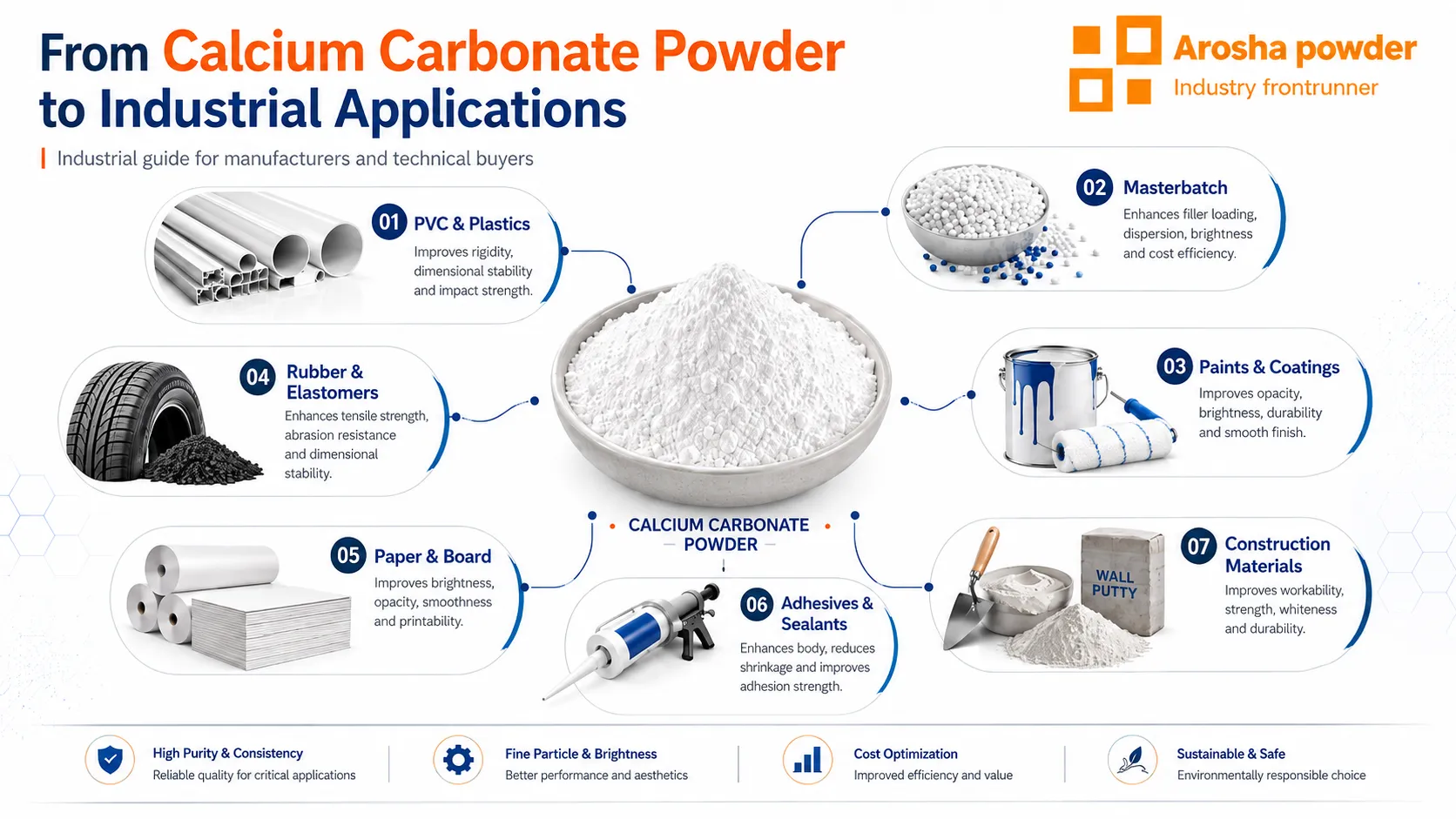
The table below provides a practical starting point for industrial grade selection. It does not prescribe a single calcium carbonate grade for every formulation. Instead, it highlights the product direction and technical parameters that buyers should evaluate before comparing data sheets, requesting samples or approving a material for production.
The final calcium carbonate grade should be selected against the buyer's technical specification and tested in the actual formulation where required. A mesh number alone is not sufficient to confirm suitability because particle size distribution, surface treatment, moisture, purity and other characteristics can influence performance.
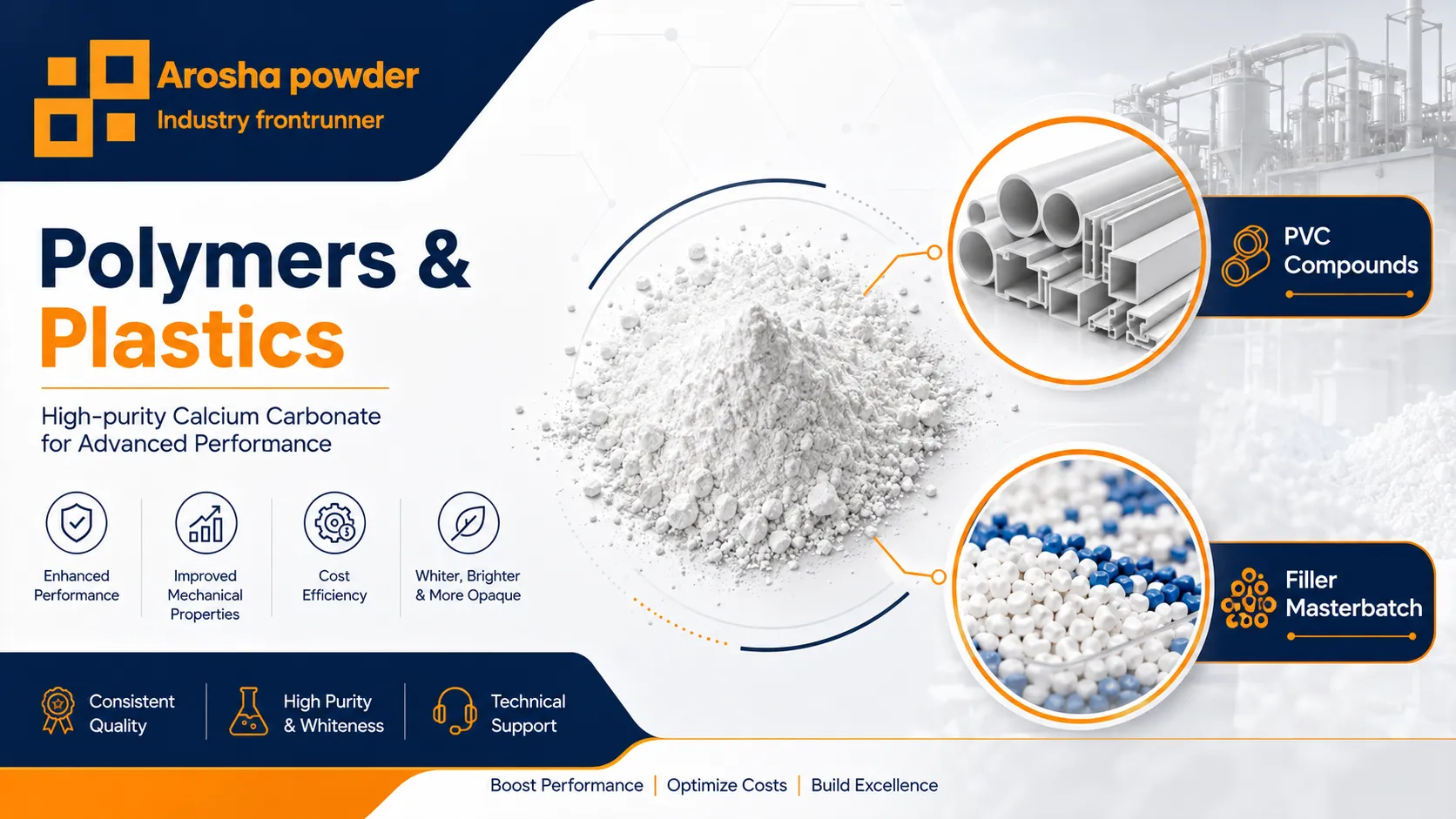
Calcium carbonate is widely evaluated in polymer processing as a mineral filler and formulation component, but the technical requirements can differ significantly between PVC, polyolefin masterbatch, cable compounds and other plastic systems. For polymer manufacturers, particle size alone is rarely sufficient for grade selection. Dispersion, surface treatment, moisture, particle size distribution and compatibility with the polymer matrix can all influence processing behavior and the characteristics of the finished compound.
In many polymer applications, coated calcium carbonate is evaluated because surface treatment can modify the interaction between the mineral particles and the surrounding polymer system. However, the use of coated GCC should still be confirmed against the actual formulation, processing conditions and technical specification rather than selected solely because a material is described as “coated.”
Rigid PVC formulations are one of the most important industrial areas in which calcium carbonate can be evaluated as a mineral filler. Depending on the compound design, calcium carbonate may contribute to the overall filler system while also affecting processing, dispersion, surface appearance and the balance between formulation cost and required product performance.
For PVC processors, the condition of the mineral surface can be particularly important. Surface-treated GCC is commonly considered where better interaction with the polymer system and more controlled dispersion are required. Moisture should also be reviewed because excessive moisture or inconsistent material condition can create processing difficulties in moisture-sensitive formulations.
Particle size distribution is another critical factor. A nominal mesh designation provides useful commercial identification, but it should not replace measurable information such as D50, D97 and other relevant parameters available in the technical data sheet. Two calcium carbonate products marketed under the same nominal mesh description may not necessarily exhibit identical particle-size distributions or processing behavior.
For this reason, a PVC manufacturer evaluating a new calcium carbonate supplier should compare the proposed grade with the current approved specification and, where necessary, perform laboratory or production trials before commercial approval.
In filler masterbatch and polyolefin compounding, calcium carbonate is incorporated into a polymer carrier system at controlled loading levels. The ability to disperse the mineral consistently throughout the compound becomes an important part of grade selection.
Surface-treated calcium carbonate is commonly evaluated in these systems because the treatment can help modify the interaction between the inorganic particle surface and the organic polymer phase. The effectiveness of the treatment, however, should not be judged only by the product label. Buyers should consider the relevant technical specification together with processing observations from actual compounding trials.
Particle size distribution, moisture and consistency between batches are also important. A formulation that runs successfully with one calcium carbonate grade may require processing adjustments if another material has a different particle-size profile, surface condition or moisture level even when both products are sold under a similar mesh designation.
For purchasing and technical teams, the most reliable approach is therefore to define the required processing behavior first and then evaluate a calcium carbonate grade against those requirements rather than selecting only on price or nominal fineness.
Calcium carbonate may also be evaluated in selected wire and cable compounds where mineral filler characteristics must remain compatible with the polymer system and the intended processing conditions. In these applications, stable dispersion and controlled moisture can become particularly important during formulation development and supplier qualification.
The required GCC characteristics depend on the specific cable compound rather than on the application name alone. Technical teams may need to compare particle size distribution, surface treatment and moisture requirements before approving a new material.
Where coated calcium carbonate is being considered, the buyer should also verify that the surface treatment is appropriate for the intended formulation. The presence of a coating by itself does not guarantee identical behavior between suppliers because treatment quality, particle characteristics and the overall grade specification can differ.
In artificial leather and other polymer-based surface materials, calcium carbonate can be evaluated as part of the filler system where processing consistency, dispersion and final surface characteristics are important. Fine particle grades may be considered depending on the polymer chemistry, formulation design and required appearance of the finished material.
Poor dispersion or an unsuitable particle-size profile can affect the uniformity of a formulation and may influence the surface characteristics obtained after processing. For that reason, suppliers should be evaluated not only on nominal mesh size but also on technical consistency and the parameters specified by the buyer.
Where the formulation is sensitive to moisture or mineral–polymer interaction, coated GCC may be considered as part of the technical evaluation. Final selection should still be confirmed through the manufacturer’s own formulation testing.
Across PVC, masterbatch, cable compounds and artificial leather, several calcium carbonate parameters repeatedly become relevant during supplier evaluation. These can include particle size distribution, D50 and D97 where applicable, surface treatment, moisture, purity and consistency between production batches.
The relative importance of each parameter depends on the formulation. A polymer manufacturer should therefore avoid treating one specification value as a universal indicator of quality. A technically suitable grade is the one that matches the approved material specification and performs acceptably under the buyer’s actual processing conditions.
Arosha Powder provides multiple coated calcium carbonate grades for industrial evaluation. Buyers can review the available
technical data sheets
and submit an existing specification for grade matching before moving to commercial evaluation.
Calcium carbonate is widely evaluated in paint and coating formulations as a mineral extender and functional formulation component. Its role can vary depending on the coating system, required surface appearance, pigment package, binder chemistry and target application. For paint manufacturers, selecting a suitable GCC grade therefore involves more than identifying a nominal mesh size.
Important parameters can include particle size distribution, whiteness, brightness, oil absorption, purity and moisture. The relative importance of these properties changes according to whether the calcium carbonate is being evaluated for an architectural coating, industrial coating, primer, putty or another formulation.
Because coating performance depends on the complete formulation, a calcium carbonate grade should be assessed together with the binder, pigments, additives and processing conditions rather than evaluated as an isolated raw material.
Particle size distribution is one of the first technical characteristics paint manufacturers should review when comparing calcium carbonate grades. It can influence particle packing, dispersion and the surface characteristics of the finished coating.
However, selecting the finest available grade is not automatically the correct approach. Different formulations may require different particle-size profiles depending on the desired balance between surface finish, rheology, filler loading and processing behavior.
For this reason, D50, D97 and other particle-size information can provide a more useful technical comparison than relying exclusively on commercial mesh designations. Buyers qualifying a new supplier should compare the proposed grade with the particle-size profile of the currently approved raw material whenever this information is available.
Whiteness and brightness can become important selection parameters in formulations where the mineral filler contributes to the visual characteristics of the final product. These values are particularly relevant when manufacturers require consistent appearance between production batches.
The two terms should not automatically be treated as interchangeable. Buyers should verify how the supplier reports each parameter and compare results obtained using compatible test methods before using the values for supplier qualification.
A high numerical value alone also does not determine overall coating quality. Optical properties need to be considered together with particle characteristics, pigment selection, binder system and the target appearance of the finished coating.
Oil absorption is another useful parameter when evaluating calcium carbonate for paints and coatings because it provides information related to the interaction between the mineral and the liquid phase of a formulation.
Changes in oil absorption between grades can influence formulation decisions, particularly where manufacturers are balancing mineral loading, viscosity and binder demand. For this reason, oil absorption should be reviewed as part of the complete technical specification rather than treated as a standalone measure of calcium carbonate quality.
When comparing suppliers, technical teams should also confirm that reported values were generated using comparable test procedures. Differences in analytical methods can make direct comparison difficult even when two technical data sheets appear to report the same parameter.
Both coated and uncoated calcium carbonate may be evaluated in coating formulations depending on the chemistry of the system and the required performance. There is no universal rule stating that one type is technically superior for every paint application.
For many conventional mineral-filled coating systems,
uncoated calcium carbonate
may be considered, while surface-treated grades can be evaluated where the formulation requires different mineral surface characteristics or compatibility behavior.
The final decision should be based on the formulation, supplier specification and application testing rather than on the coated or uncoated designation alone.
When qualifying calcium carbonate for a paint or coating formulation, buyers should compare the parameters that directly influence their own production process. These can include particle size distribution, D50, D97, whiteness, brightness, oil absorption, moisture, purity and batch-to-batch consistency.
A supplier should ideally be evaluated against an existing approved specification rather than against a generic definition of what constitutes a “good” calcium carbonate. Laboratory formulation testing can then be used to determine whether the proposed grade performs acceptably under the manufacturer’s actual conditions.
Buyers can also review Arosha Powder’s
technical data sheets
when comparing available grades.
Calcium carbonate is used in a variety of rubber and elastomer formulations as a mineral filler and formulation component. Depending on the compound, the selected GCC grade can contribute to filler loading while also influencing processing behavior, rheology, dispersion and the overall balance between technical requirements and formulation economics.
However, rubber formulations vary considerably in polymer type, curing system, additives and required physical properties. For this reason, calcium carbonate should not be selected according to mesh size alone. Particle size distribution, surface condition, oil absorption, moisture and consistency between production batches may all become relevant during technical qualification.
The required calcium carbonate specification should therefore be determined by the compound itself. A grade that performs acceptably in one elastomer system may not provide identical processing or finished-product behavior in another formulation.
In rubber compounding, mineral fillers are incorporated as part of a larger formulation that may include elastomers, reinforcing fillers, plasticizers, curing agents and processing additives. Calcium carbonate can be evaluated where the manufacturer requires a mineral filler that is compatible with the intended compound design and processing conditions.
The amount of calcium carbonate that can be incorporated should not be treated as a universal value. Appropriate loading depends on the rubber system, required mechanical properties, processing equipment and the role assigned to each filler in the formulation.
For purchasing teams, this means that a lower-cost or finer calcium carbonate grade is not automatically the better technical choice. Supplier qualification should focus on whether the material can consistently meet the parameters defined by the compound manufacturer.
Particle size distribution can influence how calcium carbonate is incorporated and distributed throughout a rubber compound. Consistent dispersion is particularly important because non-uniform filler distribution can make it more difficult to maintain predictable processing and finished-product characteristics.
A commercial mesh designation can provide a useful grade reference, but it does not describe the complete particle-size profile. Where particle-size data are available, parameters such as D50 and D97 can help technical teams make a more meaningful comparison between different calcium carbonate grades.
When qualifying a second supplier or replacing an existing raw material, buyers should ideally compare the proposed particle-size distribution with the currently approved specification rather than assuming that two products carrying the same mesh designation are technically equivalent.
Oil absorption can be relevant when comparing mineral fillers for rubber formulations because it provides additional information about the interaction between the mineral surface and liquid components of the compound.
Differences in oil absorption between calcium carbonate grades may need to be considered together with plasticizer demand, mixing behavior and the rheological requirements of the formulation. As with other specification values, oil absorption should not be interpreted as an isolated indicator of overall material quality.
Technical teams should also verify that values from different suppliers were measured using comparable test procedures before making direct specification comparisons.
Both coated and uncoated calcium carbonate can be considered for rubber and elastomer compounds depending on the formulation. Surface-treated GCC may be evaluated where mineral surface characteristics and dispersion within an organic polymer system are important, while uncoated grades may remain appropriate for other compound designs.
The presence of a surface treatment should not by itself be interpreted as proof that one calcium carbonate grade will perform better than another. The treatment, particle characteristics, compound chemistry and required finished-product properties need to be considered together.
Manufacturers comparing these options can review Arosha Powder’s
coated calcium carbonate grades
and
uncoated calcium carbonate grades
before selecting materials for technical evaluation.
When evaluating a calcium carbonate supplier for rubber production, technical and purchasing teams should define the specification parameters that are critical to their own compound. These may include particle size distribution, D50 and D97 where applicable, oil absorption, moisture, purity, surface treatment and batch-to-batch consistency.
The proposed material should then be compared with the manufacturer’s approved specification and, where necessary, evaluated through laboratory compounding or production trials. This approach provides a more reliable basis for approval than selecting a grade only by mesh designation, price or a single technical value.
Buyers can review Arosha Powder’s
calcium carbonate technical data sheets
when comparing available specifications before requesting a grade for application testing.
Calcium carbonate is used in paper and board manufacturing where mineral characteristics such as particle size distribution, brightness, whiteness and purity can influence its suitability for a specific production process. The required specification depends on the paper grade, production system and the role assigned to the mineral within the formulation.
For industrial buyers, calcium carbonate for paper applications should therefore be evaluated against measurable technical parameters rather than selected only by a commercial mesh designation. Particle-size profile, optical characteristics and consistency between batches can all become important during supplier qualification.
The correct grade also depends on how the calcium carbonate will be used within the paper or board process. A material intended for one production system should not automatically be assumed to provide identical behavior in another without reviewing the technical specification and conducting appropriate production evaluation.
Optical properties are important when calcium carbonate is evaluated for paper and board products where appearance is a key quality requirement. Brightness and whiteness can provide useful information when comparing mineral grades, particularly where manufacturers require a consistent visual result across production batches.
These values should be interpreted carefully. Whiteness and brightness describe related but different optical characteristics, and results from different suppliers should ideally be compared using compatible measurement methods.
A higher reported value should also not be considered sufficient on its own to approve a grade. Optical properties need to be evaluated together with particle characteristics, purity, process conditions and the quality requirements of the finished paper or board product.
Particle size distribution is another important consideration when comparing calcium carbonate for paper-related applications. The distribution of fine and coarse particles can affect how the mineral behaves within the manufacturing system and should therefore be reviewed according to the requirements of the specific process.
A nominal mesh designation does not provide a complete description of the particle-size profile. Where available, parameters such as D50 and D97 can help technical teams compare proposed materials more accurately and identify differences that may not be visible from the commercial grade name alone.
When replacing an existing calcium carbonate or qualifying a second supplier, comparing the proposed particle-size distribution with the currently approved specification provides a stronger technical basis than assuming that two products with similar mesh descriptions are equivalent.
Calcium carbonate purity is commonly included in technical specifications, but the reported CaCO3 percentage should be considered together with other material characteristics. Industrial buyers may also need to consider consistency, unwanted mineral variation and whether the supplied material remains within the agreed specification from batch to batch.
For continuous manufacturing operations, consistency can be as important as an individual specification value. Significant variation in raw material characteristics may require process adjustments or create difficulties in maintaining predictable finished-product quality.
Supplier evaluation should therefore include both the target specification and the supplier’s ability to provide appropriate technical documentation for the material being considered.
There is no single calcium carbonate specification that should be treated as universally suitable for all paper and board applications. The appropriate material depends on the production process, required optical properties, particle-size profile and the technical targets established by the manufacturer.
For this reason, buyers should begin with their existing material specification or define the critical parameters required by the process. A proposed GCC grade can then be compared against those requirements before laboratory or production-scale approval.
Arosha Powder’s
uncoated calcium carbonate grades
can be reviewed alongside the available
technical data sheets
when evaluating material specifications for industrial applications.
This Applications page provides only an overview of the parameters relevant to paper and board manufacturing. For a more detailed discussion of calcium carbonate in paper production, including the technical role of mineral fillers and differences between calcium carbonate options, read our dedicated guide:
Calcium Carbonate in Paper and Board Making: The Expert Guide
.
Calcium carbonate can be evaluated as a mineral filler and formulation component in a wide range of adhesive and sealant systems. Depending on the chemistry of the product, GCC may contribute to filler loading, rheological behavior, processing characteristics and the overall balance between formulation performance and raw-material cost.
However, adhesive and sealant formulations can differ considerably in polymer chemistry, viscosity, curing mechanism and application method. For this reason, calcium carbonate should be selected against the technical requirements of the specific formulation rather than by mesh designation alone.
Particle size distribution, moisture, oil absorption, surface characteristics and consistency between production batches can all become relevant during technical qualification.
The mineral filler system can influence the flow and handling characteristics of an adhesive or sealant formulation. Calcium carbonate may therefore be evaluated not only according to the quantity that can be incorporated, but also according to how the selected grade interacts with the binder, plasticizers, additives and other components of the system.
Increasing filler loading does not automatically improve formulation economics if the selected material creates unacceptable viscosity, mixing or application behavior. The practical objective is to identify a calcium carbonate grade that can be incorporated at the required level while maintaining the processing and finished-product characteristics defined by the manufacturer.
For this reason, rheological requirements should be established before comparing GCC grades. Technical teams should then evaluate particle characteristics and other specification values that may influence the behavior of the complete formulation.
Particle size distribution can influence mineral packing, dispersion and the interaction of calcium carbonate with the liquid and polymer phases of an adhesive or sealant system.
A nominal mesh designation provides only part of the information required for technical comparison. Where available, particle-size parameters such as D50 and D97 can help buyers compare grades more accurately and identify differences that may not be apparent from the commercial product name alone.
The finest available grade should not automatically be assumed to provide the best performance. The appropriate particle-size profile depends on the required rheology, surface characteristics, filler loading and processing conditions of the specific formulation.
Moisture can become an important specification parameter in adhesive and sealant systems that are sensitive to water or where raw-material variation can affect processing stability.
For these formulations, buyers should review the moisture specification of the proposed calcium carbonate and compare it with the limits established for the currently approved raw material. Storage, packaging and handling conditions should also be considered because the condition of the material at the point of use can influence its behavior during production.
A low reported moisture value should still be evaluated together with other grade characteristics rather than treated as a standalone indication of suitability.
Oil absorption can provide additional information when calcium carbonate grades are compared for adhesive and sealant formulations. Differences in mineral surface area and particle characteristics may influence the interaction between the filler and liquid components of the formulation.
Technical teams should therefore review oil absorption together with particle size distribution, rheological requirements and the binder system. When comparing values from different suppliers, the reported test method should also be considered to ensure that the data are suitable for direct comparison.
Surface treatment may also be relevant in selected polymer-based formulations. In these cases,
coated calcium carbonate
can be evaluated alongside uncoated grades according to the required compatibility and processing behavior.
When qualifying calcium carbonate for adhesives or sealants, manufacturers should begin with the technical requirements of the formulation. Parameters such as particle size distribution, D50 and D97 where applicable, moisture, oil absorption, purity, surface treatment and batch-to-batch consistency can then be compared between proposed grades.
The selected material should ultimately be evaluated against the manufacturer’s approved specification and confirmed through laboratory or production testing where required. This reduces the risk of replacing an existing filler with a material that appears similar on a commercial specification but behaves differently during actual processing.
Industrial manufacturers looking for a reliable
calcium carbonate supplier in Asia
can review Arosha Powder’s available grades and
technical data sheets
before beginning application-specific qualification.
Calcium carbonate is widely used in mineral-filled construction formulations where particle size, purity, moisture and packing behavior can influence processing and the characteristics of the finished material. Applications can include wall putty, skim coat, tile adhesives, dry mortars and other building-material formulations that require a controlled mineral component.
The technical requirements for these applications are not identical. A calcium carbonate grade suitable for a wall putty formulation may not automatically be the correct material for a tile adhesive or another cementitious system. Binder chemistry, filler loading, particle-size distribution and required application properties should therefore be considered before approving a grade.
For many construction-related formulations,
uncoated calcium carbonate
can be evaluated as a starting point, although the final selection should always follow the manufacturer’s own specification and application testing.
In wall putty and skim coat formulations, calcium carbonate can form an important part of the mineral filler system. The selected grade may influence particle packing, mixing behavior, surface smoothness and the overall consistency of the applied material.
Particle-size distribution should therefore be reviewed carefully. A finer calcium carbonate grade can provide different surface and packing characteristics from a coarser material, but finer does not automatically mean better. The correct particle profile depends on the binder system, filler combination and desired finish.
Manufacturers should also monitor moisture and material consistency because variation in mineral condition can influence mixing and make it more difficult to maintain a stable formulation from one production batch to another.
Calcium carbonate may also be incorporated into tile adhesive formulations as part of the mineral filler system. In these applications, the selected GCC should be compatible with the binder package, additives and the required application characteristics of the adhesive.
Particle size and packing behavior can become important because the mineral fraction contributes to the physical structure of the dry formulation. However, calcium carbonate should not be evaluated independently from cement, polymers, cellulose ethers and other formulation components.
When qualifying a new calcium carbonate source, manufacturers should compare the proposed material with the currently approved specification and observe whether changes in particle profile, moisture or purity require adjustments to the formulation or production process.
Dry mortar systems can contain several mineral components with different particle-size ranges and functions. Calcium carbonate may be evaluated as one part of this mineral blend where controlled particle characteristics and consistent raw-material quality are required.
The contribution of GCC depends on the specific mortar formulation. Manufacturers may need to consider particle packing, flow behavior, mineral compatibility and the interaction of calcium carbonate with the other dry ingredients in the system.
For this reason, purchasing decisions based exclusively on a nominal mesh number can be misleading. Technical teams should review the complete specification and evaluate whether the proposed grade fits the particle-size profile required by the formulation.
Particle packing is particularly relevant in mineral-rich construction formulations. The distribution of particles across different size ranges can affect how efficiently the solid fraction occupies available space and can influence mixing, application behavior and formulation consistency.
This is one reason why D50, D97 and the broader particle size distribution can provide more useful technical information than mesh designation alone. Two products identified by the same commercial mesh grade may still contain different proportions of fine and coarse particles.
Where particle-size data are available, manufacturers should compare the proposed calcium carbonate against the target distribution already established for the formulation rather than relying only on product naming.
CaCO3 purity is commonly reviewed when calcium carbonate is qualified for construction materials, but purity should not be treated as the only quality parameter. Moisture, particle-size distribution and consistency between shipments can also affect the predictability of a manufacturing process.
For dry formulations in particular, uncontrolled moisture can create handling or storage problems and may interfere with the manufacturer’s ability to maintain consistent raw-material conditions. Packaging and storage practices should therefore be considered together with the technical specification.
Batch-to-batch consistency is equally important for manufacturers operating continuous production. A material that repeatedly stays within the approved specification is generally more useful to production control than a grade selected only because one individual test result appears favorable.
When evaluating calcium carbonate for wall putty, skim coat, tile adhesives or dry mortar, manufacturers should first define which material characteristics are critical to their formulation. These can include particle size distribution, D50 and D97 where applicable, purity, moisture, bulk density and consistency between production batches.
The proposed GCC should then be compared with the approved raw-material specification and evaluated in the complete formulation. This helps prevent a technically unsuitable substitution based only on mesh number, price or a single specification value.
Buyers can review Arosha Powder’s
technical data sheets
and available
uncoated GCC grades
before beginning application-specific qualification.
The choice between coated and uncoated calcium carbonate should begin with the formulation rather than with a general assumption that one type is always superior. Surface treatment changes the characteristics of the mineral surface and can be particularly relevant in polymer-based systems, while uncoated GCC remains an important option for many paints, paper, construction and other mineral-filled formulations.
Surface-treated calcium carbonate is commonly evaluated in formulations where the interaction between the mineral surface and an organic polymer matrix is important.
Buyers should still verify the actual treatment, particle-size distribution, moisture and other technical parameters instead of assuming that all coated GCC grades are technically equivalent.
Uncoated GCC is widely evaluated in industrial systems where surface treatment is not required by the formulation and the mineral is selected primarily according to particle, optical and physical properties.
The correct grade should still be chosen according to measurable parameters such as particle-size distribution, purity, whiteness, moisture and other application-specific requirements.
| Application Requirement | Starting Direction | What Buyers Should Verify |
|---|---|---|
| Polymer compatibility and controlled dispersion | Evaluate Coated GCC | Surface treatment, PSD, moisture, D50/D97 and actual processing behavior. |
| Polyolefin filler masterbatch | Evaluate Coated GCC | Dispersion, coating quality, moisture, particle-size profile and formulation trial. |
| Paint and coating formulations | Application Dependent | Whiteness, brightness, PSD, oil absorption, surface characteristics and formulation chemistry. |
| Paper and board | Commonly Uncoated GCC | Brightness, whiteness, purity, particle-size distribution and process requirements. |
| Rubber and elastomer compounds | Application Dependent | Particle size, dispersion, oil absorption, surface treatment and compound chemistry. |
| Wall putty, skim coat and dry mortar | Commonly Uncoated GCC | Particle packing, PSD, purity, moisture and formulation requirements. |
| Adhesives and sealants | Application Dependent | Rheology, moisture, oil absorption, particle characteristics and binder chemistry. |
After choosing the appropriate grade direction, buyers should compare the complete technical specification. Particle-size distribution, D50, D97, moisture, purity, whiteness, oil absorption and other relevant parameters may still differ significantly between grades. Final suitability should be confirmed against the approved specification and through application testing where required.
Selecting a calcium carbonate grade for an industrial application requires a broader technical review than simply comparing mesh numbers. The parameters that matter most depend on the formulation, production process and required characteristics of the finished product, but several specification values repeatedly appear during supplier qualification and grade approval.
For industrial buyers, the most useful approach is to determine which parameters are critical to the application first and then compare those values across technical data sheets. This makes it easier to identify whether a proposed GCC grade is genuinely comparable with the currently approved material.
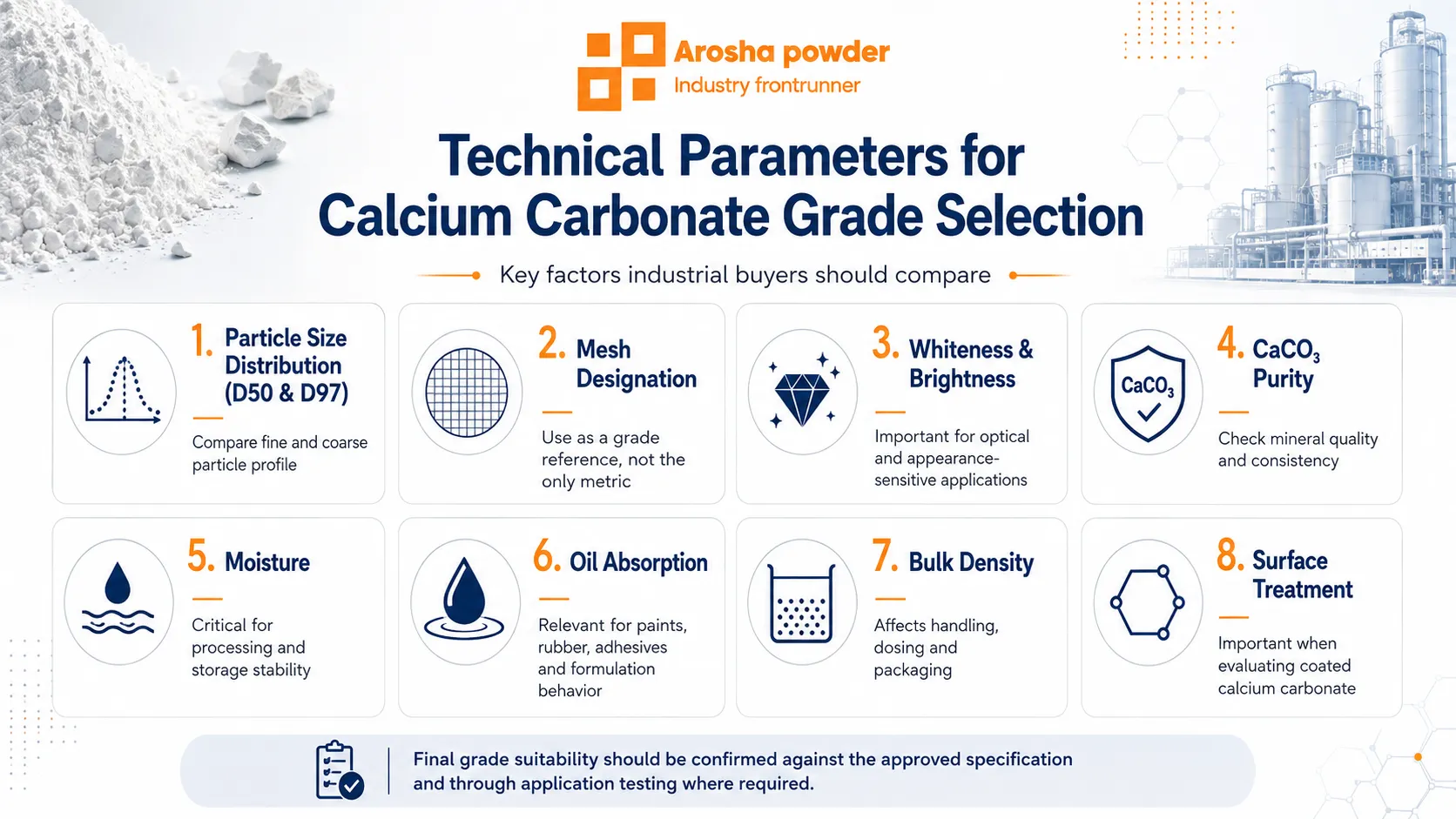
Particle size distribution describes how particles are distributed across different size ranges within a calcium carbonate grade. This is more informative than relying on a single commercial fineness designation because two products with a similar mesh label can still have different proportions of fine and coarse particles.
D50 is commonly used to describe the median particle size, while D97 provides information toward the coarse end of the particle-size distribution. These values can be particularly useful where oversized particles, surface quality, dispersion or processing consistency are important.
Particle-size values should always be interpreted together with the measurement method and sample preparation procedure. Results produced under different analytical conditions may not be directly comparable.
Mesh is widely used as a practical commercial reference for calcium carbonate grades, but it should not be treated as a complete description of particle size distribution. A mesh designation can help identify a product family, while more detailed particle-size information may be required for technical comparison.
For purchasing teams, mesh can therefore serve as an initial grade reference, but it should be supported by measurable specification data when the application is sensitive to particle size. This becomes especially important when comparing products from different suppliers because similar commercial mesh descriptions do not necessarily indicate identical particle-size profiles.
Whiteness and brightness are relevant optical parameters in applications where the appearance of the mineral can influence the finished product. Paints, coatings, paper, board and selected construction materials are examples where optical characteristics may become part of the approved raw-material specification.
Although these terms are sometimes presented together in commercial documents, they should not automatically be treated as equivalent measurements. Buyers should review the reported test method and compare values generated under compatible conditions.
Optical values should also be considered together with particle characteristics, purity and the formulation itself. A higher whiteness or brightness result does not automatically make one GCC grade technically superior for every industrial application.
Calcium carbonate purity indicates the proportion of CaCO3 present in the material and is commonly included in industrial technical specifications. However, supplier qualification should not stop at the headline purity percentage.
Buyers may also need to consider consistency of the mineral source and the presence of other mineral components that could be relevant to their application. A technically suitable material is therefore one that consistently remains within the approved specification rather than one selected only because it reports the highest individual purity value.
Moisture can be an important control parameter, particularly in formulations and processing systems that are sensitive to water. Polymer compounds, filler masterbatch, wire and cable materials, adhesives and dry formulations may all require moisture to remain within an approved range.
The value reported in a technical specification should also be considered together with packaging, transportation, storage and handling conditions. A material produced within specification still needs to remain appropriately protected before it reaches the manufacturing process.
Oil absorption is often reviewed in applications such as paints, coatings, rubber, adhesives and other formulations where interaction between the mineral surface and liquid components is relevant.
The reported value can help formulators identify differences between calcium carbonate grades, but it should not be interpreted as a universal quality score. Different particle-size distributions and mineral surface characteristics can produce different oil absorption behavior, while the preferred range depends on the formulation itself.
Bulk density can influence the practical handling of calcium carbonate in storage, dosing and material-transfer systems. It also affects how much physical volume a given mass of powder occupies, which may be relevant to production planning, packaging and material handling.
For manufacturers using automated feeding or volumetric dosing equipment, differences in bulk behavior between materials can sometimes require process adjustments even when other specification values appear similar.
Surface treatment is particularly relevant when calcium carbonate is evaluated for polymer-based systems. Treating the mineral surface can modify its interaction with an organic matrix and may influence dispersion, moisture-related behavior and processing characteristics.
However, the presence of surface treatment alone does not confirm that two coated calcium carbonate grades are technically equivalent. Buyers should evaluate treatment together with particle-size distribution, moisture, application requirements and the complete technical specification.
Where surface-treated GCC is required, manufacturers can review Arosha Powder’s
coated calcium carbonate grades
before selecting a product for technical evaluation.
No single calcium carbonate parameter should be used as a universal definition of quality. A lower D50, higher purity, lower moisture or higher whiteness may be desirable in one application while having less importance in another.
Industrial buyers should therefore compare the complete specification against the technical requirements of their production process. Where an existing calcium carbonate grade has already been approved, its specification can provide a useful benchmark for evaluating an alternative material.
Arosha Powder’s
calcium carbonate technical data sheets
can be reviewed before requesting technical grade matching or application-specific evaluation.
Industrial calcium carbonate purchasing should begin with the application and the approved technical requirement—not with a mesh number or unit price. A commercially attractive grade can still create production problems if its particle-size distribution, moisture, surface condition or other critical parameters do not match the formulation.
For manufacturers, importers and technical purchasing teams, a structured qualification process makes it easier to compare suppliers and reduces the risk of approving a material that appears similar on paper but behaves differently during production.
The first question should be where and how the calcium carbonate will be used. PVC pipe, filler masterbatch, paint, rubber, paper, adhesive and construction formulations can require very different mineral characteristics.
Defining the application allows the technical team to identify which parameters deserve the highest priority. For example, polymer processors may focus strongly on dispersion, surface treatment and moisture, while paint or paper manufacturers may place greater emphasis on particle-size distribution and optical properties.
Once the application is defined, the buyer should identify the specification values that directly affect the production process or finished product. Depending on the application, these may include D50, D97, mesh designation, CaCO3 purity, moisture, whiteness, brightness, oil absorption, bulk density and surface treatment.
Not every parameter needs to receive the same weight. The purpose of technical qualification is to determine which characteristics are essential, which are preferred and which have little practical influence on the specific manufacturing process.
The next step is to determine whether the formulation requires surface-treated or uncoated calcium carbonate. Polymer-based systems often evaluate coated GCC where mineral–polymer interaction and dispersion are important, while many paints, paper products and construction formulations may begin their evaluation with uncoated material.
This should still be treated as a technical starting point rather than an absolute rule. The chemistry of the formulation and the manufacturer’s own production experience should determine the final direction.
Buyers can compare Arosha Powder’s
coated calcium carbonate grades
and
uncoated calcium carbonate grades
before moving to individual grade comparison.
When a manufacturer already uses calcium carbonate successfully, the existing approved material provides one of the most useful benchmarks for supplier qualification. Instead of asking a new supplier simply for an equivalent mesh grade, the buyer can compare the complete technical specification.
Differences in D50, D97, moisture, oil absorption, purity or surface treatment can help explain why two apparently similar commercial grades may not behave identically during processing.
The comparison does not necessarily require every value to be identical. The objective is to understand which differences are technically acceptable and which could affect the production process or finished product.
A technical data sheet should provide the buyer with a structured overview of the characteristics associated with the proposed calcium carbonate grade. It can be used as an initial screening document before samples, laboratory testing or commercial qualification.
Buyers should pay attention not only to the reported values but also to how the parameters are defined and measured. A specification is most useful when the test method, units and reporting basis are understood by both the supplier and buyer.
Available Arosha Powder specifications can be reviewed through the
calcium carbonate data sheets
before requesting a technical comparison.
When the objective is to replace an existing calcium carbonate or qualify an additional supplier, sending the current technical specification can significantly improve the comparison process.
Instead of selecting a product based only on a familiar mesh designation, the supplier can review the key technical parameters and identify the closest available grade for further evaluation.
Industrial buyers can
send an existing specification for technical grade matching
before requesting a commercial quotation.
A technically suitable calcium carbonate grade is only one part of an industrial sourcing decision. Buyers should also consider whether the supplier can support repeat orders, provide appropriate technical documentation, communicate specification requirements clearly and prepare material for the intended supply route.
For buyers seeking a
direct-from-mine calcium carbonate supplier
,
the sourcing evaluation should include both the material specification and the supplier’s ability to support the technical and commercial requirements of the purchasing program.
This is particularly important for manufacturers and importers who depend on consistency between shipments rather than purchasing calcium carbonate as a one-time commodity.
A technical data sheet can narrow the selection, but it cannot reproduce the buyer’s complete production environment. Formulation chemistry, equipment, processing conditions, filler loading and other raw materials can all influence the behavior of calcium carbonate during actual use.
For this reason, laboratory evaluation or controlled production trials may be required before a new grade is commercially approved. The testing process should focus on the parameters and finished-product properties that are critical to the manufacturer’s own quality requirements.
A grade should move to routine purchasing only after the technical team is satisfied that it performs acceptably within the intended production system.
Once the grade has passed the required technical review, purchasing teams can move to commercial evaluation. Quantity, packaging configuration, destination, shipment terms and documentation requirements should be defined clearly so that the quotation reflects the actual purchasing scenario.
International buyers can use Arosha Powder’s
export RFQ
to submit the required product, quantity, packaging and destination information for commercial review.
A practical calcium carbonate purchasing sequence can therefore be summarized as:
Application → Technical Requirement → Coated or Uncoated Direction → Specification Comparison → TDS Review → Grade Matching → Application Testing → Commercial Approval.
Following this sequence helps separate technical qualification from commercial purchasing and reduces the risk of selecting a calcium carbonate grade only because it has a familiar mesh designation or a lower quoted price.
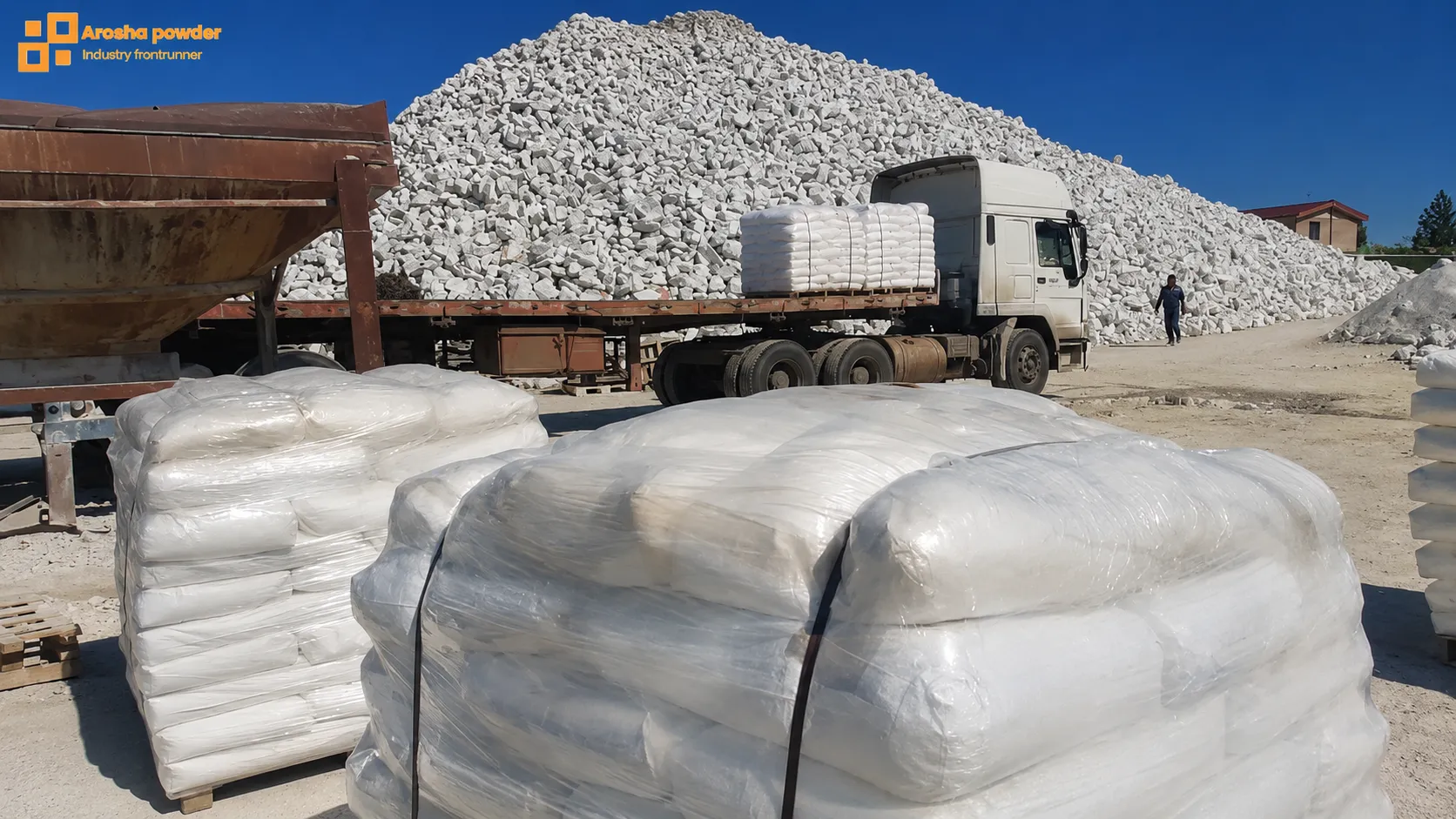
Technical specifications are essential for narrowing the list of suitable calcium carbonate grades, but specification matching alone does not guarantee identical performance in the buyer’s production environment. Differences in formulation chemistry, equipment, processing temperature, filler loading, mixing conditions and other raw materials can all affect how a GCC grade behaves during actual manufacturing.
For this reason, application testing should be treated as the final technical step before routine commercial purchasing. The objective is not simply to determine whether a sample can be processed, but to confirm that the proposed material performs within the manufacturer’s acceptable quality and process limits.
Before running a formulation trial, the proposed calcium carbonate should first be screened against the buyer’s technical requirements. Parameters such as particle size distribution, D50, D97, moisture, purity, whiteness, oil absorption and surface treatment can help determine whether the grade is technically close enough to justify further testing.
This first screening step prevents unnecessary trials with materials that already fall outside critical specification limits. It also gives the technical team a clear basis for understanding which differences between the current and proposed grades should be monitored during testing.
Where practical, the first application test should be conducted at laboratory scale using a controlled formulation. The proposed calcium carbonate should be introduced under conditions that allow meaningful comparison with the currently approved material or an established control formulation.
The evaluation criteria should reflect the actual application. A PVC processor may monitor dispersion and processing behavior, while a paint manufacturer may focus on viscosity, surface appearance and optical characteristics. A dry-mortar producer may instead examine mixing, consistency and application behavior.
The purpose of laboratory testing is therefore application-specific. There is no single universal test program that can confirm calcium carbonate suitability across every industry.
If laboratory results are acceptable, a controlled production trial may provide a stronger indication of how the calcium carbonate behaves under normal manufacturing conditions. Larger-scale equipment can reveal handling, feeding, dispersion or processing differences that may not be visible in a small laboratory batch.
During this stage, manufacturers should compare both process behavior and finished-product quality. Any required adjustments to dosing, mixing or formulation conditions should be documented before the material is approved for routine production.
A successful production trial should demonstrate that the proposed grade can be incorporated without creating unacceptable variation in the parameters that matter to the manufacturer’s process and product specification.
A single sample can provide useful initial information, but industrial qualification may require additional material or batch-specific review where consistency is critical. This is particularly relevant when the manufacturer intends to use the calcium carbonate as a recurring raw material rather than for a one-time order.
The goal is to confirm that the supplier can repeatedly provide material within the agreed technical specification and that normal production variation remains acceptable to the buyer.
Before testing begins, the buyer should define what constitutes an acceptable result. Approval criteria can include both raw-material parameters and application-specific performance targets.
Documenting these criteria makes supplier qualification more objective and reduces the risk of approving or rejecting a calcium carbonate grade based only on subjective observations.
The approved specification can then become the reference point for future purchasing, incoming quality control and batch comparison.
Once the proposed grade has passed the required technical evaluation, the purchasing team can move to commercial qualification. Quantity, packaging, shipment terms, destination and documentation requirements can then be reviewed without mixing technical uncertainty into the commercial decision.
Buyers who already have an approved calcium carbonate specification can use Arosha Powder’s
technical grade matching process
to compare available grades before requesting samples or commercial terms.
For available specifications, buyers can also review the
calcium carbonate technical data sheets
before beginning the qualification process.

Calcium carbonate grade selection depends on the application, formulation and technical specification. The following questions address some of the most common issues industrial buyers should consider before approving coated or uncoated GCC for production.
Ground calcium carbonate is used across a wide range of industrial formulations, including PVC, plastics, filler masterbatch, paints and coatings, rubber, paper and board, adhesives and sealants, wire and cable compounds, artificial leather and construction materials.
The required calcium carbonate characteristics differ between these applications, so a grade should be selected according to the formulation and approved technical specification rather than by application name alone.
Coated calcium carbonate is surface treated and is commonly evaluated in polymer-based formulations where mineral–polymer interaction, dispersion and moisture-related processing characteristics are important.
Uncoated calcium carbonate is widely evaluated in applications such as paints, paper and construction materials where surface treatment may not be required. However, the correct choice remains formulation dependent.
Buyers can compare coated calcium carbonate grades and uncoated calcium carbonate grades before reviewing individual specifications.
Coated GCC is commonly evaluated in PVC formulations because surface treatment can modify the interaction between the mineral and the polymer system. However, this does not mean that every coated grade will perform equally or that coating alone confirms suitability.
PVC manufacturers should also compare particle size distribution, D50, D97, moisture, treatment characteristics and actual processing behavior before approving a grade.
Filler masterbatch manufacturers commonly evaluate parameters such as particle size distribution, dispersion, surface treatment, moisture and consistency between batches.
The preferred specification depends on the polymer carrier, filler loading, processing equipment and performance targets of the finished compound. A mesh designation alone should not be used as the complete basis for material approval.
Paint and coating manufacturers may evaluate particle size distribution, D50, D97, whiteness, brightness, oil absorption, purity and moisture depending on the formulation.
These values should be interpreted together with binder chemistry, pigment package, required surface appearance and processing conditions. No single specification value defines the best GCC for every coating formulation.
Yes. Calcium carbonate can be evaluated as a mineral filler and formulation component in various adhesive and sealant systems. Depending on the chemistry, manufacturers may review particle size, rheological behavior, moisture, oil absorption and mineral surface characteristics.
Final suitability should be confirmed in the complete formulation because different binders and curing systems can respond differently to the same GCC grade.
Mesh should be treated as an initial commercial grade reference rather than the complete technical specification. Buyers should also review measurable particle-size information such as D50 and D97 where applicable, together with other parameters important to the intended application.
The most reliable approach is to compare the proposed material against an existing approved specification or the technical requirements defined by the manufacturer.
Where the application is technically sensitive, laboratory or controlled production testing can provide important information before commercial approval. A technical data sheet can identify potentially suitable grades, but it cannot reproduce the buyer's complete formulation, equipment and processing conditions.
Final approval should therefore follow the buyer's own qualification procedure where application testing is required.
Industrial buyers can submit an existing specification or technical requirement for comparison with available Arosha Powder grades. Parameters such as particle size, surface treatment, moisture, purity and other available technical characteristics can be reviewed before commercial evaluation.
Buyers can use the technical grade matching process to begin the comparison.
Available technical specifications can be reviewed through the Arosha Powder calcium carbonate data sheets . Buyers should compare the relevant parameters with their own approved specification before selecting a grade for testing.
If you are qualifying a new calcium carbonate source, replacing an existing grade or preparing a new industrial formulation, start with the technical requirement. Review available coated and uncoated GCC grades, compare the relevant data sheets and send your existing specification when a closer technical comparison is required.
Determine whether coated or uncoated GCC should be evaluated according to the formulation and application requirements.
Review particle size, D50, D97, moisture, purity, optical properties and other relevant parameters available for the selected grades.
Submit your current specification, application, required quantity and destination for technical matching and commercial review.