
Coated vs. Uncoated Calcium Carbonate: Differences, Performance & How to Choose
Choosing between coated and uncoated calcium carbonate is not simply a matter of deciding which product is more advanced or more expensive. The correct choice depends on the formulation, processing conditions, particle size distribution, surface compatibility, moisture sensitivity and the performance required from the finished product.
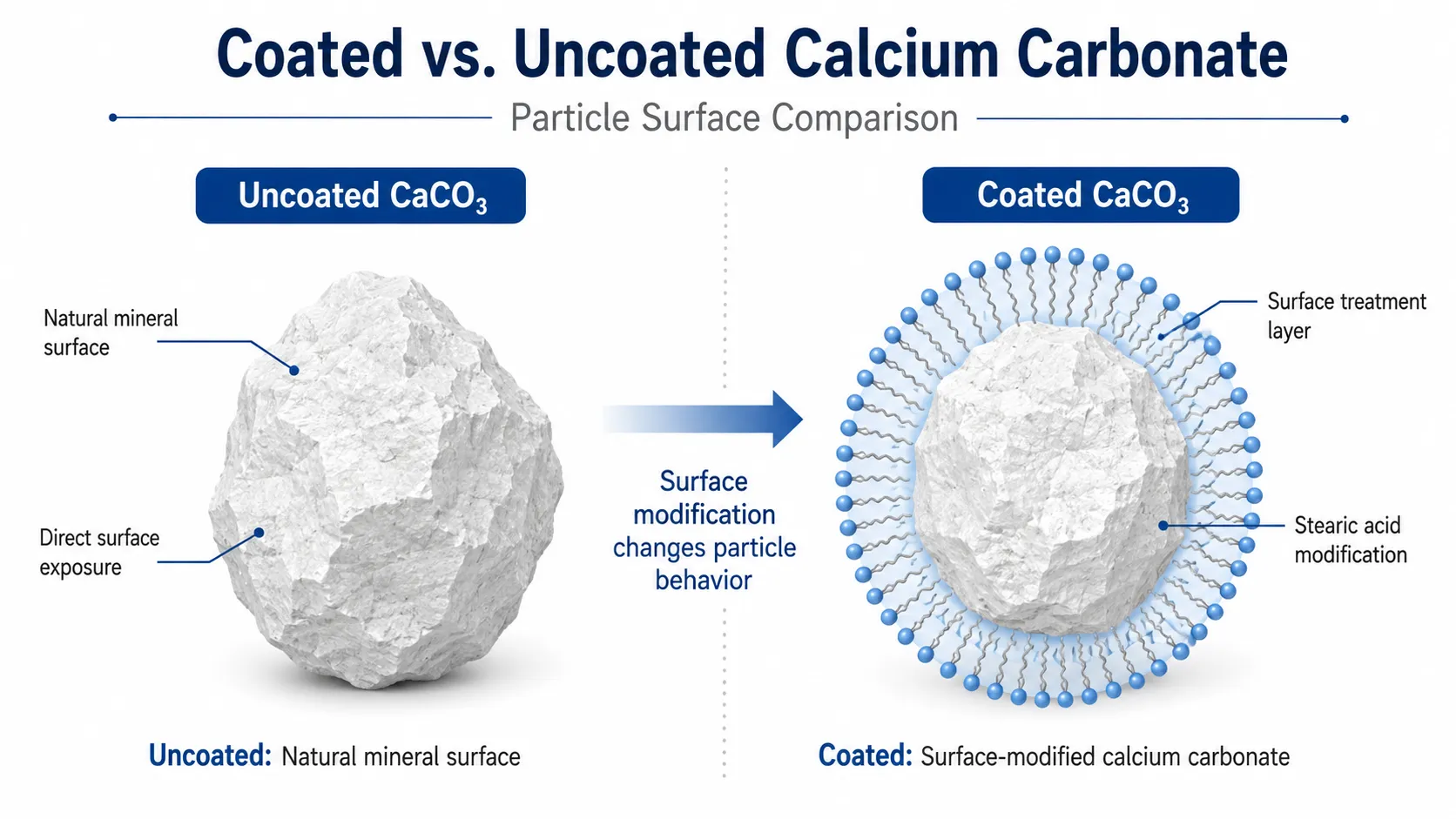
Both materials are based on calcium carbonate, but the surfaces of their particles behave differently. Uncoated calcium carbonate retains its natural mineral surface, while coated calcium carbonate undergoes an intentional surface treatment, commonly using stearic acid or another suitable fatty acid, to modify how the particles interact with surrounding materials.
This difference can influence wetting, dispersion, interaction between the filler and surrounding matrix, and overall processing behavior. For industrial buyers, compounders and formulators, understanding surface condition is therefore just as important as understanding particle size.
If you need a broader technical introduction to the mineral itself, read our detailed guide explaining what calcium carbonate is, its properties, types and industrial uses .
Coated vs. Uncoated Calcium Carbonate: The Quick Answer
The main difference is the particle surface. Uncoated calcium carbonate maintains its natural mineral surface. Coated calcium carbonate has a deliberately modified surface, commonly created through fatty acid treatment.
In suitable formulations, this treatment can reduce surface energy and change how calcium carbonate interacts with polymers and other organic matrices. This is one reason coated grades are frequently evaluated for polymer compounds, PVC and filler masterbatch.
However, coated calcium carbonate is not automatically better. Uncoated grades remain highly relevant in many aqueous, mineral and industrial systems. The correct choice must be based on the complete formulation rather than the coated or uncoated designation alone.
Scientific research supports the importance of surface modification. In a study examining the surface properties of calcium carbonate treated with stearic acid, Papirer, Schultz and Turchi reported a substantial change in the surface characteristics of fully treated calcium carbonate.
“The totally covered CaCO3 exhibits a surface energy close to that of pure stearic acid, with no surface polarity.”Papirer E., Schultz J., Turchi C., Surface Properties of a Calcium Carbonate Filler Treated with Stearic Acid, European Polymer Journal, 1984. View scientific source
This change in surface behavior forms the scientific basis for many of the practical differences between coated and uncoated calcium carbonate. To understand why those differences matter in industrial formulations, we first need to examine each material separately.
What Is Uncoated Calcium Carbonate?
Uncoated calcium carbonate is calcium carbonate powder whose particle surface has not undergone the intentional organic surface treatment used to manufacture coated grades.
In ground calcium carbonate production, selected limestone is processed through crushing, grinding and particle classification until the required fineness and particle size distribution are achieved. The resulting particles retain the natural mineral surface of calcite.
What Does Uncoated Actually Mean?
The term uncoated describes the surface condition of the calcium carbonate particle. It does not mean that the powder has received no industrial processing, nor does it describe the complete technical quality of the material.
An uncoated grade can still be carefully ground, classified and quality controlled to meet defined requirements for particle size distribution, purity, moisture, brightness and other important technical parameters.
Because the natural mineral surface remains exposed, uncoated ground calcium carbonate can interact differently with water, binders, dispersants and other formulation components compared with a surface treated grade.
This makes uncoated calcium carbonate an important option in many mineral based and aqueous formulations. However, the application name alone should never determine the correct grade. Paint, paper, construction compounds, rubber and other systems can have very different requirements even within the same industry.
Important: Two uncoated calcium carbonate products are not necessarily equivalent simply because both are sold under the same mesh designation.
D50, D97, coarse particle content, mineral purity, moisture, brightness, particle morphology and production consistency can all influence how an uncoated grade performs.
Explore Product Grades Uncoated Calcium Carbonate Grades Review available uncoated ground calcium carbonate grades and technical product options from Arosha Powder.What Is Coated Calcium Carbonate?
Coated calcium carbonate is calcium carbonate whose particle surface has been intentionally modified using a surface treatment agent.
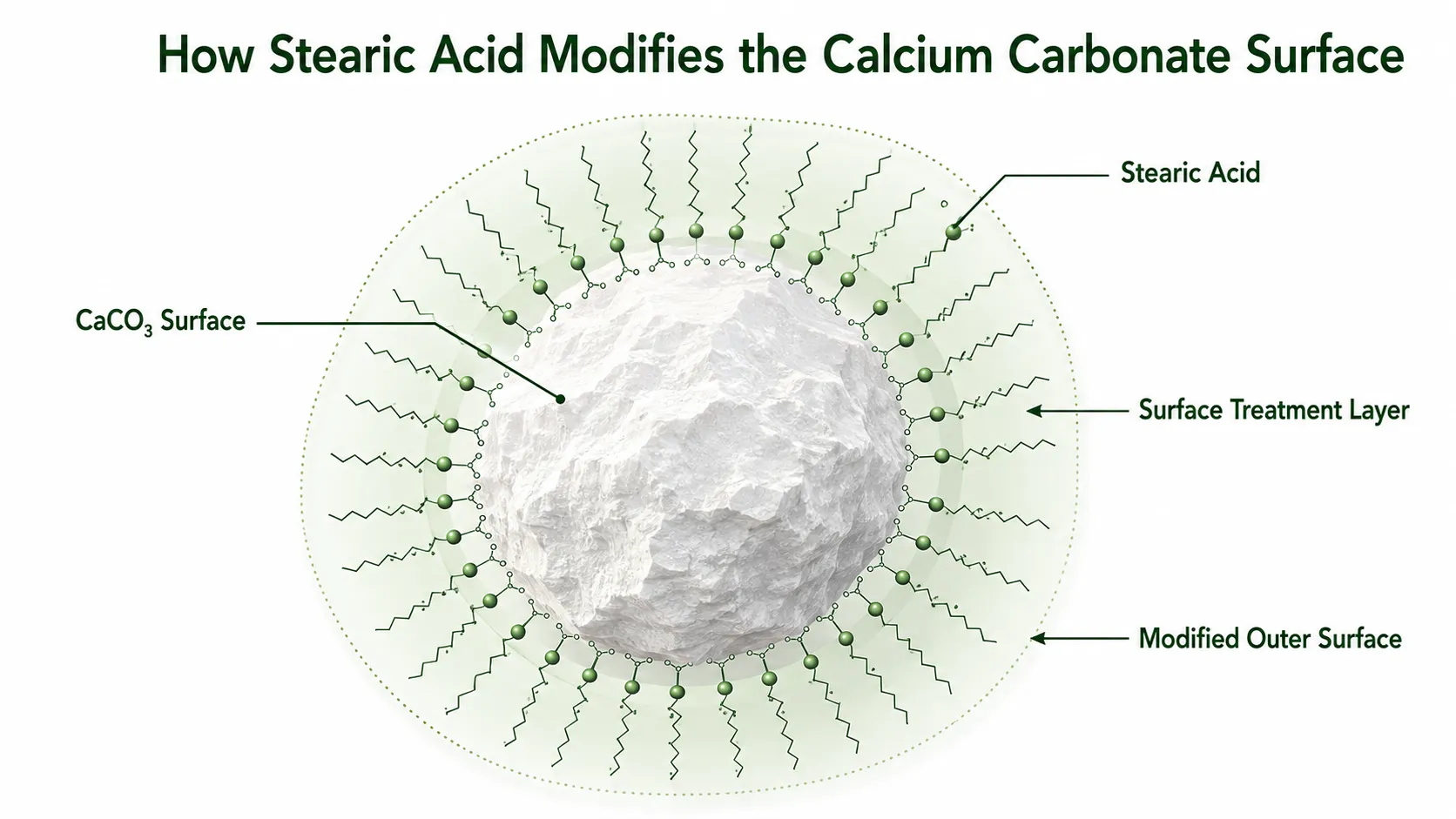
In many industrial ground calcium carbonate grades, fatty acids such as stearic acid are used to modify the outer surface of calcium carbonate particles. This treatment changes the interface between the mineral filler and the surrounding formulation.
The calcium carbonate core remains mineral CaCO₃. What changes is the chemistry and behavior of the outer particle surface, which is the region that directly contacts polymers, resins and other formulation components.
Surface treatment should not be confused with particle size reduction. A calcium carbonate powder can have different particle sizes regardless of whether it is coated or uncoated. Surface condition and particle size are separate technical characteristics and both must be evaluated during grade selection.
Research published by the American Chemical Society has examined how fatty acids interact with calcite surfaces and how an organic layer can form on the mineral surface.
“Optimal coating of calcite with stearic acid gave a monolayer of calcium stearate bicarbonate.”Osman M.A. and Suter U.W., Surface Treatment of Calcite with Fatty Acids: Structure and Properties of the Organic Monolayer, Chemistry of Materials, American Chemical Society. View scientific source
The study identified an organized fatty acid layer on suitably treated calcite. This supports the understanding that coating represents a genuine modification of the mineral surface rather than simply the addition of another ingredient to calcium carbonate powder.
Other experimental studies have also used methods such as FTIR and TGA to investigate stearic acid treated calcium carbonate. These analytical methods can provide evidence about the presence and behavior of organic material associated with the treated particle surface.
The practical purpose of this treatment is to change how the mineral particle interacts with its surrounding formulation. This is especially relevant in many polymer systems where the natural mineral surface may not provide the desired interaction with the organic matrix.
Explore Product Grades Coated Calcium Carbonate Grades Explore surface treated ground calcium carbonate grades available for industrial applications from Arosha Powder.Now that both materials are clearly defined, the next step is to understand exactly what surface treatment changes and why those changes can influence surface energy, wettability and dispersion.
What Actually Happens When Calcium Carbonate Is Coated?
The most important effect of calcium carbonate coating occurs at the interface between the mineral particle and the material surrounding it.
Untreated calcite has a naturally polar mineral surface. When calcium carbonate is treated with an appropriate fatty acid such as stearic acid, the chemistry of that outer surface changes. The treatment can reduce surface energy and alter the way the particle interacts with water, polymers and neighboring filler particles.
Surface treatment should therefore be understood as a process that modifies the interface between the calcium carbonate particle and its surrounding material.
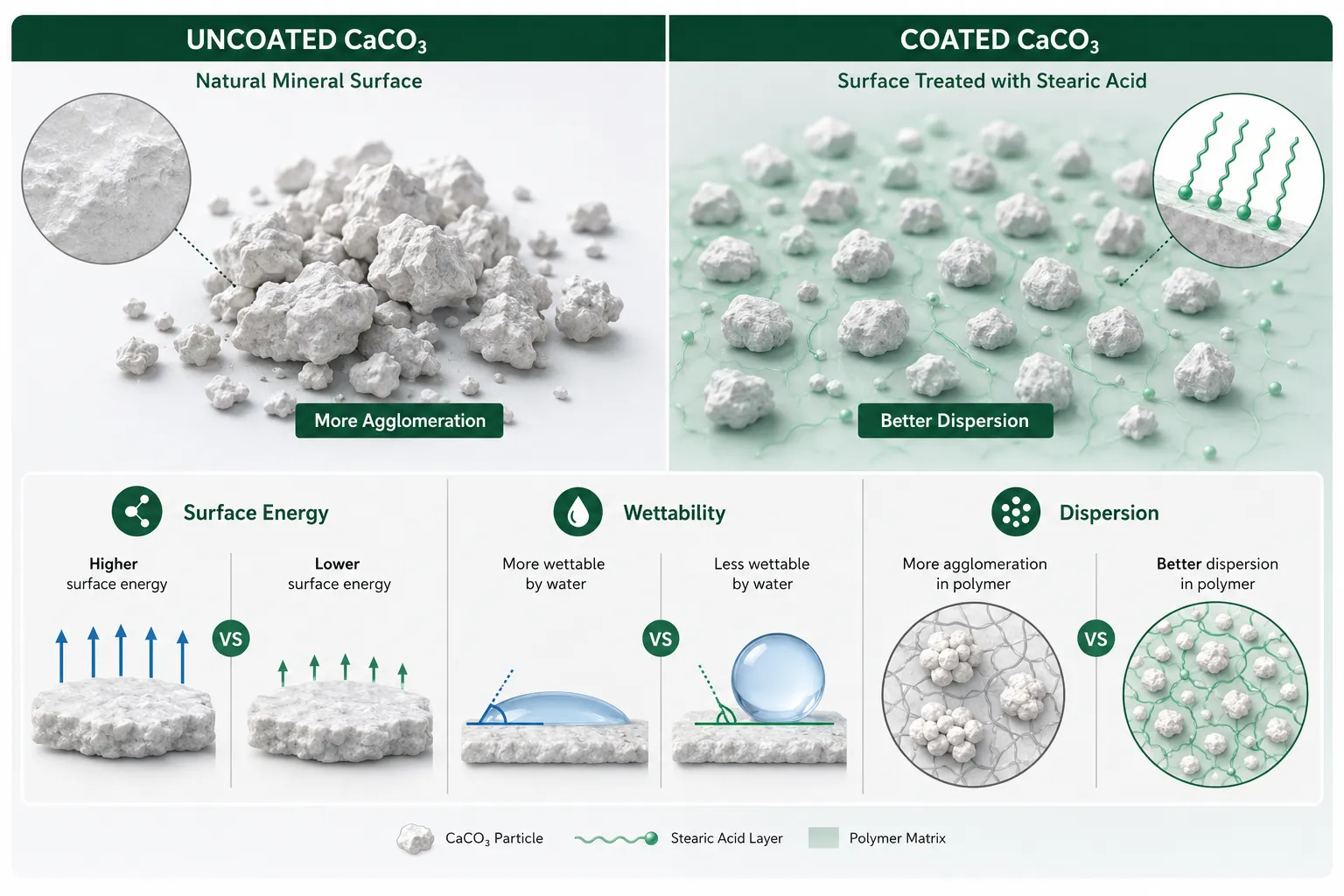
Surface Energy Changes
The treated surface can have lower surface energy than untreated calcium carbonate. This changes the way the mineral interacts with surrounding organic materials.
Wettability Changes
The natural mineral surface is more readily wetted by polar liquids. Suitable fatty acid treatment can make the surface more hydrophobic and less easily wetted by water.
Dispersion Can Change
In an appropriate polymer system, modification of the filler surface can change particle interaction and help calcium carbonate distribute more effectively through the matrix.
Why Does Surface Energy Matter?
Every solid surface has characteristic surface properties. In a filled formulation, the difference between the surface characteristics of the mineral and the surrounding matrix can influence how effectively the two materials interact.
Calcium carbonate has a polar inorganic surface, while many commonly used polymers have a more nonpolar character. This difference can make interaction between untreated mineral particles and the polymer matrix less favorable.
Surface treatment with fatty acids is one method used to change this interface. Instead of presenting the original calcite surface directly to the polymer, the treatment creates an organic modified outer surface with different surface characteristics.
“Calcium carbonate fillers are usually coated with stearic acid to reduce their surface energy and improve their dispersion in polymers.”Osman M.A. and Atallah A., Influence of Excessive Filler Coating on the Tensile Properties of LDPE Calcium Carbonate Composites, Polymer, 2004. View scientific source
Important technical distinction: Lower surface energy does not mean that every coated calcium carbonate grade will automatically disperse well in every polymer. Dispersion still depends on particle size distribution, coating quality, filler loading, polymer chemistry, mixing conditions and processing equipment.
How Does Coating Change Wettability?
Wettability describes how readily a liquid spreads across or interacts with a solid surface.
Untreated calcium carbonate has a comparatively hydrophilic mineral surface. After suitable stearic acid treatment, the outer surface can become more hydrophobic and less favorable to interaction with water.
Experimental research using contact angle measurements has shown that stearic acid treatment can increase the contact angle of calcium carbonate surfaces. In practical terms, this indicates reduced water wettability after suitable surface treatment.
This change helps explain why coated and uncoated calcium carbonate can behave differently even when their mineral composition and nominal particle size appear similar.
How Does Coating Affect Calcium Carbonate Dispersion?
Dispersion refers to how effectively calcium carbonate particles become distributed throughout a formulation.
Poor dispersion can create agglomerates or regions where filler particles are distributed unevenly. In polymer processing, this may influence processing stability, surface quality and the consistency of the finished compound.
Stearic acid treatment can improve dispersion in suitable polymer systems because the modified surface interacts differently with both the polymer matrix and neighboring calcium carbonate particles.
Scientific studies involving surface modified calcium carbonate and polypropylene have reported improved particle dispersion after suitable surface treatment compared with untreated calcium carbonate.
Coating is not a substitute for correct particle size. A surface treated powder with an unsuitable particle size distribution can still perform poorly. Surface condition and particle size must therefore be evaluated together.
If you need to compare mesh, micron, D50, D97 and particle size distribution before selecting a coated or uncoated grade, read our Calcium Carbonate Particle Size: Mesh, Micron, D50 & D97 Explained .
Coated vs. Uncoated Calcium Carbonate: Technical Comparison
| Technical Factor | Uncoated Calcium Carbonate | Coated Calcium Carbonate | Why It Matters |
|---|---|---|---|
| Particle Surface | Natural calcite surface remains exposed | Surface is intentionally modified | Influences direct interaction with the surrounding formulation |
| Surface Energy | Natural mineral surface characteristics remain present | Surface energy can be reduced through suitable fatty acid treatment | Important for interaction between filler and organic matrices |
| Water Wettability | Generally more readily wetted by water | Water wettability can decrease after hydrophobic treatment | Relevant when selecting material for aqueous or moisture sensitive systems |
| Polymer Compatibility | Depends strongly on polymer chemistry and additives | Can provide more suitable surface characteristics for many hydrophobic polymer systems | May influence filler distribution and processing behavior |
| Dispersion | Depends on formulation, particle size and dispersant system | Suitable surface treatment can improve dispersion in certain polymer matrices | Uniform filler distribution is important during compounding |
| Moisture Interaction | Natural mineral surface remains exposed | Suitable surface treatment can reduce interaction with water | Can be important in moisture sensitive formulations |
| Particle Size | Remains a critical parameter | Remains a critical parameter | Surface treatment cannot compensate for an unsuitable particle size distribution |
| Selection Method | Must be evaluated according to the complete formulation | Must be evaluated according to the complete formulation | Neither surface condition is universally superior |
This technical comparison is intended to support preliminary material selection. Actual performance depends on the calcium carbonate grade, treatment level, particle size distribution, matrix chemistry, filler loading and processing conditions.
These differences explain why industrial buyers should not compare coated and uncoated calcium carbonate only by price, mesh designation or calcium carbonate purity. The next step is to examine how these technical differences influence real industrial applications such as PVC, filler masterbatch, paint, rubber and adhesive formulations.
How Do Coated and Uncoated Calcium Carbonate Differ by Application?
Surface treatment becomes most useful when it is connected to a specific formulation. The same calcium carbonate grade can behave very differently in a polymer compound, a water based coating, a rubber formulation or a mineral construction product.
For this reason, application should be used as the starting point for technical evaluation rather than as a rigid rule that automatically determines whether coated or uncoated calcium carbonate must be used.
Selection principle: The application tells us what properties matter. The formulation then determines whether surface treatment, particle size distribution, purity, moisture and other technical parameters are suitable.
For a broader explanation of how calcium carbonate is used across different industries, visit our Industrial Applications of Calcium Carbonate Powder guide.
Coated or Uncoated Calcium Carbonate for PVC?
PVC is one of the most important examples of why calcium carbonate should not be selected only by mesh designation.
Surface treated calcium carbonate is commonly evaluated in both rigid and flexible PVC formulations because the modified surface can provide more suitable interaction with the organic polymer phase.
Commercial mineral producers also supply surface treated calcium carbonate grades specifically for rigid PVC and flexible PVC applications. However, this does not mean that every PVC formulation requires the same coating level, particle size or filler loading.
The correct calcium carbonate grade must still be evaluated according to resin type, additives, processing temperature, filler concentration, particle size distribution, moisture and the required properties of the finished PVC product.
Common starting point for evaluation: Coated calcium carbonateCoated Calcium Carbonate for Filler Masterbatch
Filler masterbatch production places strong emphasis on how efficiently calcium carbonate is distributed through a polymer carrier.
Polypropylene and polyethylene are common carrier resins in calcium carbonate masterbatch production. Because these polymers have a relatively nonpolar character, surface treatment of calcium carbonate is frequently considered when formulators want to improve interaction between the mineral filler and the surrounding polymer phase.
Particle size remains equally important. A coated calcium carbonate powder with an unsuitable coarse fraction or inconsistent particle size distribution can still produce poor processing or finished product results.
“Calcium carbonate is the ideal mineral filler for many polymer concentrates.”Omya, Masterbatch and Compounding View industry source
Calcium Carbonate for Polypropylene and Polyethylene
Polypropylene and polyethylene formulations are another important area where the surface condition of calcium carbonate can influence performance.
Suitable surface treatment can reduce unfavorable interaction between calcium carbonate particles and improve their distribution through a polymer matrix. This is particularly relevant when high filler loading or consistent dispersion is required.
The final decision should still be based on compound testing because changes in resin grade, additives, filler loading and processing conditions can change the optimum calcium carbonate specification.
Common starting point for evaluation: Often coated calcium carbonateCoated or Uncoated Calcium Carbonate for Paints and Coatings?
Paint and coating formulations require a different selection approach because many systems rely on liquid media, dispersants and binder chemistries that behave very differently from polymer melts.
Uncoated ground calcium carbonate is commonly evaluated in many water based paint and coating systems because the natural mineral surface can be compatible with aqueous dispersion strategies.
Important selection parameters may include particle size distribution, brightness, whiteness, oil absorption, mineral purity and interaction with the binder and dispersant package.
Surface treated grades can still be useful in specialized coating systems. This is why the terms paint or coating alone are not sufficient to determine the correct calcium carbonate surface condition.
Common starting point for many water based systems: Uncoated calcium carbonateCalcium Carbonate for Adhesives and Sealants
Adhesives and sealants are highly formulation dependent applications. Both coated and uncoated calcium carbonate can be used depending on binder chemistry, rheology requirements, moisture sensitivity and processing conditions.
Surface treated ground calcium carbonate is commercially used in some adhesive and sealant systems where controlled moisture interaction and compatibility with an organic binder are important.
Imerys, for example, offers fatty acid treated ground calcium carbonate grades within its ImerSeal range for adhesive and sealant applications.
Common starting point for evaluation: Formulation dependentWhat About Rubber, Paper and Construction Materials?
Rubber Compounds
Both coated and uncoated calcium carbonate can be evaluated in rubber compounds. Selection depends on elastomer chemistry, filler loading, processing behavior and the required properties of the finished product.
Starting point: Compare according to formulationPaper and Paperboard
Calcium carbonate selection in paper applications is often strongly influenced by brightness, particle size, optical performance and processing requirements. Uncoated mineral grades are commonly evaluated, although the exact specification depends on the paper process and product.
Starting point: Often uncoated calcium carbonatePutty and Dry Mortar
Mineral based construction formulations often begin with uncoated calcium carbonate because compatibility with mineral binders and the required particle size distribution can be more important than creating a hydrophobic particle surface.
Starting point: Commonly uncoated calcium carbonateSpecialized Formulations
Some industrial formulations do not fit a simple coated or uncoated rule. Binder chemistry, moisture sensitivity, processing method and required performance may justify testing both surface conditions.
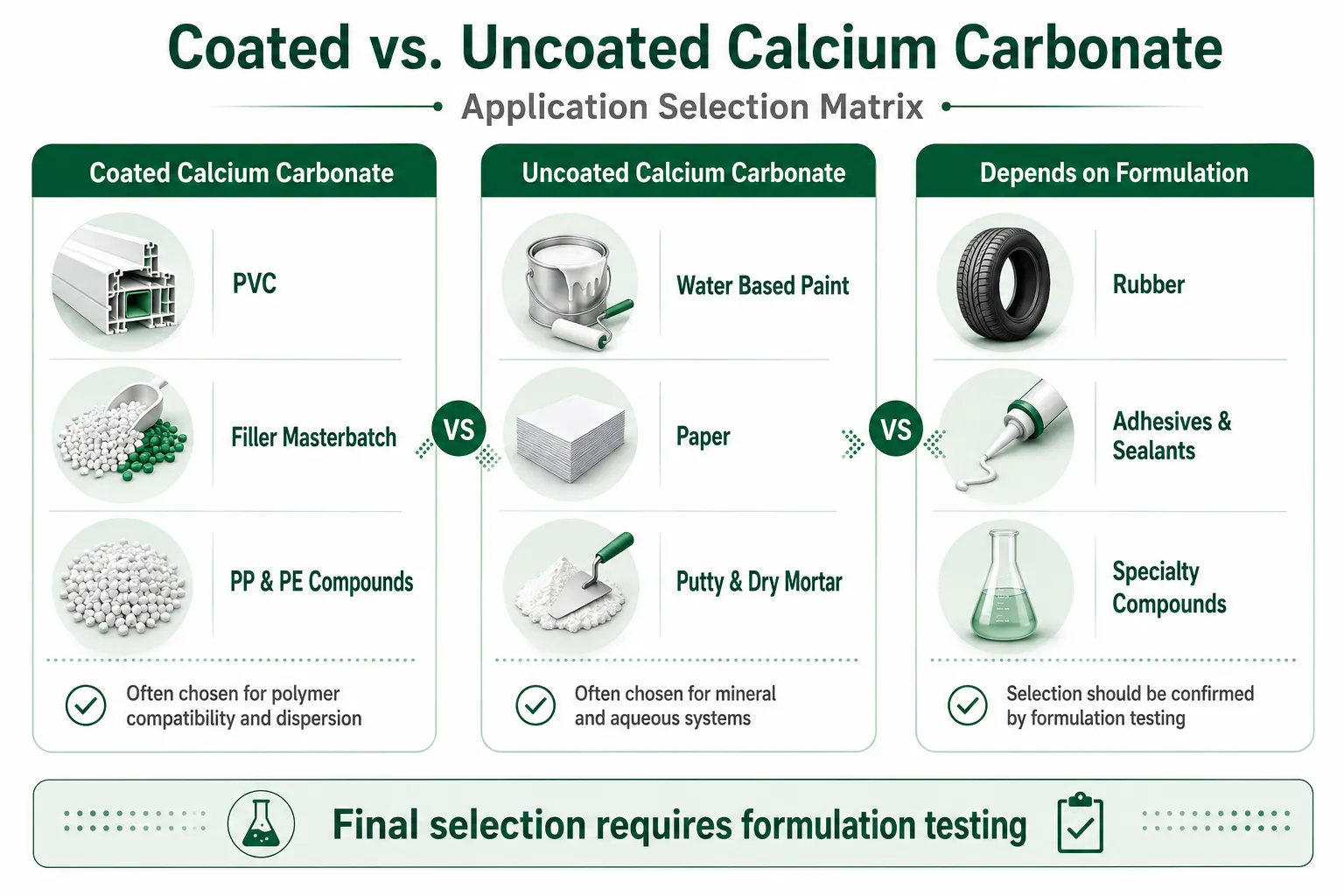
Starting point: Application testing requiredApplication Selection Matrix
| Application | Common Starting Point | Main Selection Reason | Important Parameters to Verify |
|---|---|---|---|
| PVC | Often coated | Interaction with polymer phase and processing requirements | Particle size distribution, coating condition, moisture, filler loading |
| Filler Masterbatch | Often coated | Dispersion through polymer carrier | D50, D97, coating consistency, moisture, loading level |
| Polypropylene and Polyethylene | Often coated | Mineral interaction with relatively nonpolar polymers | Dispersion, particle size, loading, compound performance |
| Water Based Paint | Often uncoated | Compatibility with aqueous dispersion systems | Brightness, oil absorption, particle size, binder interaction |
| Adhesives and Sealants | Depends on formulation | Binder chemistry, moisture and rheology requirements | Surface condition, moisture, particle size, rheology |
| Rubber | Either may be evaluated | Compound chemistry and required filler behavior | Dispersion, loading, viscosity, finished properties |
| Paper and Paperboard | Often uncoated | Optical and particle properties | Brightness, particle size, purity, processing behavior |
| Putty and Dry Mortar | Commonly uncoated | Mineral binder compatibility | Particle size, purity, moisture, consistency |
The recommendations above are intended as technical starting points rather than fixed formulation rules. Final material selection should be confirmed through testing under the actual processing and formulation conditions.
Important: An application name cannot identify the correct calcium carbonate grade by itself. Two PVC factories, two paint producers or two masterbatch manufacturers may require different particle sizes, coating conditions and quality parameters even when they produce products in the same industry.
The practical question is therefore no longer simply where coated or uncoated calcium carbonate is used. The next step is learning how to choose between them using actual formulation requirements, technical data and quality control information.
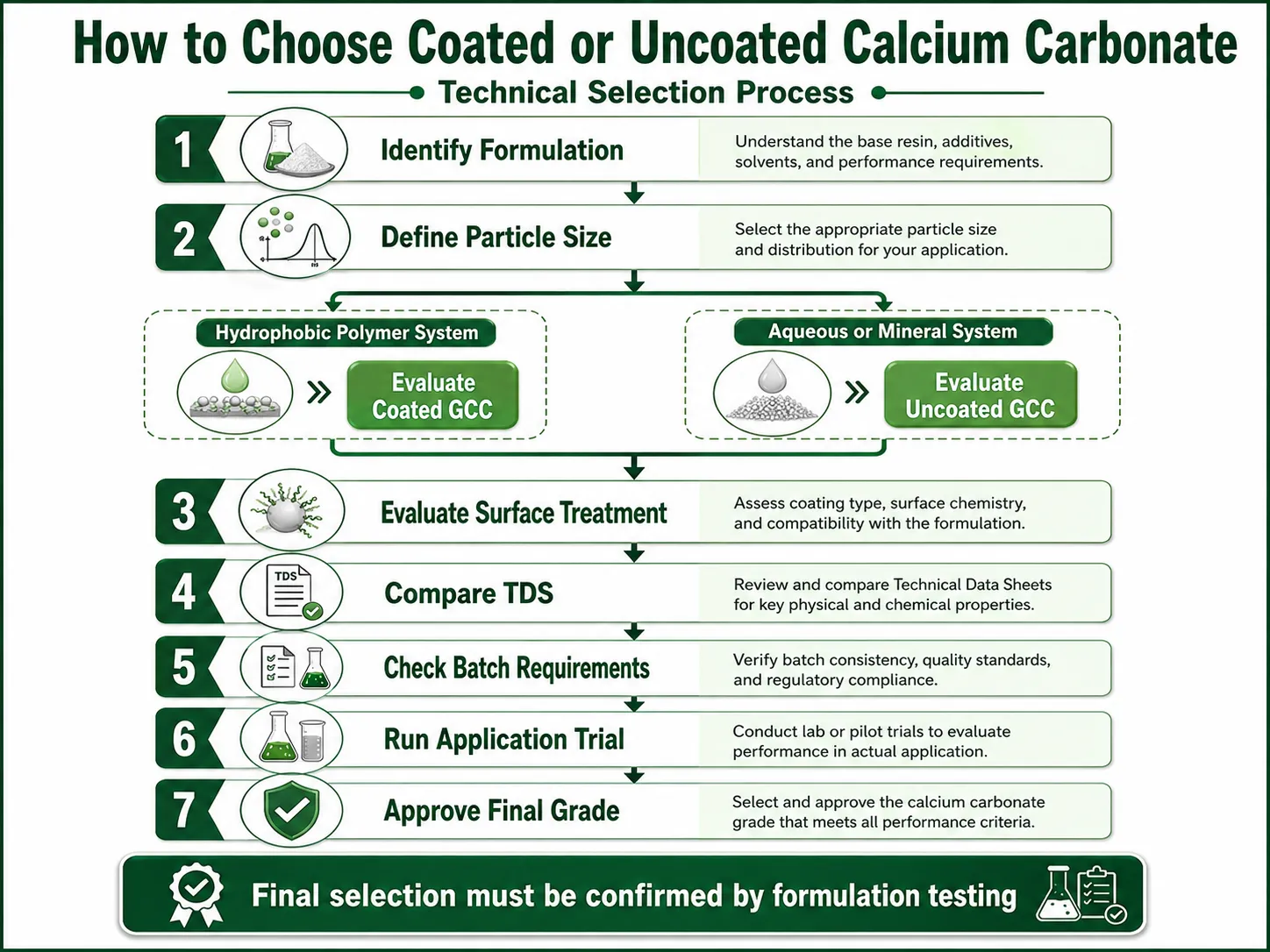
How to Choose Between Coated and Uncoated Calcium Carbonate
The safest way to select calcium carbonate is to begin with the formulation and work backward toward the required mineral specification.
Starting with a product name such as 800 mesh coated calcium carbonate may be convenient for purchasing, but it does not provide enough information to determine whether that grade is technically suitable for a specific production process.
A better selection process evaluates the matrix, particle size distribution, surface condition, quality parameters, technical documentation and actual formulation performance together.
Define the Formulation Matrix
Begin by identifying the material that will surround the calcium carbonate particles. This may be PVC, polypropylene, polyethylene, rubber, an aqueous paint binder, an adhesive resin or a mineral construction system.
Define the Required Particle Size Distribution
Determine the required fineness using meaningful particle size data whenever possible. Commercial mesh designation can be useful for identification, but D50, D97 and the complete particle size distribution provide a stronger basis for technical comparison.
Evaluate Whether Surface Treatment Is Necessary
Consider whether modifying the natural mineral surface provides a practical advantage in the formulation. In many hydrophobic polymer systems, coated calcium carbonate can be an appropriate starting point. In many aqueous or mineral systems, uncoated calcium carbonate may be more suitable.
Compare the Complete Technical Specification
Do not stop after confirming particle size and coating status. Calcium carbonate purity, moisture, brightness, whiteness, bulk density, oil absorption and other application specific parameters may also influence processing and finished product performance.
Review the Technical Data Sheet
The Technical Data Sheet provides a structured description of the product grade and its declared technical characteristics. It should be used to compare candidate grades before laboratory or production qualification.
Determine Which Batch Data Must Be Verified
For continuous industrial supply, buyers may also need batch specific analytical results. A Certificate of Analysis can provide relevant test results for a specific production batch according to the agreed quality control process.
Test the Material in the Actual Formulation
Technical documentation helps identify suitable candidates, but final qualification should include testing in the real formulation. Laboratory evaluation can be followed by production scale testing when filler behavior has a significant effect on processing or final product properties.
Why Application Testing Still Matters
Surface treatment can improve filler behavior in suitable polymer systems, but laboratory and production conditions determine whether that theoretical advantage becomes useful in practice.
Resin chemistry, filler concentration, mixing energy, processing temperature, additives and particle size distribution can all influence the result.
“This will lead to a better dispersion of the particles in the host matrix.”Zuiderduin W.C.J. and coauthors, Toughening of Polypropylene with Calcium Carbonate Particles, Polymer, 2003. View scientific source
Treat coated or uncoated as one specification parameter rather than as the final purchasing decision. The strongest qualification combines surface condition with particle size, chemical properties, physical properties and actual formulation performance.
What Should Buyers Check on a Technical Data Sheet?
A Technical Data Sheet should help the buyer determine whether a calcium carbonate grade is a realistic candidate for further evaluation.
The exact parameters required depend on the application, but industrial buyers commonly need to review several properties together rather than selecting material from one value.
Buyers comparing available grades can review the calcium carbonate Technical Data Sheets published by Arosha Powder before selecting a product for further evaluation.
TDS vs. COA: What Is the Difference?
A Technical Data Sheet and a Certificate of Analysis serve different purposes and should not be treated as interchangeable documents.
| Document | Main Purpose | Typical Use | Buyer Question |
|---|---|---|---|
| Technical Data Sheet | Describes the declared technical characteristics of a product grade | Grade comparison and preliminary technical selection | Is this grade technically suitable for evaluation? |
| Certificate of Analysis | Reports relevant analytical results associated with a specific production batch | Batch verification and quality documentation | Does this production batch meet the agreed requirements? |
Not every technical parameter must appear on every Certificate of Analysis. The appropriate acceptance criteria should be determined according to the product, formulation and commercial agreement between the buyer and supplier.
Important purchasing principle: Never assume that two calcium carbonate grades are technically equivalent because they share the same mesh designation and coating status. The complete specification and actual production performance must be compared.
Do Not Select Calcium Carbonate by Price per Ton Alone
Purchase price is important, but it is only one part of the economic result.
A lower priced calcium carbonate that causes inconsistent dispersion, unstable feeding, formulation adjustments, reduced production output or higher reject rates may create a greater total manufacturing cost than a technically better matched grade.
Industrial buyers should therefore evaluate calcium carbonate according to both technical suitability and total process performance.
Once these factors are considered together, the selection process becomes much more reliable. The next step is to identify the most common mistakes buyers make when comparing coated and uncoated calcium carbonate and how those mistakes can be avoided.
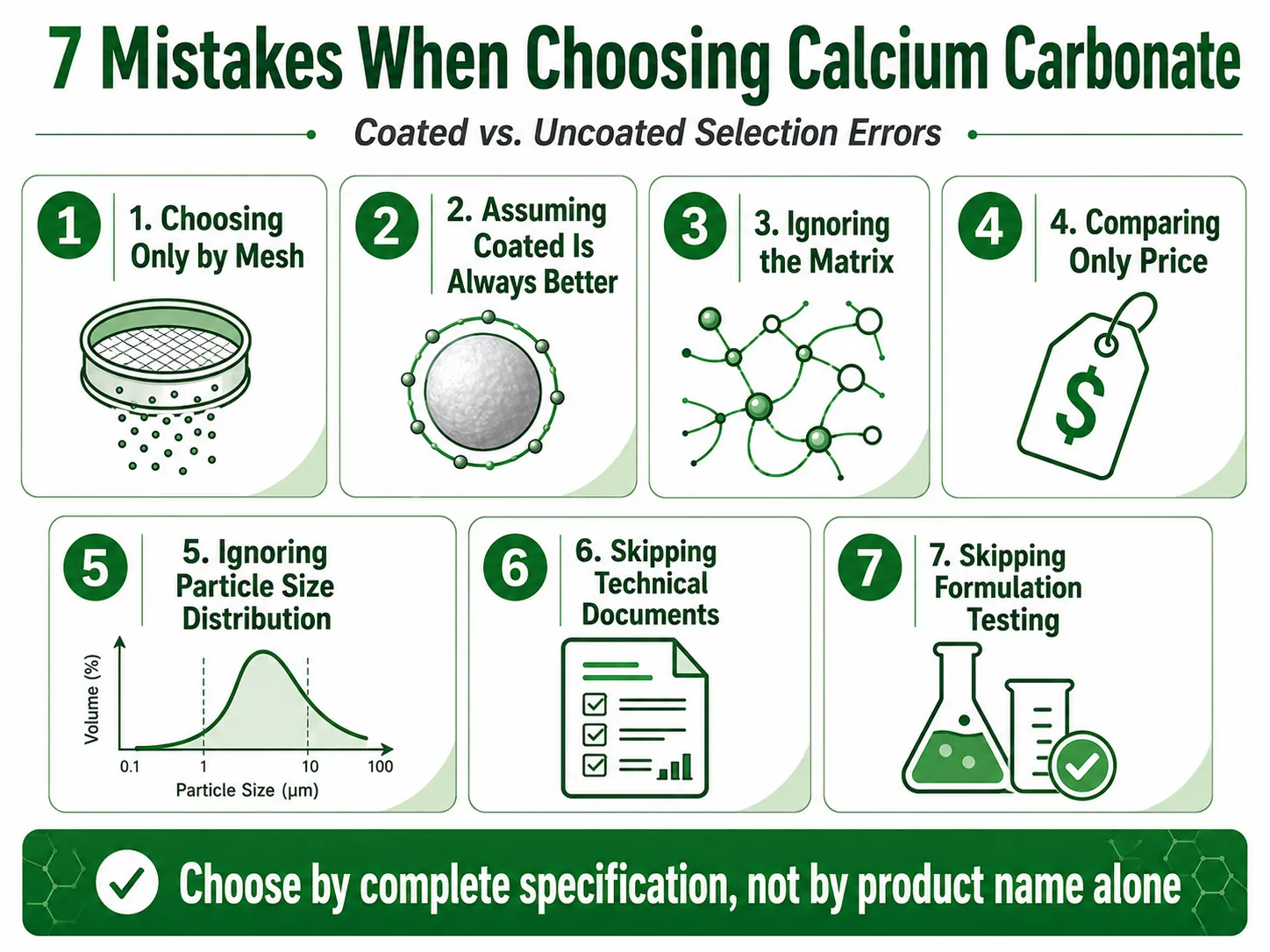
Seven Common Mistakes When Choosing Coated or Uncoated Calcium Carbonate
Many purchasing problems begin before the calcium carbonate reaches the production line. The material may be ordered according to an incomplete specification, an unsuitable comparison method or an assumption that does not reflect the actual formulation.
Avoiding the following mistakes can make technical qualification more reliable.
Choosing Only by Mesh
Mesh is useful as a commercial reference, but it does not describe the complete particle size distribution. Two products with the same mesh designation can have different D50, D97 and coarse particle content.
Assuming Coated Always Means Better
Surface treatment is intended to change particle behavior for specific formulation needs. A coated grade is not automatically superior in every application, especially when the natural mineral surface is more suitable for the surrounding system.
Ignoring the Polymer or Binder
The surrounding matrix strongly influences whether surface treatment is useful. PVC, polypropylene, water based paint and mineral construction systems should not be evaluated using the same selection logic.
Comparing Suppliers Only by Price
A lower purchase price does not guarantee a lower production cost. Differences in particle size, moisture, dispersion, consistency and processing behavior can influence the real economic result.
Treating Coating as a Substitute for Particle Size Control
Surface treatment and particle size solve different technical problems. A coated powder with unsuitable particle size distribution can still perform poorly in the final formulation.
Accepting a Product Label Without Technical Documentation
Terms such as coated, uncoated, fine or high purity should be supported by relevant technical documentation. Buyers should review the product specification rather than relying only on the commercial name.
Skipping the Formulation Trial
Laboratory data helps identify suitable candidates, but the actual formulation remains the final test. Processing conditions, filler concentration, additives and equipment can change the result.
Buyer rule: A useful calcium carbonate specification describes more than the commercial product name. Particle size data, surface condition, chemical properties, physical properties and agreed quality requirements should be evaluated together.
Why the Word Coated Is Not Enough
Industrial product descriptions provide a useful example of how surface condition is only one part of a calcium carbonate specification.
A commercial surface treated grade may also be defined by fineness, raw material quality, dispersion characteristics, end use and technical documentation.
“Surface treated, very fine calcium carbonate powder with good dispersion properties.”Omya, Omyacarb 1 T AV product description. View official product source
This is an important distinction for buyers. Surface treatment should be considered together with particle size, dispersion characteristics and the intended application rather than treated as a complete product specification by itself.
More coating is not automatically better. Research on calcium carbonate filled polymer composites has shown that excessive filler coating does not create unlimited improvement in mechanical performance. The appropriate surface treatment depends on the filler, polymer and formulation conditions. View scientific study
How Should Industrial Buyers Evaluate a Calcium Carbonate Supplier?
Product selection is only one part of industrial sourcing. Repeat supply also depends on whether the manufacturer can control important stages of production and provide the technical and commercial information required by the buyer.
Raw Material Control
Buyers should understand where the mineral originates and whether raw material characteristics are evaluated before processing.
Grinding and Classification Control
Consistent particle size requires controlled grinding and classification rather than relying only on a commercial mesh name.
Surface Treatment Control
For coated grades, the manufacturer should be able to identify the product as surface treated and maintain a consistent production process for the selected grade.
Technical Documentation
Product data should be available in a format that allows buyers to compare relevant specifications and define the parameters that matter for their application.
Batch Quality Verification
Buyers purchasing repeatedly should determine which technical parameters require batch verification and what documentation will accompany commercial supply.
Packaging and Export Capability
International buyers should also evaluate packaging, shipment preparation, documentation, destination requirements and communication throughout the supply process.
Why Direct Manufacturing Control Matters
For industrial buyers, access to the production source can make technical communication more practical. Questions about particle size, surface condition, packaging and repeat orders can be discussed closer to the manufacturing process instead of passing through multiple trading layers.
Arosha Powder operates as a calcium carbonate manufacturer with direct access to limestone resources and production operations . This structure allows technical product discussions to be connected more directly with mineral processing, product preparation and industrial supply requirements.
After the product and supplier have both passed preliminary evaluation, the final purchasing decision should be based on the complete technical requirement, application testing and the ability to maintain suitable quality across repeat orders.
A final checklist can make this process easier. Before requesting a quotation or approving a grade, buyers should confirm exactly what information they need from the supplier.
Final Buyer Checklist Before Ordering Calcium Carbonate
By this stage, the difference between coated and uncoated calcium carbonate should be viewed as part of a complete technical specification rather than as a simple product label.
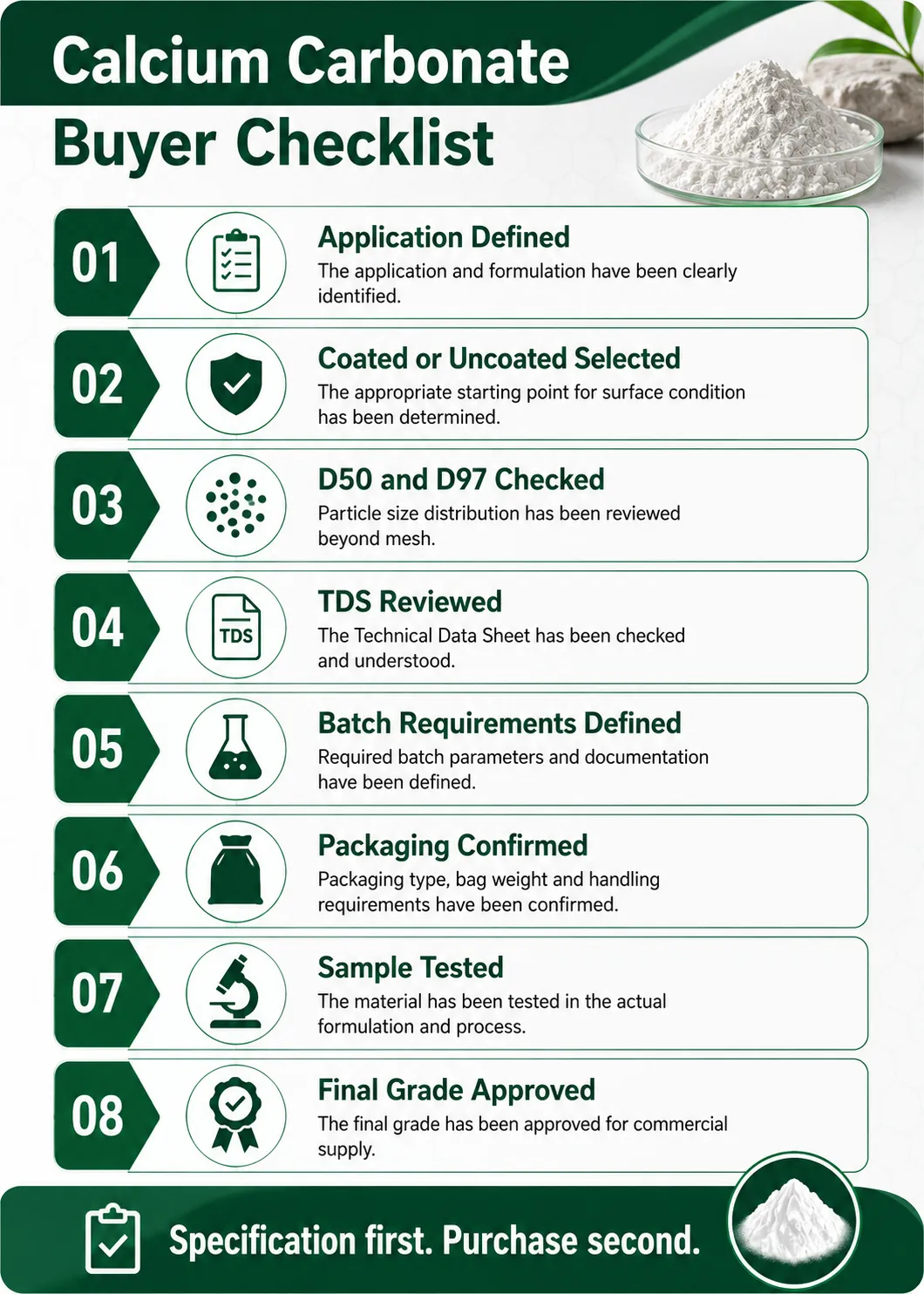
Before approving a grade or requesting a commercial order, industrial buyers should confirm the following points.
The objective is not simply to buy calcium carbonate. The objective is to qualify a calcium carbonate grade that can perform consistently in the intended formulation and production process.
The supplier should understand whether the product will be used in PVC, masterbatch, polypropylene, polyethylene, paint, rubber, adhesive, paper, construction material or another formulation.
The buyer should know whether coated calcium carbonate, uncoated calcium carbonate or a comparison between both options is the appropriate starting point for evaluation.
Where the application requires tighter control, particle size information such as D50, D97 and the broader particle size distribution should be reviewed rather than relying only on mesh designation.
Calcium carbonate content and other relevant chemical characteristics should be compared according to the needs of the intended formulation.
Moisture, brightness, whiteness, bulk density, oil absorption and other application specific parameters should be considered where they can affect processing or final product performance.
The selected grade should have technical documentation that allows the buyer to understand its declared properties and compare it with other suitable candidates.
The buyer should determine which parameters require verification for commercial shipments and whether batch specific analytical documentation will be requested.
Bag size, bulk packaging, pallet requirements and handling conditions should be confirmed before commercial supply.
The candidate material should be tested under conditions that represent the real formulation and production process before final technical approval.
Commercial qualification should consider not only the first sample but also the ability to maintain appropriate characteristics across repeat orders.
Questions to Ask a Calcium Carbonate Supplier Before Ordering
A technical purchasing conversation should go beyond asking for price and mesh size. The following questions can help buyers obtain the information needed for a more meaningful comparison.
Confirm the actual surface condition rather than assuming it from the product name.
When relevant to the application, ask how the surface treated product is defined and documented.
These values can provide more useful information than mesh alone when particle size distribution affects the process.
Measurement method matters when technical values from different suppliers are being compared.
This helps the buyer understand which properties form part of the regular quality control process.
Technical documentation should be reviewed before deciding which grade should enter application testing.
For repeat industrial purchasing, determine what quality documentation can be associated with production batches.
Packaging should match storage, handling, transportation and production requirements.
Sample qualification can reduce the risk of approving a material that does not perform correctly in the formulation.
Repeatability matters when the calcium carbonate becomes part of an established industrial formulation.
What Does Proper Surface Treatment Look Like in Industrial Practice?
Industrial mineral products provide useful examples of how surface treatment is connected to a specific performance objective rather than being applied only as a marketing label.
For example, Omya describes one of its surface treated calcium carbonate products by connecting fatty acid coating directly with dispersibility in an organic medium.
“The particles are homogeneously coated with fatty acids to ensure good dispersibility in organic media.”Omya, Viscoexcel 30 SG product description. View official product source
This example illustrates an important purchasing principle. The useful question is not simply whether calcium carbonate is coated. The buyer should understand what the surface treatment is intended to achieve in the relevant formulation.
A Simple Final Decision Framework
Start with the formulation, not the product name
If the formulation involves a hydrophobic polymer and filler dispersion is an important requirement, a suitable coated calcium carbonate grade may be an appropriate candidate for testing.
If the formulation is primarily aqueous or mineral based, an uncoated grade may provide a more appropriate starting point.
When the formulation is complex or the correct surface condition is uncertain, compare suitable candidates and confirm the final choice through application testing.
Final purchasing principle: Select calcium carbonate using the complete technical requirement. Surface condition, particle size distribution, chemical properties, physical properties, quality documentation, packaging and actual formulation performance should support the final decision together.
Where Should Buyers Go Next?
Once the technical requirements have been defined, buyers can move from general comparison toward product evaluation and commercial discussion.
International buyers who have already defined their required grade, particle size, surface condition and packaging can also review calcium carbonate export and international supply information before beginning a commercial inquiry.
The final part of this guide answers the most common technical questions buyers and formulators ask about coated and uncoated calcium carbonate.
Frequently Asked Questions About Coated and Uncoated Calcium Carbonate
Is coated calcium carbonate hydrophobic?
Suitable fatty acid treatment can make the calcium carbonate surface considerably more hydrophobic than untreated calcite. The actual surface behavior depends on the treatment chemistry, treatment level and manufacturing process, so the term coated should not be treated as a precise measurement of hydrophobicity by itself.
What is commonly used to coat calcium carbonate?
Stearic acid is one of the most widely studied and commercially used fatty acids for calcium carbonate surface treatment. Other treatment systems may also be used depending on the formulation and intended performance.
Is coated calcium carbonate better for PVC?
Coated calcium carbonate is commonly evaluated for rigid and flexible PVC because surface modification can provide more suitable interaction with the polymer phase. However, the optimum calcium carbonate grade also depends on particle size distribution, filler concentration, additives, moisture and processing conditions.
Can uncoated calcium carbonate be used in plastics?
Yes. Uncoated calcium carbonate can be used in plastic formulations when its properties are suitable for the formulation and processing conditions. Surface treatment becomes useful when the modified surface provides a practical advantage in dispersion, compatibility or processing.
Does coating change the particle size of calcium carbonate?
Surface treatment and particle size are separate technical characteristics. Coating modifies the outer particle surface, while particle size distribution must still be controlled and measured independently. A coated calcium carbonate grade can therefore still have an unsuitable particle size distribution for a particular application.
Are two coated calcium carbonate grades with the same mesh equivalent?
No. Two products with the same commercial mesh designation can differ in D50, D97, coarse particle content, surface treatment, moisture, mineral purity and other properties. The complete specification should be reviewed before treating two grades as equivalent.
How can calcium carbonate surface treatment be evaluated?
Analytical methods such as FTIR and thermogravimetric analysis can provide information about organic material associated with a treated calcium carbonate surface. Wettability measurements and application testing can provide additional information about how the modified surface behaves.
Should I choose calcium carbonate by mesh or by application?
Begin with the application and formulation requirements. Then define particle size distribution, surface condition and the other chemical and physical properties that matter for the process. Mesh can be useful for product identification, but it should not replace a complete technical specification.
What documents should I request before buying calcium carbonate?
Buyers should normally review the relevant Technical Data Sheet before product qualification. Depending on the commercial agreement and quality requirements, batch specific analytical documentation may also be requested for commercial shipments.
Is more surface treatment always better?
No. The appropriate level of surface treatment depends on the filler, polymer and formulation. Scientific research on calcium carbonate filled polymer systems has shown that excessive coating does not produce unlimited improvement in material performance.
What Does Commercial Surface Treatment Aim to Achieve?
Commercial calcium carbonate products provide useful evidence that surface treatment is connected to measurable processing objectives rather than simply to the coated designation.
For example, Omya describes one surface treated calcium carbonate grade as having strong dispersion behavior in polyolefin systems.
“with excellent dispersion properties in polyolefins and low moisture content.”Omya, Omyafilm 725 SY product description. View official product source
The example reinforces the central principle of this guide. Coating should be connected to a technical purpose such as surface compatibility, dispersion or moisture behavior rather than treated as a quality label on its own.
Coated or Uncoated Calcium Carbonate: Final Conclusion
Neither option is universally better
Uncoated calcium carbonate retains the natural mineral surface and remains an important choice for many aqueous, mineral and industrial formulations.
Coated calcium carbonate intentionally modifies that surface, commonly through fatty acid treatment, so that the filler can interact differently with polymers and other organic matrices.
The correct decision depends on the complete formulation. Particle size distribution, surface condition, purity, moisture, optical properties, filler concentration, processing conditions and technical documentation should all be considered before a grade is approved.
For this reason, the most useful question is not simply whether coated or uncoated calcium carbonate is better. The more useful question is which calcium carbonate specification provides the required performance in the actual production process.
Continue Your Calcium Carbonate Research
This article focuses specifically on surface treatment and product selection. Related technical topics are covered separately so that each subject can be explored in greater depth.
Technical References
The technical discussion in this guide is supported by peer reviewed research and industrial product documentation relating to calcite surface treatment, calcium carbonate dispersion and polymer filler interaction.
Surface Properties of a Calcium Carbonate Filler Treated with Stearic Acid. European Polymer Journal, 1984. Scientific source
Surface Treatment of Calcite with Fatty Acids: Structure and Properties of the Organic Monolayer. Chemistry of Materials, 2002. Scientific source
Influence of Excessive Filler Coating on the Tensile Properties of LDPE Calcium Carbonate Composites. Polymer, 2004. Scientific source
Toughening of Polypropylene with Calcium Carbonate Particles. Polymer, 2003. Scientific source
On the Coating of Precipitated Calcium Carbonate with Stearic Acid in Aqueous Medium. Langmuir, 2010. Scientific source
Surface treated calcium carbonate product information and application examples used as industrial context within this guide. Industry source
Need to Select a Calcium Carbonate Grade?
Define your application, required particle size, surface condition, packaging and technical parameters before commercial ordering. Arosha Powder can provide product information for coated and uncoated calcium carbonate grades for industrial evaluation.
Technical Content and Review
This guide was prepared to provide industrial buyers and formulators with technically grounded information about coated and uncoated calcium carbonate, surface treatment and product selection.
Technical content focused on industrial calcium carbonate production, product specifications, particle size, surface treatment and international supply requirements.

Prof. Dr. Ali Ihsan Arol
Mining Engineering, Middle East Technical UniversityAcademic expertise in mining engineering, mineral processing and related mineral systems provides an independent technical perspective for the scientific review of mineral industry content.
View Official Academic ProfileHow useful was this post?
Click on a star to rate it!
Average rating 5 / 5. Vote count: 1
No votes so far! Be the first to rate this post.