
Calcium carbonate (CaCO3) is one of the most abundant naturally
occurring mineral compounds and an important raw material used across modern
industry. It occurs naturally in rocks and minerals such as limestone,
marble, and calcite and can be processed into calcium carbonate powder with
controlled properties for different applications.
In industrial use, calcium carbonate is much more than a simple mineral
filler. Its performance can be influenced by factors such as purity,
particle size distribution, morphology, brightness, moisture, and surface
treatment. These characteristics help determine how a particular calcium
carbonate grade performs in plastics, paints and coatings, paper, rubber,
construction materials, and other formulations.
What Is Calcium Carbonate?
Calcium carbonate is an inorganic compound with the chemical formula
CaCO3, composed of calcium, carbon, and oxygen. In nature, it is
widely associated with limestone and occurs in mineral forms including
calcite and aragonite. Because natural calcium carbonate deposits can be
mined, processed, ground, and classified into different particle sizes,
the material has become an important industrial mineral used worldwide.
“Limestone means any rock formed mostly of calcium carbonate.”
This distinction is important:
calcium carbonate is the chemical compound, while limestone is a
naturally occurring rock that consists predominantly of calcium carbonate.
The terms are therefore closely related, but they are not technically
interchangeable.
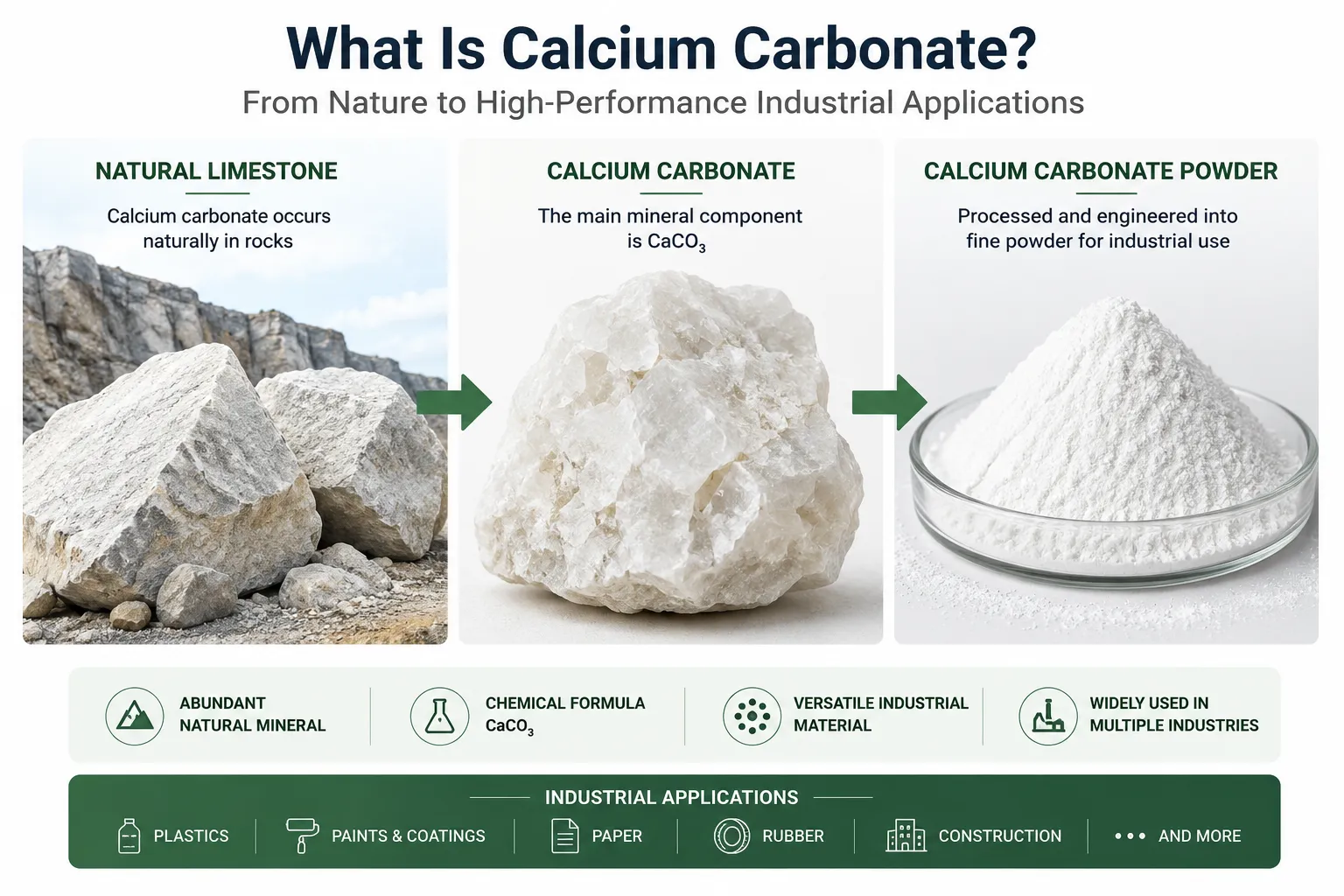
Calcium Carbonate at a Glance
Calcium carbonate is a naturally occurring inorganic compound with the chemical formula CaCO3. Although its basic chemistry is simple, calcium carbonate can occur in different mineral forms and can be processed into materials with different particle sizes, morphologies and surface properties. These differences are particularly important in industrial applications.
| Chemical Name | Calcium Carbonate |
|---|---|
| Chemical Formula | CaCO3 |
| Molar Mass | 100.086 g/mol |
| Common Appearance | White solid or fine white powder |
| Major Natural Sources | Limestone, marble and chalk |
| Important Mineral Forms | Calcite and aragonite |
| Main Industrial Forms | Ground Calcium Carbonate (GCC) and Precipitated Calcium Carbonate (PCC) |
| Surface Treatment | Available as uncoated or surface-treated grades depending on application requirements |
| Typical Industrial Uses | Plastics, PVC, masterbatch, paints and coatings, paper, rubber, adhesives, sealants and construction materials |
Basic chemical identification and molecular data can be verified through PubChem, National Library of Medicine .
Where Does Calcium Carbonate Occur Naturally?
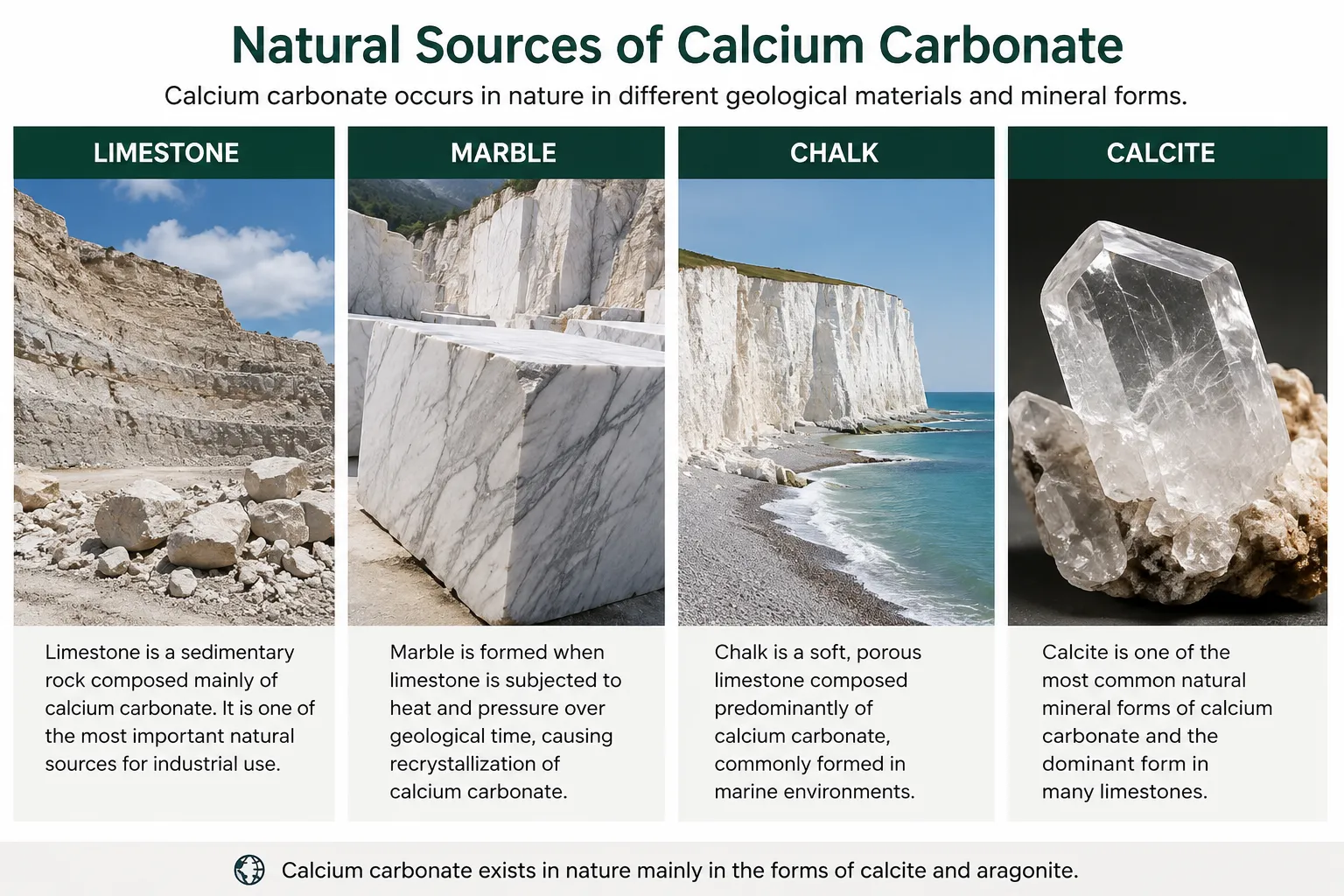
Calcium carbonate occurs widely in nature and is found in several important geological materials and mineral forms. Common natural sources include limestone, marble and chalk, while the compound itself occurs principally in crystalline forms such as calcite and aragonite.
Limestone is one of the most important natural sources of calcium carbonate for industrial use. In many deposits, calcite is the dominant calcium carbonate mineral, and high-quality limestone can be processed into ground calcium carbonate for use in industrial formulations.
“Limestone, as used by the minerals industry, is any rock composed mostly of calcium carbonate.”
— U.S. Geological Survey (USGS)
Marble is closely related to limestone from a geological perspective. When limestone is exposed to heat and pressure during metamorphism, its mineral structure can recrystallize and form marble. Both limestone and marble commonly contain calcite as a major mineral component.
Chalk is another naturally occurring calcium carbonate-rich material. Unlike many dense limestones, chalk is typically softer and more porous, but it is still predominantly associated with calcium carbonate.
Calcite and Aragonite: Two Important Forms of CaCO3
Calcium carbonate can exist in different crystal structures even though the chemical formula remains CaCO3. Calcite and aragonite are two of the most important naturally occurring mineral forms.
Calcite is particularly common in limestone and marble, while aragonite is also found in natural geological and biological environments. PubChem identifies both calcite and aragonite as mineral forms associated with natural calcium carbonate.
Natural calcium carbonate and its mineral forms can be verified through PubChem — National Library of Medicine .
How Is Calcium Carbonate Formed?
Calcium carbonate forms in nature through a combination of geological, chemical and biological processes. Over long periods of time, these processes can lead to the accumulation of calcium carbonate-rich sediments and eventually to the formation of carbonate rocks such as limestone.
One of the most important natural pathways occurs in marine environments. Many marine organisms use dissolved calcium and carbonate to build shells and skeletal structures made partly or predominantly from calcium carbonate. When these organisms die, their remains can accumulate on the seafloor, forming calcium-rich sediments that may later become compacted and cemented into limestone.
“Most carbonate rocks form from calcareous deposits that accumulate in marine environments.”
— U.S. Geological Survey (USGS)
Calcium carbonate can also form through direct chemical precipitation. Under suitable conditions, dissolved calcium ions and carbonate species in water can combine and precipitate as solid calcium carbonate minerals. The crystal form produced may depend on environmental conditions such as temperature, water chemistry and the surrounding biological system.
Biological Formation of Calcium Carbonate
Biological activity plays a major role in the natural calcium carbonate cycle. Corals, mollusks and many other marine organisms produce calcium carbonate structures. The U.S. Geological Survey notes that marine organisms rely on calcium carbonate to build shells and skeletons, with calcite and aragonite being two important mineral forms found in marine environments.
Learn more about naturally occurring calcium carbonate minerals from U.S. Geological Survey — Aragonite .
From Calcium Carbonate Sediment to Limestone
After calcium carbonate-rich sediments accumulate, geological processes such as compaction, cementation and recrystallization can gradually transform them into carbonate rock. Limestone formed in this way may later undergo additional geological transformation. Under elevated heat and pressure, limestone can recrystallize and form marble.
This natural geological history is important for industrial calcium carbonate production because the mineral composition, geological origin and characteristics of the original deposit can influence the properties of the raw material that is later mined, ground and processed.
Physical and Chemical Properties of Calcium Carbonate
Calcium carbonate (CaCO3) is a white inorganic solid with a molar mass of approximately 100.09 g/mol. Its physical properties can vary depending on crystal structure, particle size, purity and processing conditions. In industrial applications, these differences are important because they can influence dispersion, surface area, oil absorption, brightness and performance in the final formulation.
| Property | Typical / General Description |
|---|---|
| Chemical Formula | CaCO3 |
| Molar Mass | Approximately 100.09 g/mol |
| Appearance | White solid; industrial grades are commonly supplied as fine white powder |
| Major Crystal Forms | Calcite, aragonite and vaterite |
| Water Solubility | Low solubility in water under ordinary conditions |
| Reaction with Acids | Reacts with acids and releases carbon dioxide (CO2) |
| Industrial Particle Form | Available across a wide range of particle-size distributions depending on grinding, classification or precipitation process |
| Surface Characteristics | Can be supplied untreated or surface-modified for specific industrial systems |
How Does Calcium Carbonate React with Acids?
One of the characteristic chemical behaviors of calcium carbonate is its reaction with acids. When calcium carbonate comes into contact with an appropriate acid, carbon dioxide gas is released along with the formation of a calcium salt and water.
The release of carbon dioxide produces visible effervescence, which is one reason acid reaction is commonly associated with the identification of carbonate minerals.
Why Do Physical Properties Matter in Industrial Applications?
Chemical identity alone does not determine how a calcium carbonate powder will perform in an industrial formulation. Two products may both be primarily CaCO3 while having substantially different performance because of differences in particle-size distribution, crystal morphology, moisture, surface chemistry and other physical characteristics.
CaCO3 purity should not be evaluated in isolation. For industrial purchasing and formulation, parameters such as D50, D97, particle-size distribution, brightness or whiteness, moisture, oil absorption and surface treatment may also be important when selecting an appropriate calcium carbonate grade.
Chemical identification and compound data for calcium carbonate can be consulted through PubChem — National Library of Medicine .
GCC vs PCC: What Is the Difference?
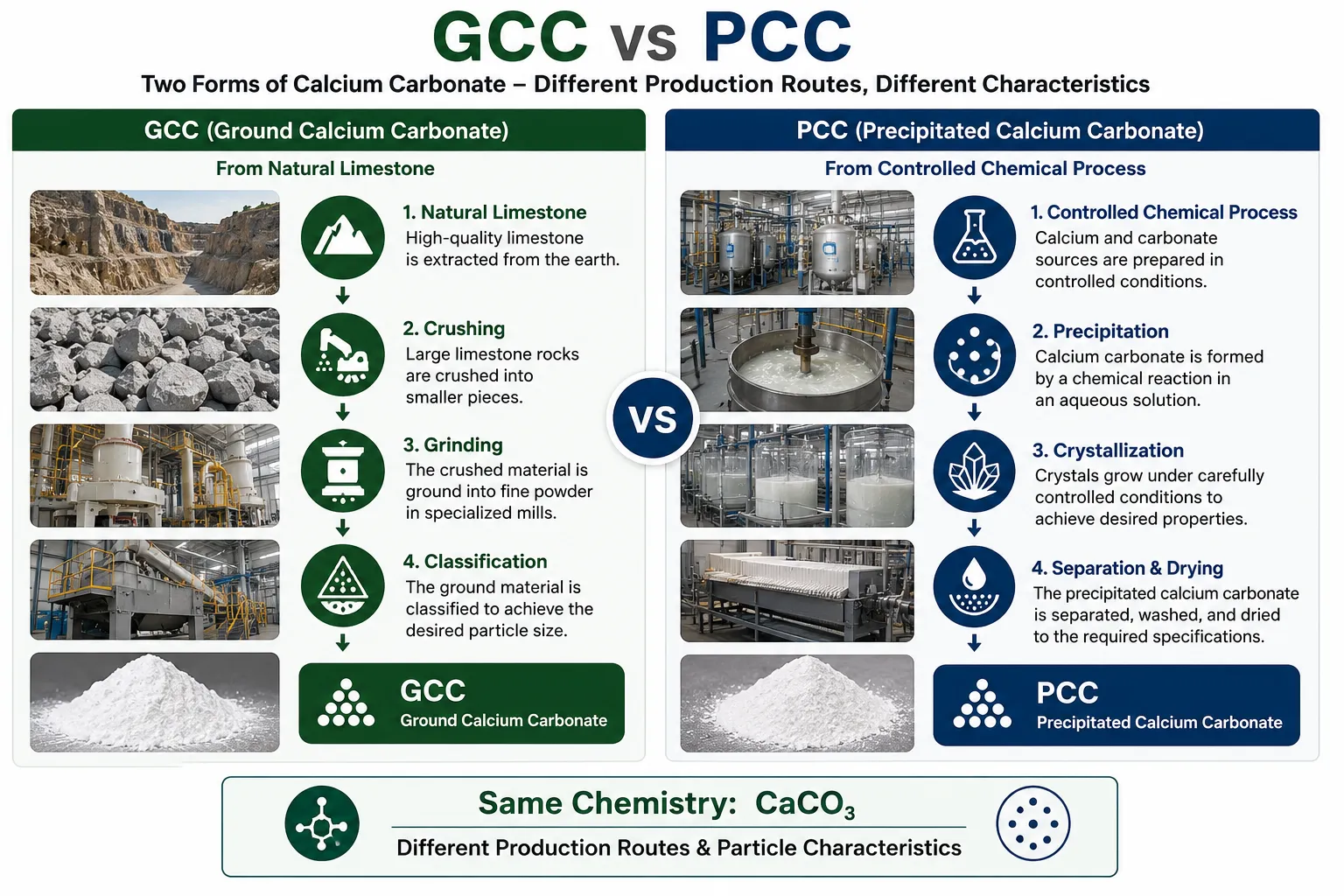
Industrial calcium carbonate is commonly discussed in two major forms: Ground Calcium Carbonate (GCC) and Precipitated Calcium Carbonate (PCC). Although both materials are based on CaCO3, their production routes and resulting particle characteristics can be significantly different.
What Is Ground Calcium Carbonate (GCC)?
Ground Calcium Carbonate, or GCC, is produced by mechanically processing naturally occurring calcium carbonate-rich rock such as high-quality limestone, marble or calcite. The raw mineral is typically crushed, ground and classified to obtain a controlled particle-size distribution suitable for industrial applications.
Because GCC originates from a natural mineral deposit, the quality of the raw material is particularly important. Mineral purity, brightness, geological consistency and the performance of the grinding and classification process can all influence the characteristics of the final calcium carbonate powder.
GCC is widely used in applications such as plastics, PVC, masterbatch, paints and coatings, paper, rubber, adhesives, sealants and construction materials.
“Ground calcium carbonate (GCC) ... is milled from natural limestone.”
— ScienceDirect Topics — Calcium Carbonate
What Is Precipitated Calcium Carbonate (PCC)?
Precipitated Calcium Carbonate, or PCC, is produced through a controlled chemical precipitation process rather than simply grinding a natural calcium carbonate rock. This production route allows manufacturers to influence characteristics such as particle size, morphology, crystal form and surface area.
These controlled characteristics can make PCC suitable for applications where specific optical, rheological or particle-performance requirements are important. Research on PCC production shows that processing conditions can strongly influence properties such as morphology, particle size and surface area.
Research on precipitated calcium carbonate production and particle engineering is available through Powder Technology — Property Optimization of Precipitated Calcium Carbonate .
Ground Calcium Carbonate vs Precipitated Calcium Carbonate
| Parameter | GCC | PCC |
|---|---|---|
| Full Name | Ground Calcium Carbonate | Precipitated Calcium Carbonate |
| Origin | Natural calcium carbonate-rich mineral deposits | Produced through controlled chemical precipitation |
| Production Method | Mining, crushing, grinding and classification | Chemical reaction, precipitation and controlled crystallization |
| Particle Morphology | Influenced by the original mineral structure and grinding process | Can be engineered more deliberately through precipitation conditions |
| Particle-Size Control | Controlled primarily through grinding and classification | Can be controlled through precipitation and crystallization parameters |
| Raw Material Dependence | Strongly dependent on the quality and consistency of the natural deposit | More dependent on chemical process control and production conditions |
| Typical Industrial Role | Widely used as an industrial mineral filler and functional extender | Often selected where engineered particle properties are required |
GCC and PCC should not be selected simply by asking which one is “better.” The appropriate choice depends on the formulation, required particle characteristics, processing conditions, performance targets and economics of the final application.
For many high-volume industrial applications, properly processed GCC offers an effective combination of mineral functionality and processing practicality. In more specialized formulations, PCC may be preferred when tightly engineered particle morphology or specific optical and rheological properties are required.
Coated vs Uncoated Calcium Carbonate
Another important distinction in industrial calcium carbonate is whether the particle surface is untreated (uncoated) or surface-treated (coated). This distinction does not change the basic identity of calcium carbonate as CaCO3, but it can significantly influence how the particles interact with the surrounding formulation.
The appropriate choice depends on the application and the medium in which the calcium carbonate must disperse. Uncoated grades retain the natural mineral surface, while coated grades are surface-modified to alter particle-surface behavior.
What Is Uncoated Calcium Carbonate?
Uncoated calcium carbonate is ground calcium carbonate whose mineral surface has not undergone an additional hydrophobic surface-treatment step. Depending on particle size and other specifications, uncoated GCC can be used across a wide range of industrial applications.
Important selection parameters may include CaCO3 purity, particle-size distribution, D50, D97, brightness or whiteness, moisture, bulk density and other application-specific requirements.
What Is Coated Calcium Carbonate?
Coated calcium carbonate is calcium carbonate whose particle surface has been modified with a surface-treatment agent. In many industrial GCC applications, fatty acids such as stearic acid are used to modify the surface characteristics of calcium carbonate particles.
Surface treatment can make the mineral surface more compatible with hydrophobic organic systems and can influence characteristics such as dispersion, moisture sensitivity and interaction between the mineral filler and a polymer matrix.
This is particularly relevant in polymer-based applications where the behavior of the filler at the interface with the surrounding matrix can affect processing and final-product performance.
Coated vs Uncoated Calcium Carbonate: Quick Comparison
| Parameter | Uncoated Calcium Carbonate | Coated Calcium Carbonate |
|---|---|---|
| Particle Surface | Natural / untreated mineral surface | Surface-modified |
| Common Treatment | No additional hydrophobic coating | Often treated with fatty acids such as stearic acid |
| Surface Behavior | Relatively hydrophilic mineral surface | More hydrophobic after suitable surface treatment |
| Compatibility | Suitable for applications where an untreated mineral surface is appropriate | Often selected to improve compatibility with hydrophobic polymer systems |
| Selection Depends On | Final application, formulation chemistry, processing conditions, particle-size distribution and required product performance | |
“Coated” does not automatically mean “higher quality.” Coated and uncoated calcium carbonate serve different formulation needs. The correct choice depends on the material system and the performance required from the mineral filler.
Scientific research on surface modification of calcium carbonate shows that fatty-acid treatment can alter the surface characteristics and hydrophobicity of CaCO3 particles. See research indexed by ScienceDirect .
How Is Calcium Carbonate Powder Produced?
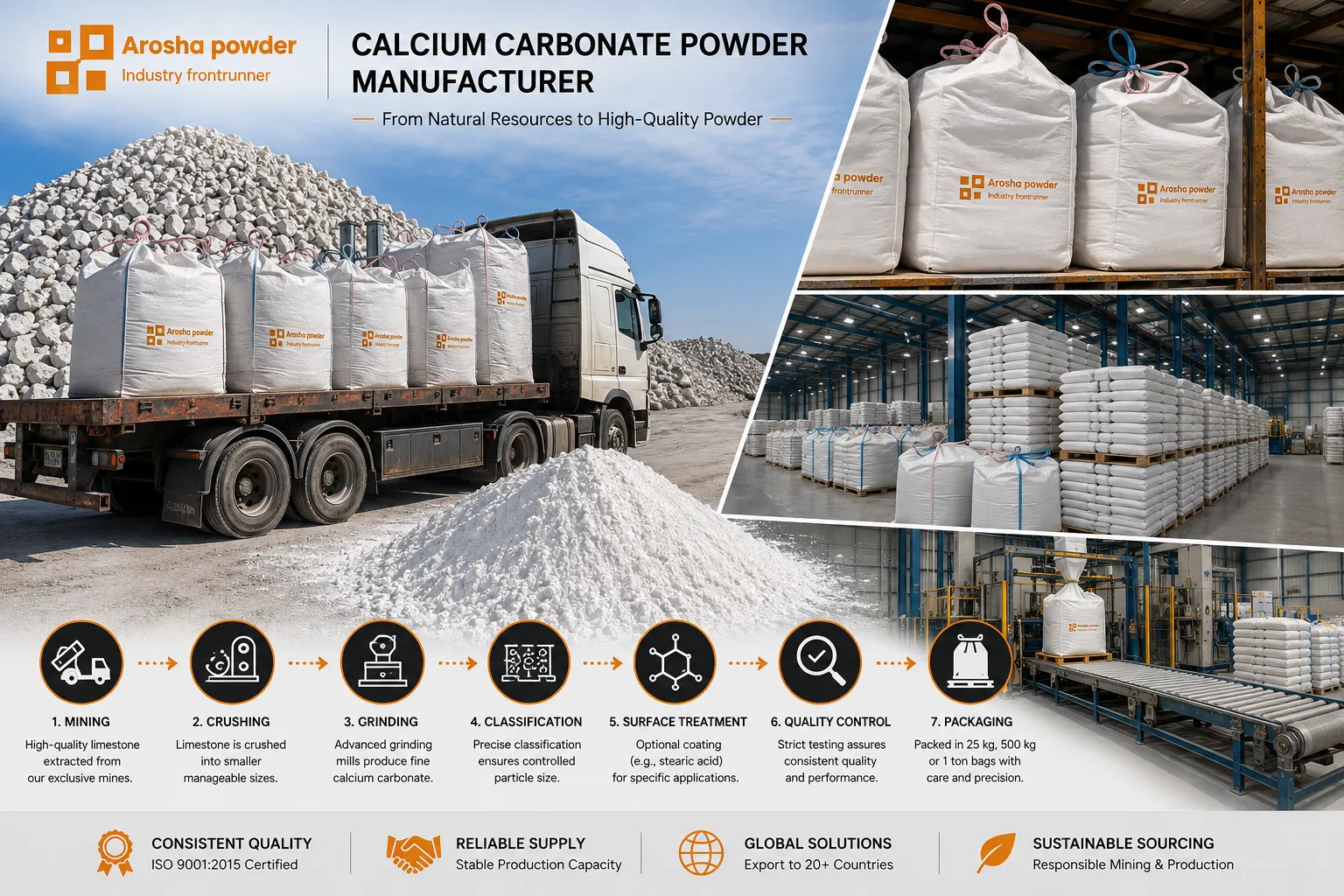
The production of industrial ground calcium carbonate begins with the selection of suitable calcium carbonate-rich mineral resources. However, producing a consistent industrial powder requires considerably more than simply grinding limestone. Raw-material quality, crushing, grinding, classification, optional surface treatment, quality control and packaging all contribute to the characteristics of the finished product.
For an industrial calcium carbonate powder supplier and manufacturer , control over these stages is important because customers require more than CaCO3 chemistry alone. Particle-size distribution, consistency between production batches, moisture, brightness or whiteness and other application-specific parameters can influence how the powder performs in the customer's formulation.
Mining and Raw Material Selection
Production begins with calcium carbonate-rich rock, commonly limestone. The mineralogical and chemical characteristics of the deposit are important because the raw material establishes the foundation for the quality and consistency of the final GCC product.
Crushing
Extracted rock is reduced into smaller and more manageable sizes. Crushing prepares the mineral feed for subsequent grinding and helps create a more controlled production stream.
Grinding
The crushed mineral is mechanically ground to reduce particle size. Grinding conditions and equipment configuration influence the particle-size distribution of the resulting calcium carbonate powder.
Classification and Particle-Size Control
After grinding, classification is used to separate particles according to size and obtain the required product distribution. For technical evaluation, particle-size data such as D50 and D97 can provide more useful information than a mesh designation alone.
Optional Surface Treatment
When a coated grade is required, calcium carbonate particles may undergo an additional surface-treatment process. Treatment with an appropriate agent, commonly a fatty acid such as stearic acid in certain GCC applications, modifies the particle surface for the intended formulation.
Quality Control
Finished powder should be evaluated against the relevant product specification. Depending on the grade and application, quality-control parameters may include chemical composition, particle-size distribution, moisture, brightness or whiteness and other application-specific characteristics.
Packaging and Industrial Supply
After the required specifications are confirmed, calcium carbonate powder is packed in suitable industrial packaging for storage, transportation and delivery. Packaging selection depends on customer, logistics and handling requirements.
Buyers should not evaluate calcium carbonate powder only by a nominal mesh number. Two powders described using the same mesh designation can still differ in particle-size distribution and other properties. Where performance is critical, technical data such as D50, D97 and the relevant test method should be reviewed alongside the product specification.
This is why technical documents such as a product calcium carbonate data sheet are useful during supplier evaluation. They allow industrial buyers and formulation teams to compare relevant specifications rather than selecting a grade solely by its commercial name or mesh designation.
What Is Calcium Carbonate Used For?
Calcium carbonate is used across a wide range of industries because it can function as a mineral filler, extender, processing aid, opacity or brightness contributor, and performance-modifying additive depending on the formulation and grade selected.
Its industrial role is not identical in every application. The required particle-size distribution, surface treatment, brightness, moisture level, purity and other technical properties can vary significantly between PVC, paints, paper, rubber and construction materials.
Calcium Carbonate in Plastics and PVC
In plastics and PVC formulations, calcium carbonate is commonly used as a mineral filler and functional extender. Depending on the formulation, particle characteristics and surface treatment can influence dispersion, processing behavior, stiffness, dimensional stability and the economics of the final compound.
Calcium Carbonate in Masterbatch
Calcium carbonate is widely used in filler masterbatch and related polymer compounds. Fine and consistently classified grades are often selected where uniform dispersion and stable processing behavior are important.
Calcium Carbonate in Paints and Coatings
In paints and coatings, calcium carbonate can serve as an extender and functional mineral. Particle size, brightness, oil absorption and surface characteristics can influence formulation behavior and final coating properties.
Calcium Carbonate in Paper
Calcium carbonate is used in paper applications as a mineral filler and, in some systems, as part of coating formulations. Its role can include contributing to opacity, brightness, printability and sheet properties.
Calcium Carbonate in Rubber
In rubber compounds, calcium carbonate can be used as a filler to modify formulation cost, hardness, processing behavior and mechanical properties. The suitability of a particular grade depends on particle characteristics and the requirements of the rubber system.
Calcium Carbonate in Adhesives and Sealants
Calcium carbonate is also used in adhesives and sealants as a mineral filler and rheology-modifying component. Depending on the formulation, factors such as particle size, moisture and surface treatment may affect processing and final performance.
Calcium Carbonate in Construction Materials
In construction-related materials, calcium carbonate is used in products such as dry mixes, putties, compounds, sealants and other mineral-based formulations. Its exact function depends on the product design and required physical properties.
For a deeper technical overview of how calcium carbonate performs in plastics, PVC, paints, paper, rubber and other industrial systems, visit our dedicated application guide.
Industrial Applications of Calcium Carbonate Powder →The same calcium carbonate grade is not automatically suitable for every industry. A grade selected for PVC may require different particle-size, surface-treatment or moisture characteristics from a grade intended for paint, paper or rubber. Technical selection should therefore be based on the requirements of the target formulation rather than on mesh number alone.
How to Choose the Right Calcium Carbonate Grade
Choosing the right calcium carbonate grade requires more than selecting a mesh number or comparing CaCO3 purity alone. Industrial buyers, compounders and formulation teams should evaluate the grade according to the final application, processing conditions and required performance.
A technically suitable product is one whose particle characteristics, surface properties and quality parameters are aligned with the intended formulation.
Define the Final Application
Start with the intended use of the calcium carbonate. PVC, masterbatch, paints, paper, rubber and construction materials can require different particle characteristics and surface behavior.
Choose Coated or Uncoated
Select the surface condition according to the formulation. Coated grades may be more suitable for some hydrophobic polymer systems, while uncoated grades may be preferred in other industrial applications.
Review Particle-Size Distribution
Do not rely only on a nominal mesh designation. Review particle-size data such as D50, D97 and the relevant test method where these parameters are important for the application.
Check CaCO3 Purity
Chemical composition is important, but purity should be evaluated together with physical properties and application-specific requirements rather than as a single quality indicator.
Evaluate Brightness or Whiteness
Optical characteristics can be important in applications such as paints, plastics and paper. The required value depends on the formulation and the appearance expected from the final product.
Review Moisture
Moisture can affect storage, dispersion and processing behavior, especially in moisture-sensitive formulations. The acceptable level should be assessed according to the target application.
Consider Oil Absorption and Surface Behavior
Oil absorption and surface characteristics can influence formulation demand, dispersion and processing behavior in systems such as paints, coatings and polymer compounds.
Confirm Packaging and Logistics
Packaging should match production volume, handling requirements, warehousing conditions and transportation needs. Industrial supply may require smaller bags, jumbo bags or other customer-specific solutions.
Technical Documents to Request Before Purchasing
Before approving a calcium carbonate grade for industrial use, buyers should review the relevant technical documentation. A Technical Data Sheet provides the declared specifications for the product, while a batch-specific Certificate of Analysis can be used to verify selected quality parameters for a particular production batch.
Arosha Powder provides technical documentation for its industrial calcium carbonate grades through the calcium carbonate data sheets section. For applications with tighter technical requirements, buyers should also compare the product specification with their own formulation and processing conditions before full-scale use.
Application first, technical specification second, mesh number third. This sequence provides a more useful basis for selecting industrial calcium carbonate than choosing a product only because it is described as 400, 800, 1250 or another mesh designation.
Mesh vs Micron vs D50 vs D97 in Calcium Carbonate
Particle-size terminology is one of the most important technical topics in calcium carbonate selection. Terms such as mesh, micron, D50 and D97 describe different aspects of particle size and should not be treated as interchangeable.
A nominal mesh designation may be useful as a commercial reference, but for technical evaluation it is often more meaningful to review the actual particle-size distribution of the calcium carbonate powder.
What Does Mesh Mean?
Mesh is traditionally associated with sieve-based particle-size classification. In general, a higher mesh number indicates a finer material, but the exact relationship between mesh and particle size depends on the sieve standard and test method used.
This is why a product described only as “800 mesh” or “1250 mesh” does not provide a complete description of its particle-size distribution.
What Does Micron Mean?
A micron, or micrometer (µm), is a unit of length equal to one thousandth of a millimeter. In particle-size analysis, micron values are used to describe the physical size of particles more directly than a nominal mesh number.
What Is D50?
D50 is the median particle diameter of a particle-size distribution. In simple terms, it is the particle diameter at which 50% of the measured particles are smaller and 50% are larger, based on the relevant analytical method and distribution basis.
D50 is useful for comparing the central tendency of particle-size distributions, but it does not describe the coarse end of the distribution by itself.
What Is D97?
D97 describes the particle diameter below which approximately 97% of the measured particle population falls according to the analytical method used. It is particularly useful for understanding the coarse tail of a particle-size distribution.
In many industrial applications, D97 can be highly relevant because a small fraction of oversized particles may affect dispersion, surface quality, processing or final-product appearance.
Quick Comparison: Mesh, Micron, D50 and D97
| Term | What It Describes | Why It Matters |
|---|---|---|
| Mesh | A sieve-related commercial or classification designation | Useful as a general grade reference, but depends on the sieve standard and does not fully describe particle-size distribution |
| Micron (µm) | A direct unit of particle dimension | Provides a more direct physical size reference |
| D50 | Median particle diameter | Helps describe the central region of the particle-size distribution |
| D97 | Diameter below which approximately 97% of measured particles fall | Helps evaluate the coarse end of the particle-size distribution |
Mesh should not be converted to micron with a single universal number unless the sieve standard and test method are known. Likewise, D50 and D97 values should always be interpreted together with the particle-size measurement method, sample preparation and dispersion conditions.
For industrial calcium carbonate selection, the most reliable approach is to review the supplier's technical data and compare the declared particle-size parameters with the actual requirements of the formulation. Product-specific data should therefore be taken from the relevant technical data sheet rather than estimated from mesh number alone.
Is Calcium Carbonate the Same as Limestone?
No. Calcium carbonate and limestone are closely related, but they are not exactly the same thing. Calcium carbonate is the chemical compound CaCO3, whereas limestone is a naturally occurring sedimentary rock composed predominantly of calcium carbonate minerals, especially calcite.
Limestone may also contain varying amounts of other minerals and impurities depending on the geological deposit. For industrial production, suitable limestone can be mined, crushed, ground and classified to produce Ground Calcium Carbonate (GCC).
Is Calcium Carbonate the Same as Calcite?
Not exactly. Calcite is one crystalline mineral form of calcium carbonate. Its chemical composition is CaCO3, but the term calcium carbonate refers to the compound more broadly and can include different crystal structures.
Calcite is the most common calcium carbonate mineral in many limestone and marble deposits. Other naturally occurring calcium carbonate polymorphs include aragonite, while vaterite is another crystalline form that is less stable under ordinary natural conditions.
Calcium Carbonate vs Calcium Oxide: What Is the Difference?
Calcium carbonate and calcium oxide are different calcium compounds with different chemical formulas, properties and industrial uses. Calcium carbonate has the formula CaCO3, while calcium oxide has the formula CaO and is commonly known as quicklime.
Calcium oxide can be produced by heating calcium carbonate-containing materials such as limestone to sufficiently high temperatures. During this thermal decomposition, calcium carbonate releases carbon dioxide and forms calcium oxide.
| Parameter | Calcium Carbonate | Calcium Oxide |
|---|---|---|
| Chemical Formula | CaCO3 | CaO |
| Common Name | Calcium carbonate | Quicklime |
| Natural Occurrence | Commonly occurs in limestone, marble, chalk and carbonate minerals | Primarily manufactured through thermal processing of calcium carbonate-rich materials |
| Typical Industrial Role | Mineral filler, extender and functional mineral | Reactive lime used in chemical, metallurgical, environmental and construction processes |
| Chemical Behavior | Relatively stable under ordinary conditions; reacts with acids | Highly reactive with water compared with calcium carbonate |
Limestone, calcite, calcium carbonate and calcium oxide are related terms, but they do not describe the same material. For industrial purchasing, the exact chemical composition, mineral form and product specification should always be confirmed before selecting a material.
Frequently Asked Questions About Calcium Carbonate
The following questions summarize some of the most common technical and industrial questions about calcium carbonate, its forms, particle size and applications.
What is calcium carbonate?
Calcium carbonate is an inorganic compound with the chemical formula CaCO3. It occurs naturally in materials such as limestone, marble and chalk and in mineral forms including calcite and aragonite. It is also widely processed into industrial calcium carbonate powder.
What is the chemical formula of calcium carbonate?
The chemical formula of calcium carbonate is CaCO3. It consists of calcium, carbon and oxygen.
Where is calcium carbonate found naturally?
Calcium carbonate occurs naturally in limestone, marble, chalk and calcium carbonate minerals such as calcite and aragonite. It is also an important component of many shells, coral structures and marine sediments.
What is the difference between GCC and PCC?
Ground Calcium Carbonate (GCC) is produced by mechanically crushing, grinding and classifying naturally occurring calcium carbonate-rich minerals. Precipitated Calcium Carbonate (PCC) is produced through a controlled chemical precipitation process that allows greater control over characteristics such as particle morphology and size.
What is coated calcium carbonate?
Coated calcium carbonate is calcium carbonate whose particle surface has been modified with a surface-treatment agent. In many industrial GCC applications, fatty acids such as stearic acid are used to alter surface behavior and improve compatibility with selected hydrophobic systems.
Explore Coated Calcium Carbonate →What is uncoated calcium carbonate?
Uncoated calcium carbonate is calcium carbonate whose mineral surface has not undergone an additional hydrophobic surface-treatment process. Its suitability depends on particle size, purity and the requirements of the intended formulation.
Explore Uncoated Calcium Carbonate →What is calcium carbonate powder used for?
Industrial calcium carbonate powder is widely used in plastics, PVC, masterbatch, paints and coatings, paper, rubber, adhesives, sealants, construction materials and other formulations. The appropriate grade depends on the technical requirements of each application.
Explore Industrial Applications →Is calcium carbonate the same as limestone?
No. Calcium carbonate is the chemical compound CaCO3, while limestone is a naturally occurring rock composed predominantly of calcium carbonate minerals. Limestone may also contain other minerals depending on the geological deposit.
What is the difference between mesh and micron?
Mesh is associated with sieve-based classification, while micron (µm) is a direct unit of length used to describe particle dimensions. A universal mesh-to-micron conversion should not be assumed without knowing the sieve standard and measurement method.
What are D50 and D97 in calcium carbonate?
D50 is the median particle diameter of a measured particle-size distribution, while D97 describes the diameter below which approximately 97% of the measured particles fall. These values are useful for evaluating particle-size distribution more precisely than a nominal mesh designation alone.
How should an industrial buyer choose a calcium carbonate grade?
Grade selection should begin with the intended application and then consider factors such as coated or uncoated surface, particle-size distribution, D50, D97, CaCO3 purity, moisture, brightness or whiteness, oil absorption and other relevant specifications.
What technical documents should be reviewed before purchasing calcium carbonate?
Industrial buyers should review the relevant Technical Data Sheet (TDS), Safety Data Sheet (SDS) and, when required, a batch-specific Certificate of Analysis (COA). These documents help evaluate declared specifications, handling information and batch-specific quality data.
View Calcium Carbonate Data Sheets →References & Scientific Sources
This article was prepared using authoritative geological, chemical and peer-reviewed scientific sources. The references below support the definitions, mineralogical information, chemical properties and surface-treatment concepts discussed throughout this guide.
Reference for the geological definition of limestone, its relationship with calcium carbonate and its importance as an industrial mineral.
View USGS Source →Reference for calcium carbonate chemical identification, molecular formula, molecular weight and general compound information.
View PubChem Record →Supporting geological and marine-science reference concerning aragonite, an important crystalline form of calcium carbonate.
View USGS Aragonite Source →Peer-reviewed research addressing the use of stearic acid for modifying calcium carbonate surface characteristics and hydrophobic behavior.
View Research Article →Peer-reviewed research examining the interaction and binding mechanism of stearic acid on calcite surfaces.
View Research Article →Supporting reference for the occurrence of calcite and aragonite as crystalline forms with the chemical formula CaCO3.
View USGS Publication →
Technical Review by Prof. Ali Ihsan Arol
The technical and mineral-processing concepts presented in this article have been reviewed for scientific clarity and consistency by Prof. Ali Ihsan Arol.
Independent technical review helps distinguish general educational information from product-specific specifications. Values for individual calcium carbonate grades should always be verified through the relevant Technical Data Sheet (TDS) or batch-specific Certificate of Analysis (COA).
View Prof. Ali Ihsan Arol's Academic Profile →How useful was this post?
Click on a star to rate it!
Average rating 5 / 5. Vote count: 1
No votes so far! Be the first to rate this post.