
Particle size is one of the most important technical characteristics of industrial calcium carbonate powder. It can influence dispersion, processing behavior, surface finish, filler loading and the overall performance of calcium carbonate within a formulation.
However, calcium carbonate particle size cannot be described accurately by a single term in every situation. Commercial grades may be identified by mesh, while laboratory and technical data may report particle dimensions in microns (µm) and distribution parameters such as D50 and D97.
Understanding the difference between these terms is essential when comparing calcium carbonate grades, reviewing technical data sheets or selecting material for PVC, masterbatch, paints and coatings, rubber, paper and other industrial applications.
What Is Calcium Carbonate Particle Size?
Calcium carbonate particle size describes the dimensions and distribution of the particles contained in a calcium carbonate powder. Because an industrial powder contains a population of particles rather than particles of one identical size, technical evaluation usually requires information about the particle size distribution (PSD).
In other words, describing a calcium carbonate grade simply as “fine” or assigning it a nominal mesh number does not provide a complete picture of the powder. Two materials marketed under a similar mesh designation may still have different particle-size distributions and therefore behave differently in an industrial formulation.
Particle size distribution describes how different particle sizes are distributed throughout a powder sample. Parameters such as D50 and D97 provide specific points within that distribution and can help industrial buyers compare calcium carbonate powders more precisely.
“D50 ... is the size point below which 50% of the material is contained.”
— Malvern Panalytical
Why Does Particle Size Matter in Calcium Carbonate?
Particle size can affect how calcium carbonate interacts with the surrounding material. Depending on the application, the particle-size distribution may influence dispersion, surface appearance, rheology, processing behavior and the balance between mineral loading and final product performance.
This is why industrial buyers should not evaluate calcium carbonate only by chemical purity. A powder may have a high CaCO3 content but still be unsuitable for a particular formulation if its particle-size distribution does not meet the processing or performance requirements of that application.
“400 mesh,” “800 mesh” or “1250 mesh” should not be treated as a complete particle-size specification. For technical comparison, buyers should also review the measurement method and available particle-size distribution data such as D50, D97 or other relevant percentile values.
If you need a broader introduction to the mineral itself before evaluating particle size, see our guide: What Is Calcium Carbonate?
Laser diffraction particle-size analysis is covered by ISO 13320:2020 — Particle size analysis — Laser diffraction methods .
What Does Mesh Mean in Calcium Carbonate?
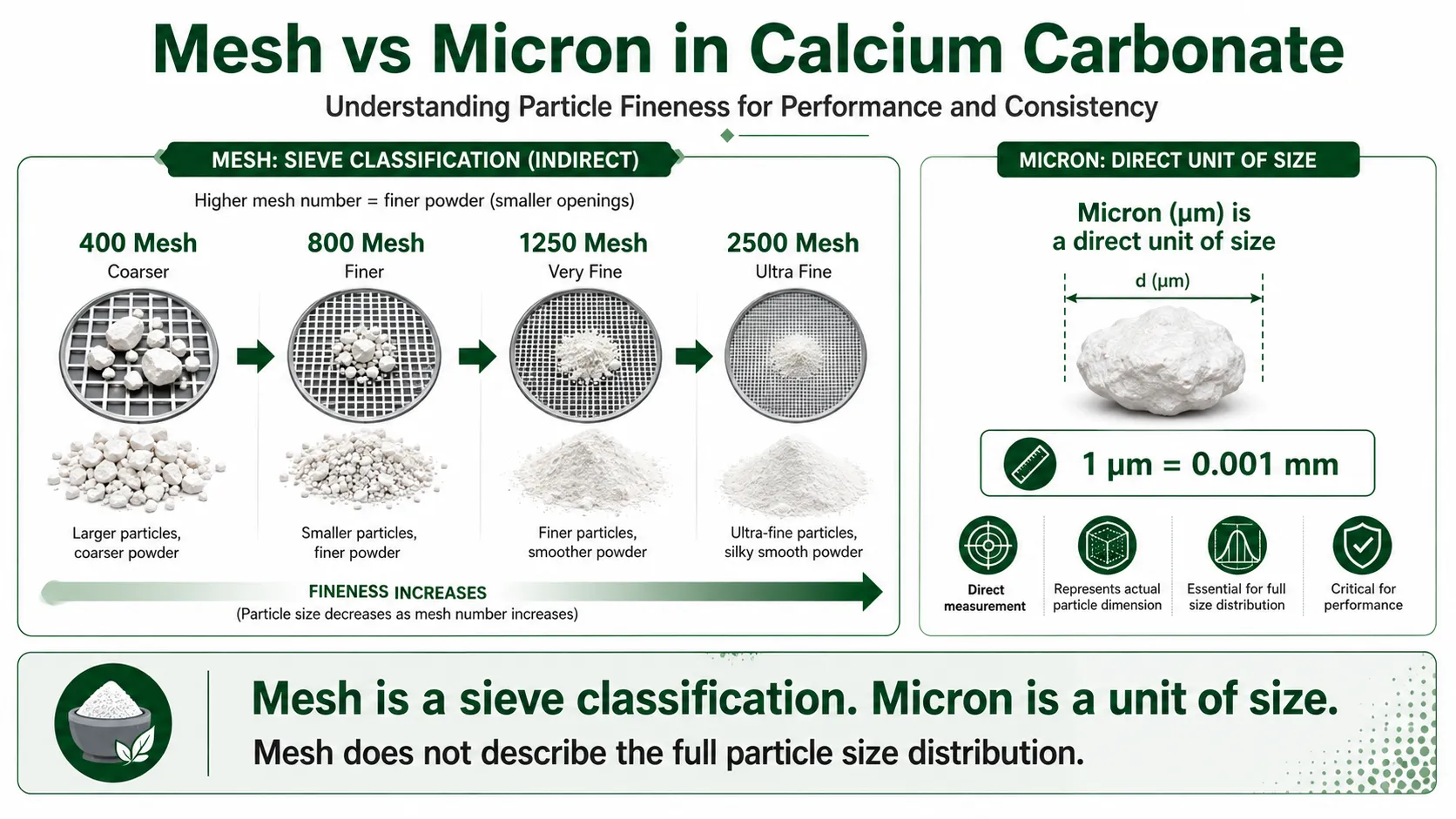
In calcium carbonate powder, mesh is commonly used as a commercial reference for particle fineness. In traditional sieve terminology, mesh is associated with the number and size of openings in a screening medium. As the mesh designation increases, the corresponding sieve opening generally becomes smaller, indicating a finer material.
However, mesh should not be interpreted as a complete description of calcium carbonate particle size. Industrial powders contain particles with a distribution of sizes rather than particles of one identical diameter, and the exact relationship between a mesh designation and particle size depends on the sieve standard and test method being used.
Higher mesh generally means finer material, but a mesh number alone does not define the complete particle-size distribution of calcium carbonate powder.
How Does a Sieve Separate Calcium Carbonate Particles?
A test sieve contains openings of a defined nominal size. During sieve analysis, particles sufficiently small to pass through an opening move to the next size fraction, while larger particles are retained.
Standardized test sieves are manufactured according to defined technical requirements. For example, ISO 3310-1 specifies requirements and test methods for metal-wire-cloth test sieves, while ASTM E11 specifies requirements for woven-wire test sieve cloth and test sieves.
ISO 3310-1
Technical requirements and testing for test sieves made from metal wire cloth.
View ISO Standard →ASTM E11
Specification covering woven-wire test sieve cloth, test sieves and permissible opening tolerances.
View ASTM Standard →Does Higher Mesh Always Mean Smaller Calcium Carbonate Particles?
As a general commercial convention, a higher mesh designation is associated with finer powder. For example, a calcium carbonate product marketed as 1250 mesh would normally be regarded as finer than a product marketed as 400 mesh.
But this comparison should not be extended into an exact particle-size conversion without additional technical information. A mesh designation does not tell the buyer how the entire particle population is distributed, nor does it automatically provide D50, D97 or the amount of coarse material present in the powder.
The sequence above illustrates relative commercial fineness only. It is not an exact mesh-to-micron conversion table.
Why Is Mesh Alone Not Enough for Industrial Buyers?
Two calcium carbonate powders can carry the same nominal mesh designation and still show different performance in a formulation. Differences in grinding technology, classification efficiency, particle morphology and particle-size distribution can produce powders with different D50, D97 and coarse-particle characteristics.
This becomes especially important when comparing materials for applications such as PVC, filler masterbatch, paints and coatings, rubber and other formulations where dispersion and the coarse end of the particle-size distribution can influence processing or final-product quality.
When comparing offers from a calcium carbonate powder supplier in Asia , do not compare products only by statements such as “800 mesh” or “1250 mesh.” Request the applicable technical data and confirm how particle size was measured.
This distinction is particularly important for manufacturers with direct control over mineral sourcing, grinding and classification. A direct from mine calcium carbonate manufacturer can connect raw-material consistency with downstream particle-size control, but the final grade should still be evaluated using its declared technical specification.
Technical requirements for standardized metal-wire test sieves are described in ISO 3310-1 and ASTM E11 .
Mesh vs Micron: What Is the Difference?
Mesh and micron are both used when discussing calcium carbonate particle size, but they describe size in different ways. Mesh is connected to sieve classification, while micron is a direct unit of length that can be used to express particle dimensions.
This difference matters when comparing calcium carbonate grades. A mesh designation gives useful information about fineness within a particular sieve system, but a micron value describes a physical dimension directly. For this reason, the two terms should not be treated as if they were simply different names for the same measurement.
What Is a Micron?
A micron is another name commonly used for a micrometre, written with the symbol µm. One micrometre is equal to one thousandth of a millimetre. It is a convenient unit for describing very small particles such as the particles found in fine industrial calcium carbonate powders.
The SI prefix micro represents a factor of 10−6. Measurement conventions for SI units can be reviewed through National Institute of Standards and Technology .
How Is Mesh Different From Micron?
Mesh is related to screening through openings in a sieve. Micron, by contrast, expresses an actual dimension. This means that a sieve can have an opening described in micrometres, while the commercial mesh designation refers to the sieve classification system associated with that opening.
For industrial calcium carbonate, this distinction becomes increasingly important as powders become finer. A buyer may receive a product described commercially by a mesh number, while the Technical Data Sheet reports particle size using micron values, D50, D97 or a full particle size distribution.
| Parameter | Mesh | Micron |
|---|---|---|
| What it represents | Sieve based classification | Direct unit of physical dimension |
| Common use | Commercial description of powder fineness | Technical description of particle or opening size |
| Depends on a standard | Yes, the sieve system and applicable standard matter | No, the micrometre itself is a defined SI unit |
| Describes full PSD | No | No, a single micron value alone does not describe the full distribution |
| Useful for supplier comparison | Useful as an initial commercial reference | More direct, but should still be interpreted with D50, D97 and the measurement method |
Can Mesh Be Converted Directly to Micron?
Mesh values can often be associated with nominal sieve opening sizes, but buyers should be careful with simple conversion tables found online. The relationship depends on the sieve standard and the actual opening specification being referenced.
A conversion table can therefore be useful for orientation, but it should not automatically be treated as the technical particle size specification of a calcium carbonate product. This is especially important for very fine powders that are evaluated using instrumental particle size analysis rather than conventional sieving alone.
If a supplier describes a calcium carbonate product as 1250 mesh, do not assume that every particle in the powder has one specific micron size. Industrial powder contains a distribution of particle sizes. Requesting D50, D97 and the measurement method gives you a much clearer picture of what you are actually buying.
Why Can Online Mesh to Micron Tables Be Misleading?
Most simple conversion charts show a nominal relationship between a sieve designation and an opening size. They do not show the actual distribution of particles inside a calcium carbonate powder.
Imagine two suppliers offering material under the same commercial mesh designation. One powder may contain a tightly controlled population of fine particles, while another may contain a broader distribution with more coarse particles. The mesh label can look identical on both quotations, even though the powders may behave differently during processing.
This is why professional comparison should move beyond the commercial grade name and examine measurable technical data.
The next step is therefore to understand D50 and D97. These values describe specific points within the particle size distribution and provide much more useful information when comparing fine calcium carbonate grades.
Requirements for test sieve construction and opening dimensions are covered by ISO 3310 1 and ASTM E11 .
What Are D50 and D97 in Calcium Carbonate?
D50 and D97 are particle size distribution values that help describe a calcium carbonate powder more precisely than a commercial mesh number alone. Instead of trying to represent the entire powder with one nominal grade name, these values identify specific points within the measured particle size distribution.
This is particularly useful for fine calcium carbonate powders because a real sample contains many particles of different sizes. Understanding where the middle of the distribution lies and how far the coarse portion extends gives buyers a much clearer picture of the material.
What Does D50 Mean?
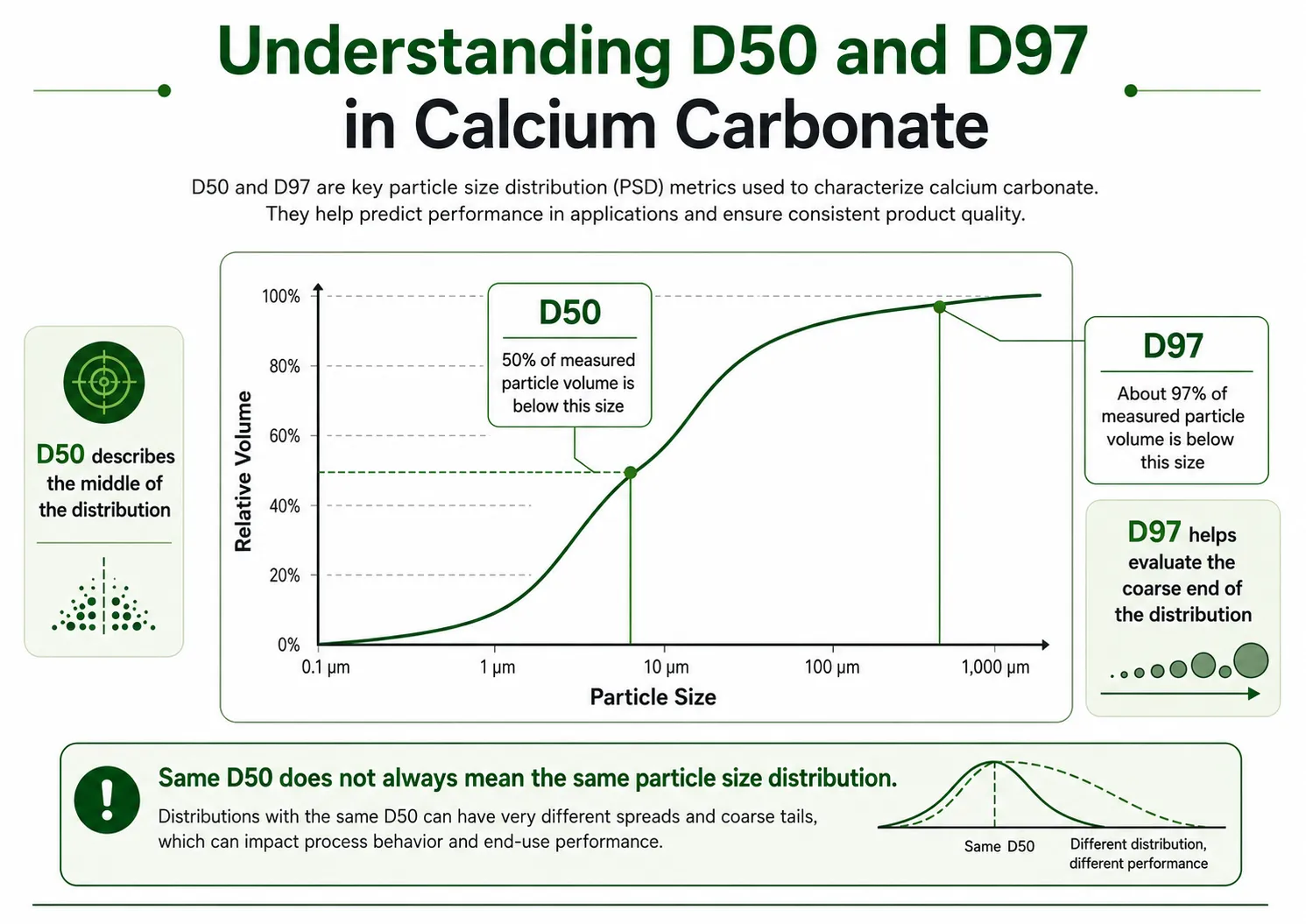
D50 is the median particle size of the measured distribution. When a result is reported on a volume basis, D50 represents the particle diameter below which 50 percent of the measured particle volume is found.
For example, if a calcium carbonate sample has a reported D50 of 5 µm on a volume based distribution, this means that 50 percent of the measured particle volume is below 5 µm and the remaining 50 percent is above that size.
“The area occupying less than this point is 50% of the total size distribution.”
Malvern Panalytical
D50 is useful for understanding the typical fineness of a calcium carbonate powder, but it does not tell you everything about the coarse particles that may still be present in the sample.
What Does D97 Mean?
D97 represents a point near the coarse end of the measured particle size distribution. When it is reported on a volume basis, approximately 97 percent of the measured particle volume lies below the stated particle diameter.
This makes D97 useful when the larger particles in a calcium carbonate powder matter to the application. A powder can have an attractive D50 value while still containing a coarse portion that may influence dispersion, surface quality or processing.
These numbers are illustrative only and do not represent a specification for any Arosha Powder product.
D50 vs D97: Why Do You Need Both?
D50 tells you about the central part of the distribution, while D97 gives you information about its coarse region. Looking at both values can reveal differences that would remain hidden if you compared products using only one particle size number.
| Parameter | D50 | D97 |
|---|---|---|
| Main purpose | Describes the middle of the measured distribution | Provides information about the coarse region of the distribution |
| Percentile | 50 percent below the stated size | Approximately 97 percent below the stated size |
| Useful for | Comparing typical particle fineness | Evaluating larger particles in the sample |
| Can it replace PSD? | No | No |
| Should the measurement method be known? | Yes | Yes |
Why Can Two Powders With the Same D50 Still Be Different?
This is one of the most important points for an industrial buyer. Two calcium carbonate samples can have the same D50 while having very different distributions around that value.
One powder may have a relatively narrow distribution with fewer large particles. Another may have a broader distribution that contains a more significant coarse fraction. Their D50 values can still look similar on a quotation or Technical Data Sheet.
Looking at D97 and, where available, the full particle size distribution provides more context and makes supplier comparison more meaningful.
Never compare D50 or D97 values without checking how the measurement was performed. The analytical method, distribution basis, sample preparation and dispersion conditions can influence the reported result.
Why Should the Measurement Method Be Reported?
Particle size is not simply a number printed on a data sheet. The method used to obtain that number matters. Laser diffraction is widely used for particle size distribution measurement because it can analyse a broad range of particle sizes using their light scattering behaviour.
ISO 13320 provides guidance for particle size distribution measurement by laser diffraction. For calcium carbonate buyers, knowing the measurement method makes it easier to compare technical data from different samples or suppliers on a consistent basis.
Guidance for particle size distribution measurement using laser diffraction is provided in ISO 13320:2020 . Additional explanations of particle size statistics are available from Malvern Panalytical .
What Is Particle Size Distribution in Calcium Carbonate?
Particle Size Distribution, commonly called PSD, describes how the different particle sizes are distributed throughout a calcium carbonate powder. Instead of describing the material with only one number, PSD gives a broader view of the particle population inside the sample.
This matters because industrial calcium carbonate is not made up of identical particles. Even a carefully controlled fine powder contains a range of particle sizes. Some particles are smaller, some are close to the middle of the distribution, and a smaller portion may be considerably larger.
D50 tells you where the middle of the measured distribution is located, but PSD shows what is happening around that middle. It helps reveal how narrow or broad the distribution is and whether a significant coarse portion is present.
Narrow vs Broad Particle Size Distribution
A narrow particle size distribution means that a larger proportion of the particles are concentrated within a relatively limited size range. A broad distribution contains a wider variety of particle sizes, including a greater spread between smaller and larger particles.
Neither type should automatically be described as better. The suitable distribution depends on the formulation, processing conditions and the performance expected from the calcium carbonate.
Narrow PSD
Particle sizes are concentrated within a more limited range. The powder has less spread around the central portion of the distribution.
Broad PSD
The powder contains a wider range of particle sizes, with a larger difference between the finer and coarser portions of the sample.
Why Can Two Calcium Carbonate Powders With the Same D50 Be Different?
Imagine two calcium carbonate powders that both report a D50 of 5 µm. At first glance they may appear technically similar, but their complete distributions can look very different.
The first powder may have most of its particles concentrated close to the median size. The second may contain more very fine particles together with a larger coarse portion. Both can still report the same D50 because D50 identifies only the midpoint of the measured distribution.
More concentrated distribution with fewer particles far from the median size.
Broader distribution with a larger spread between fine and coarse particles.
The values above are illustrative examples only. They are not product specifications for Arosha Powder.
How Can PSD Affect Industrial Performance?
The effect of PSD depends on the application. In some formulations, the presence of larger particles may influence surface appearance or dispersion. In other applications, the balance between fine and coarse particles may influence packing, processing behaviour or the amount of mineral that can be incorporated into the formulation.
This is why particle size should be evaluated together with the actual application. A distribution that works well in one formulation may not be the best choice for another.
When two calcium carbonate products appear similar, compare more than the commercial mesh name and D50. Review D97, the complete PSD where available, the measurement method and the requirements of your own production process.
Number Based and Volume Based Distributions Are Not the Same
Particle size results can also be expressed using different distribution bases. A number based distribution gives each detected particle equal importance as one particle. A volume based distribution gives more weight to larger particles because their volume is much greater.
This distinction is important when reading a Technical Data Sheet or laboratory report. Two particle size values should not be compared unless you understand how the results were calculated and reported.
Malvern Panalytical explains that particle size distributions can be displayed using different bases, including number and volume. ISO 13320 provides guidance for measuring particle size distributions using laser diffraction.
Particle Size Distribution Reference ISO 13320:2020When reviewing Arosha Powder grades, product specific particle size values should always be taken from the relevant calcium carbonate technical data sheet rather than estimated from a general mesh designation.
How Is Calcium Carbonate Particle Size Measured?
Calcium carbonate particle size can be measured using different analytical methods. The most suitable method depends on the fineness of the powder, the information required and the way the result will be used.
For industrial calcium carbonate, two common approaches are sieve analysis and laser diffraction. These methods do not measure particle size in exactly the same way, so results should always be interpreted together with the method used.
Sieve Analysis
Sieve analysis separates particles according to whether they can pass through openings of a defined size. Material is placed on a test sieve or a series of sieves, and the retained or passing fractions are evaluated.
This method is useful for understanding coarser particle fractions and for products that are commercially described using sieve related terminology. The actual sieve construction, opening size and applicable standard should be known when interpreting the result.
Particles smaller than the sieve opening can pass through it, while larger particles remain on the sieve. The result therefore describes material relative to a defined opening size rather than providing a complete picture of every particle in the sample.
ASTM E11 defines requirements for woven wire test sieve cloth and test sieves used for particle size classification. View ASTM E11
Laser Diffraction
Laser diffraction is used to determine a particle size distribution by analysing how particles scatter light. The measured scattering pattern is interpreted through an optical model to calculate a distribution of particle sizes.
This approach is especially useful when a buyer needs more information than a simple sieve designation can provide. A laser diffraction report can show the distribution across a range of sizes and provide values such as D50, D90 or D97 depending on the reporting format used by the laboratory or supplier.
“This document provides guidance on instrument qualification and size distribution measurement of particles.”
ISO 13320:2020
Why Sample Preparation Matters
Accurate particle size measurement depends on more than the instrument itself. The sample must represent the material being tested and should be prepared in a way that allows the particles to be measured consistently.
If powder contains agglomerates, the instrument may detect groups of particles as larger units unless the preparation and dispersion procedure is appropriate. This can shift the reported distribution and make a powder appear coarser than expected.
Representative Sampling
The laboratory sample should represent the actual production material rather than an unusual fine or coarse portion of the batch.
Suitable Dispersion
Particles should be dispersed appropriately so that the measurement reflects individual particles as closely as the test procedure requires.
Consistent Test Conditions
Supplier comparisons are more meaningful when samples are measured using comparable methods and preparation conditions.
Dry vs Wet Laser Diffraction
Laser diffraction measurements can be performed using dry or liquid based dispersion systems. In a dry system, powder is introduced into the instrument through a controlled air stream. In a liquid based system, particles are dispersed in a suitable liquid before measurement.
The appropriate approach depends on the material and the analytical procedure. This is another reason why a D50 or D97 value should not be compared blindly between two suppliers unless the measurement conditions are understood.
When reviewing calcium carbonate particle size data, ask for the measurement method in addition to the reported number. A D50 value becomes much more useful when you know whether the result came from laser diffraction, how the sample was prepared and how the powder was dispersed.
Why Can Different Methods Give Different Results?
Different particle size methods are based on different physical principles. Sieve analysis evaluates whether particles pass through defined openings, while laser diffraction interprets light scattering to calculate an equivalent particle size distribution.
For this reason, values obtained from different techniques should not automatically be expected to match. The test method should always be part of the technical conversation when comparing fine calcium carbonate grades.
ISO 13320:2020 provides guidance for particle size distribution measurement by laser diffraction and explains that results from this technique may differ from methods based on other physical principles such as sieving. View ISO 13320:2020
Product specific particle size values should be checked through the relevant Arosha Powder technical data sheets where verified data is available for the selected grade.
Why Can Two 800 Mesh Calcium Carbonate Powders Perform Differently?
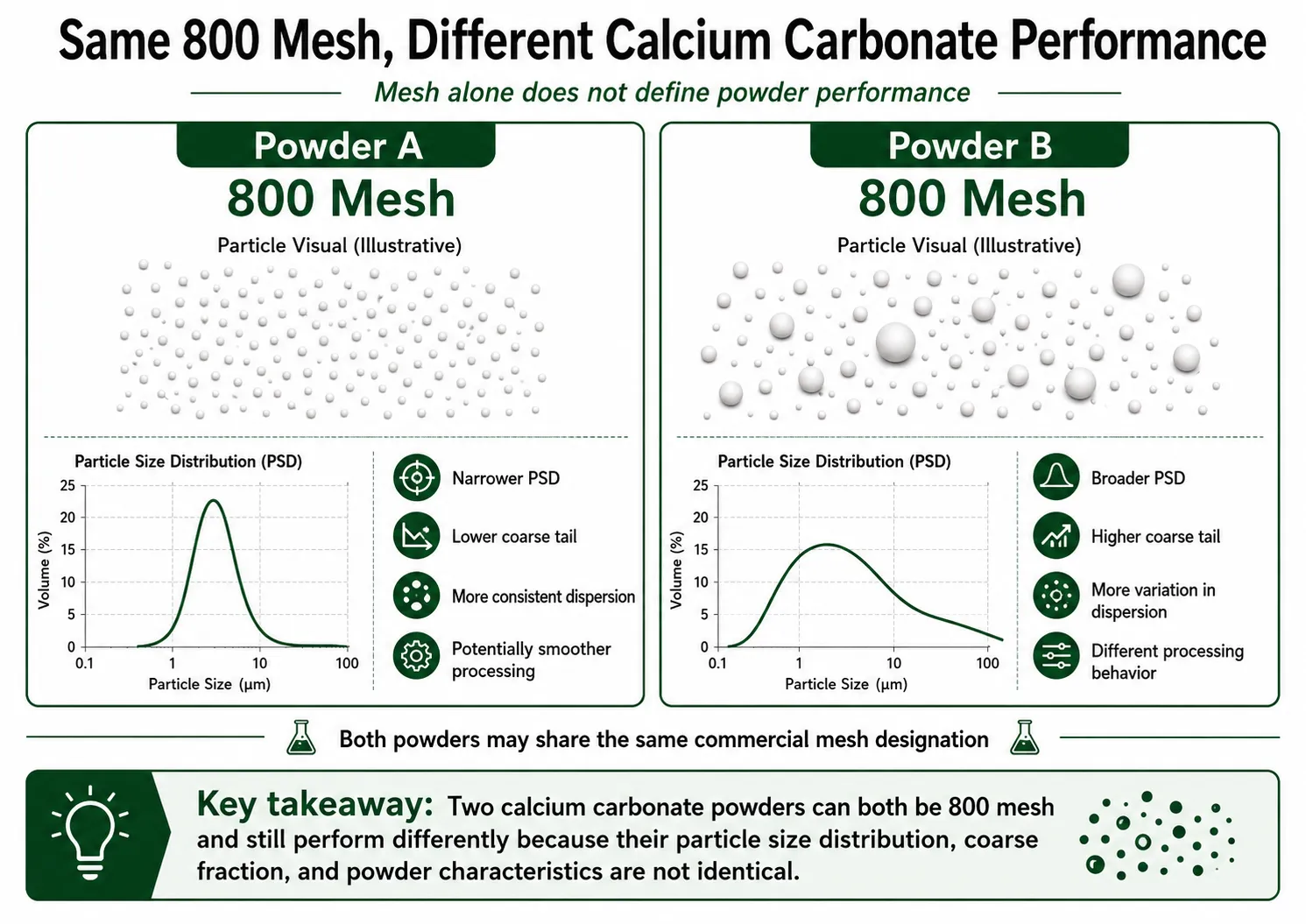
Two calcium carbonate powders can both be sold as 800 mesh and still behave differently in the same industrial formulation. This is because the mesh designation gives only a general indication of fineness. It does not describe every property of the powder or the complete distribution of particle sizes inside the material.
For a technical comparison, buyers need to look beyond the commercial mesh name. Particle size distribution, D50, D97, particle shape, surface condition, dispersion behaviour and production consistency can all help explain why two powders with the same nominal mesh designation may produce different results.
An 800 mesh label can be useful for initial product classification, but it should not be treated as proof that two calcium carbonate products have the same particle size distribution or the same behaviour in production.
1. Their Particle Size Distributions May Be Different
The first difference may appear in the overall particle size distribution. One powder can contain particles concentrated within a relatively limited size range, while another may contain a broader mixture of fine and coarse particles.
Both products may still be marketed under the same mesh designation. Reviewing D50, D97 and the complete PSD where available gives the buyer more information about the actual powder.
2. The Coarse Portion May Be Different
Two products can have similar D50 values while showing noticeably different D97 values. In that situation, their typical particle fineness may appear similar, but one powder contains a greater coarse portion.
Depending on the application, these larger particles may influence dispersion, surface appearance or processing behaviour. This is why the coarse region of the distribution deserves attention when evaluating a fine calcium carbonate grade.
3. Particle Shape and Morphology Can Differ
Calcium carbonate particles are not always identical in shape. Mineral structure, grinding conditions and production processes can influence particle morphology.
Particle shape can affect the way particles pack, disperse and interact with the surrounding material. This means that two powders with similar size data can still behave differently if their particle morphology is significantly different.
4. Dispersion and Agglomeration Matter
Fine particles can form agglomerates when they are not dispersed effectively. This is particularly important in polymer systems and other formulations where uniform distribution of the mineral filler is required.
A powder may look sufficiently fine on a data sheet, but poor dispersion can reduce the practical benefit of that fineness. The behaviour of the material during mixing should therefore be considered alongside laboratory particle size values.
5. Surface Treatment Can Change Powder Behaviour
Surface treatment can change how calcium carbonate particles interact with the surrounding formulation. Coated calcium carbonate is often selected for certain polymer systems because modification of the particle surface can improve compatibility with hydrophobic materials.
For this reason, an uncoated 800 mesh calcium carbonate and a suitably coated 800 mesh calcium carbonate should not be expected to behave identically even when their nominal mesh designation is the same.
6. Production Consistency Is Important
A calcium carbonate product should also be evaluated for consistency from one production batch to another. Stable mineral sourcing, controlled grinding, effective classification and appropriate quality control help maintain more predictable technical characteristics.
This matters for industrial customers because a material that performs well during an initial trial should ideally maintain comparable characteristics during routine production.
The complete spread of particle sizes can differ even when mesh is the same.
The amount of coarse material can differ significantly between powders.
Particle shape can influence packing, dispersion and material interaction.
Agglomeration can change how a fine powder behaves during processing.
Coated and uncoated particles can interact differently with a formulation.
Stable production helps maintain similar characteristics between batches.
A Simple Hypothetical Comparison
Consider two hypothetical powders that are both commercially described as 800 mesh. Their quotation may look similar at first, but a technical review could reveal important differences.
| Parameter | Powder A | Powder B |
|---|---|---|
| Commercial designation | 800 mesh | 800 mesh |
| D50 | Similar range | Similar range |
| D97 | Lower coarse limit | Higher coarse limit |
| PSD | Relatively narrower | Relatively broader |
| Surface condition | Could be untreated | Could be surface treated |
| Application result | Must be confirmed through technical evaluation and application testing | |
This comparison is illustrative only. It does not represent specifications for any Arosha Powder product.
If two suppliers offer the same mesh grade, ask for D50, D97, the measurement method, surface treatment status and the relevant Technical Data Sheet. When the application is sensitive to particle size, testing the material in the actual formulation is even more valuable than comparing commercial mesh names alone.
Research on calcium carbonate filled polymer systems has shown that particle dispersion, particle size and surface characteristics can influence material behaviour. Supporting research is available through Polymer and Powder Technology .
How Does Calcium Carbonate Particle Size Affect Different Industrial Applications?
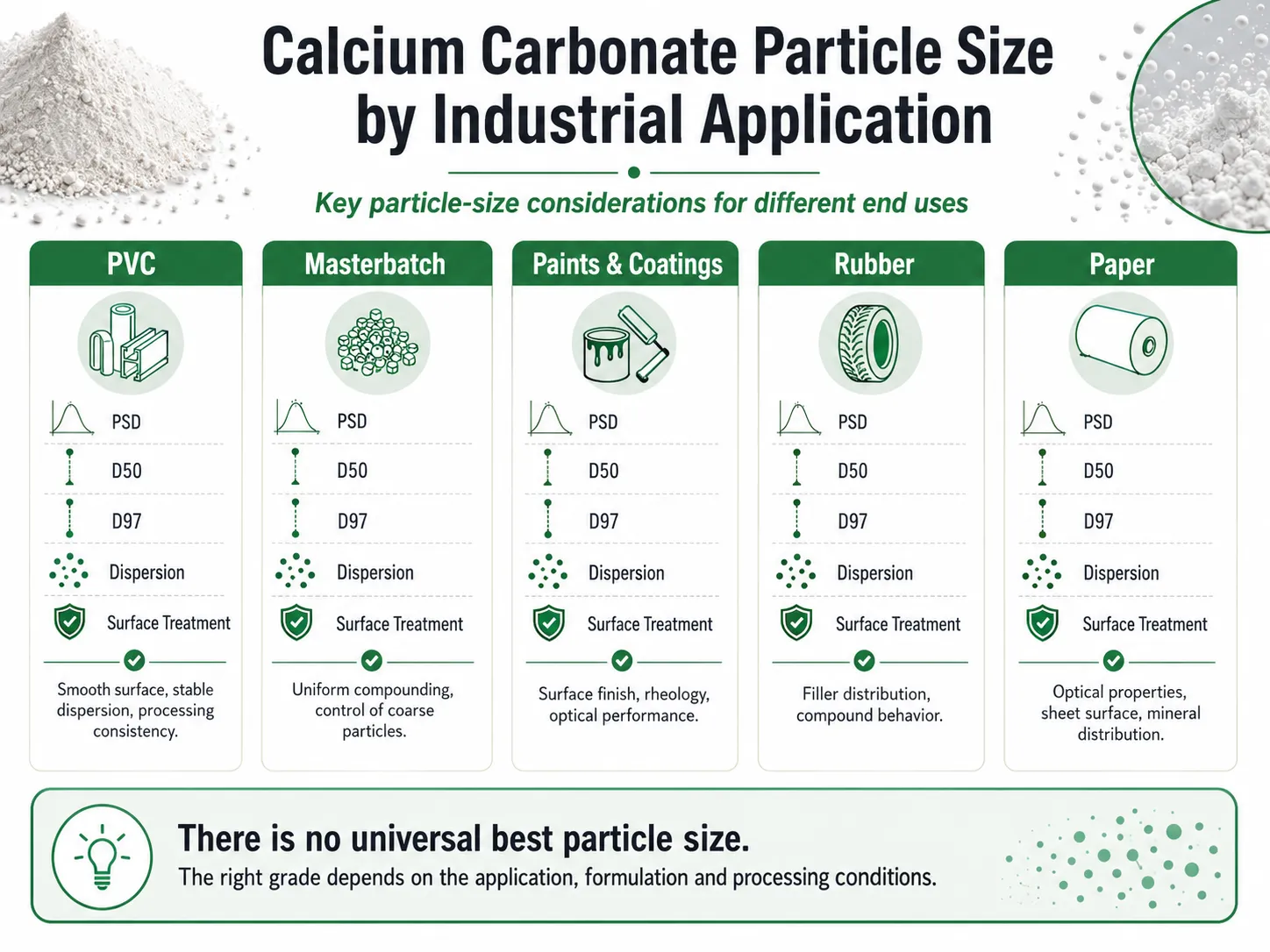
The best calcium carbonate particle size depends on how the mineral will be used. A powder that performs well in one formulation may not be the best choice for another because each application places different demands on dispersion, surface quality, processing and filler loading.
For this reason, industrial buyers should connect particle size data with the final application. Mesh, D50 and D97 become much more useful when they are interpreted alongside the formulation, processing conditions and required product performance.
Calcium Carbonate Particle Size for PVC
In PVC formulations, particle size can influence dispersion, surface appearance, stiffness and processing behaviour. Fine and consistently classified calcium carbonate grades are often considered when a smooth appearance and stable dispersion are important.
The surface condition of the particles also matters. In many polymer systems, coated calcium carbonate may be selected when improved compatibility with the surrounding organic phase is required.
Calcium Carbonate Particle Size for Filler Masterbatch
Filler masterbatch production requires calcium carbonate to disperse effectively through the carrier resin. A suitable particle size distribution can help achieve more uniform mineral distribution during compounding.
Buyers should pay close attention to the coarse portion of the PSD because oversized particles may behave differently during mixing, extrusion and downstream processing.
Calcium Carbonate Particle Size for Paints and Coatings
In paints and coatings, particle size can influence surface finish, rheology, opacity contribution and the way calcium carbonate interacts with other pigments and extenders.
A finer grade may provide different surface and formulation behaviour from a coarser grade, but fineness should not be considered in isolation. Brightness, oil absorption, particle shape and PSD can also be important when evaluating a grade for coating applications.
Calcium Carbonate Particle Size for Rubber
In rubber compounds, particle size affects how the mineral filler is distributed throughout the compound. The relationship between particle size, dispersion and filler loading can influence processing and the mechanical behaviour of the finished material.
The correct choice depends on the rubber formulation and the role calcium carbonate is expected to perform within that system.
Calcium Carbonate Particle Size for Paper
Paper applications can require close control of particle size because the mineral may be used to influence optical properties, surface characteristics and sheet performance.
In these applications, the complete particle size distribution can be more informative than a commercial mesh number because both the fine portion and the coarse portion of the powder may influence performance.
| Application | Why Particle Size Matters | What Buyers Should Review |
|---|---|---|
| PVC | Dispersion, surface appearance, processing and filler interaction | PSD, D50, D97, surface treatment and product consistency |
| Masterbatch | Uniform dispersion and stable behaviour during compounding | D50, D97, coarse fraction, coating status and moisture |
| Paints and Coatings | Surface finish, rheology and interaction with other formulation components | PSD, brightness, oil absorption, particle shape and moisture |
| Rubber | Filler distribution, processing and final compound behaviour | Particle size, dispersion, surface condition and loading requirements |
| Paper | Optical performance, surface characteristics and mineral distribution | PSD, fine fraction, coarse fraction and application requirements |
The finest calcium carbonate grade is not automatically the best grade. The correct particle size distribution is the one that matches the formulation, the production process and the required performance of the finished product.
Particle size is only one part of grade selection. Different industries can also require different levels of brightness, moisture, oil absorption, purity and surface treatment.
Industrial Applications of Calcium Carbonate PowderShould You Choose a Calcium Carbonate Grade by Application or Mesh?
Start with the application. Once the technical requirements of the formulation are clear, particle size data can be used to narrow the selection.
This approach is more reliable than starting with a mesh number and trying to force that grade into every application. A useful purchasing sequence is to define the application, review the required PSD, check surface treatment and other technical parameters, then confirm performance through an application trial when necessary.
Define the final product and processing requirements.
Review mesh, D50, D97 and PSD together.
Confirm whether coated or uncoated material is required.
Compare the declared values in the relevant TDS.
Confirm suitability in the actual formulation when needed.
Product specific particle size information should always be checked through the relevant calcium carbonate data sheet before making a final technical decision.
How to Read Particle Size Data on a Calcium Carbonate TDS
A Technical Data Sheet can tell you much more about calcium carbonate than the commercial grade name alone. The key is knowing which particle size values deserve attention and how those values relate to each other.
When a buyer receives a quotation for calcium carbonate, the first number shown may be a mesh designation. That can be useful as an initial reference, but the technical review should continue with the actual particle size data, the measurement method and the requirements of the intended application.
Do not judge a calcium carbonate grade from one number. Mesh, D50, D97, the measurement method, surface condition and other relevant properties should be considered together.
1. Start With the Product Grade and Surface Condition
First confirm which product you are reviewing. Check whether the material is coated or uncoated and make sure the TDS belongs to the exact grade being offered.
This may sound obvious, but particle size values should not be separated from the identity of the product. A coated grade and an uncoated grade can have similar particle size data while being intended for different formulation conditions.
2. Read the Mesh Designation as a Commercial Reference
If the TDS lists a mesh number, use it as a general indication of the commercial fineness category. Do not assume that the mesh number tells you the exact size of every particle in the powder.
If the sieve standard is important to your purchasing specification, ask which standard and test method were used.
3. Check D50
D50 gives you information about the middle of the measured particle size distribution. It is useful when comparing the general fineness of two powders, but it should not be used as the only particle size criterion.
If two products have similar D50 values, continue reading the TDS before deciding that they are technically equivalent.
4. Check D97 or Another Coarse Percentile
D97 helps you understand the coarse region of the measured distribution. This information can reveal differences that are not obvious from D50.
If a TDS reports D90 instead of D97, the same general principle applies. Identify which percentile is being reported and compare equivalent values rather than treating different percentiles as interchangeable.
5. Confirm the Measurement Method
Particle size numbers become much more useful when the measurement method is known. If the result was obtained by laser diffraction, the TDS or supporting laboratory documentation should ideally make that clear.
When comparing suppliers, values obtained using different analytical methods or preparation procedures may not be directly comparable.
6. Look for the Distribution Basis
Check whether the reported particle size values are based on volume, number or another reporting basis. This detail changes how the distribution should be interpreted.
Larger particles contribute much more strongly to a volume based distribution than they do to a number based distribution, so the basis should be known before technical comparisons are made.
7. Read Particle Size Together With Other Properties
Particle size is important, but it is only one part of calcium carbonate selection. Depending on the application, the same TDS may also provide useful information about CaCO3 content, moisture, brightness, whiteness, oil absorption, bulk density and surface treatment.
These values help explain why two calcium carbonate powders with similar particle size data may still behave differently in an actual formulation.
| TDS Parameter | Example Entry | What the Buyer Should Ask |
|---|---|---|
| Commercial Grade | 800 Mesh | Which sieve reference or commercial convention is being used? |
| D50 | Example value in µm | What is the median particle size and what method produced this value? |
| D97 | Example value in µm | How far does the coarse portion of the distribution extend? |
| Measurement Method | Laser Diffraction | Was the same method used for the products being compared? |
| Distribution Basis | Volume based | Are all compared values reported on the same basis? |
| Surface Condition | Coated or Uncoated | Is the surface condition suitable for the target formulation? |
The entries above are educational examples only. They are not technical specifications for an Arosha Powder product.
What If the TDS Only Shows Mesh?
If particle size is important to your application and the TDS only provides a mesh designation, ask the supplier for additional technical information. Depending on the product and available quality control data, this may include D50, D97, a particle size distribution report or clarification of the test method.
This is particularly useful when comparing fine grades that may look very similar in a commercial quotation.
The safest supplier comparison uses equivalent parameters measured under comparable conditions. Comparing an 800 mesh label from one supplier with a D50 value from another supplier does not give you a meaningful technical comparison.
Arosha Powder product documentation can be reviewed through the calcium carbonate data sheets section. Product specific values should always be taken from the relevant technical document rather than estimated from general particle size tables.
ISO 13320 provides guidance for particle size distribution measurement using laser diffraction. Malvern Panalytical also provides technical guidance on particle size distribution and the interpretation of particle size statistics.
ISO 13320:2020 Malvern Panalytical Particle Size GuideHow Should Buyers Compare Calcium Carbonate Suppliers?
Comparing calcium carbonate suppliers should involve more than checking the quoted price and commercial mesh number. A supplier may offer an attractive grade name, but the real question is whether the material can deliver consistent technical performance from one shipment to the next.
For industrial buyers, supplier evaluation should combine product data, mineral sourcing, particle size control, quality documentation, production consistency and logistics capability. Looking at these factors together gives a much clearer picture than comparing price per ton alone.
A useful supplier is not simply the company offering the finest mesh or the lowest price. The stronger choice is the supplier that can provide the required grade with consistent specifications, clear technical documentation and dependable supply.
1. Ask Where the Raw Material Comes From
The quality of ground calcium carbonate begins with the mineral source. Buyers should understand whether the supplier has stable access to suitable calcium carbonate rich deposits and whether the raw material remains reasonably consistent over time.
Variations in the mineral source can influence chemical composition, brightness, impurities and the behaviour of the material during grinding and classification.
2. Review Particle Size Data, Not Just Mesh
If two suppliers both offer an 800 mesh or 1250 mesh product, continue the comparison with D50, D97 and the available PSD information.
Ask how the values were measured and whether the same analytical method is used consistently during quality control. This makes technical comparisons more meaningful and reduces the risk of selecting two products that look similar on paper but behave differently in production.
3. Check the Technical Data Sheet
A Technical Data Sheet should provide the declared characteristics of the selected product grade. Depending on the product, buyers may review particle size values, chemical composition, moisture, brightness, whiteness, oil absorption, bulk density and surface treatment.
The important point is not simply whether a supplier has a TDS. The document should belong to the exact grade being offered and the information should be relevant to the buyer's application.
4. Ask for Batch Specific Quality Data When Needed
For applications with tighter technical requirements, buyers may also need a Certificate of Analysis for the production batch being supplied.
A batch specific COA can help confirm selected measured values and provides an additional level of confidence when the customer needs traceable quality information for incoming material.
5. Compare Surface Treatment Status
Coated and uncoated calcium carbonate should not be compared as if they were the same material simply because their particle size is similar.
Surface treatment can change the way the powder interacts with polymers and other formulation components. When comparing suppliers, confirm whether the material is coated, which type of treatment is used where relevant and whether that surface condition matches the intended application.
6. Evaluate Production Consistency
A successful laboratory trial is only the beginning. Industrial customers usually need the same grade repeatedly, which makes production consistency an important part of supplier evaluation.
Buyers should consider whether the supplier can maintain comparable particle size characteristics and other declared properties across routine production batches.
7. Consider Supply and Export Capability
Technical quality is only useful if the material can arrive when the customer needs it. Buyers importing calcium carbonate should also review packaging options, production capacity, lead time, documentation and the supplier's ability to support international shipments.
When evaluating a calcium carbonate powder supplier in Asia , it is useful to consider the relationship between mineral sourcing, production control and export capability rather than evaluating these areas separately.
Review the consistency and suitability of the calcium carbonate rich raw material.
Compare mesh, D50, D97, PSD and the measurement method.
Review the TDS and request batch specific quality data when required.
Confirm whether the grade is coated or uncoated and whether it fits the formulation.
Consider whether the supplier can maintain stable characteristics over repeated production.
Review packaging, lead time, logistics and the ability to support regular industrial demand.
Why Direct Mineral Access Can Matter
For ground calcium carbonate, the production chain begins before the grinding mill. Access to a stable mineral source can help a producer manage raw material selection before crushing, grinding and classification begin.
This is one reason industrial buyers may consider working with a direct from mine calcium carbonate supplier when mineral consistency and long term supply are important to the purchasing strategy.
Direct mineral access does not replace technical testing. The final product should still be evaluated using its declared specifications, quality documents and performance in the customer's own formulation.
| Supplier Question | Why It Matters |
|---|---|
| What is the mineral source? | Raw material consistency can influence the characteristics of the finished GCC powder. |
| What are the D50 and D97 values? | These values provide more technical information than mesh alone. |
| How is particle size measured? | The measurement method affects how the reported values should be interpreted. |
| Is the product coated or uncoated? | Surface condition can change compatibility with the final formulation. |
| Is a TDS available? | The TDS provides the declared technical characteristics of the selected grade. |
| Can a COA be provided? | A batch specific COA can help verify selected quality parameters. |
| Can regular industrial quantities be supplied? | Supply reliability is important when the material becomes part of routine production. |
A lower purchase price can become expensive if the powder creates processing instability, inconsistent finished product quality or repeated adjustments to the formulation. Technical consistency and application performance should therefore be considered alongside commercial price.
Buyers can review Arosha Powder's export information, packaging approach and international supply process before requesting a technical quotation.
View Calcium Carbonate Export InformationFrequently Asked Questions About Calcium Carbonate Particle Size
Particle size data can look complicated at first, especially when mesh, micron, D50, D97 and PSD appear together on quotations and technical data sheets. The following answers cover the questions industrial buyers most often need to understand before comparing calcium carbonate grades.
What is calcium carbonate particle size?
Calcium carbonate particle size describes the dimensions of the particles present in a calcium carbonate powder. Because a real powder contains particles of different sizes, technical evaluation usually considers the complete particle size distribution rather than one single particle diameter.
What does mesh mean in calcium carbonate?
Mesh is commonly used as a commercial reference for powder fineness and is related to sieve classification. In general, a higher mesh designation indicates a finer commercial grade, but the mesh number alone does not describe the complete particle size distribution.
What is the difference between mesh and micron?
Mesh is related to a sieve classification system, while micron is a direct unit of length. One micron is equal to 0.001 millimetre. A mesh value should not be treated as an exact particle diameter unless the applicable sieve standard and opening size are known.
Can calcium carbonate mesh be converted directly to micron?
Mesh can be associated with nominal sieve opening sizes, but a general conversion table should only be used as a reference. It does not describe the complete particle population inside a calcium carbonate powder and should not replace product specific particle size data.
What does D50 mean in calcium carbonate?
D50 represents the median particle size of the measured distribution. When reported on a volume basis, 50 percent of the measured particle volume lies below the stated particle diameter.
What does D97 mean in calcium carbonate?
D97 provides information about the coarse region of the particle size distribution. When reported on a volume basis, approximately 97 percent of the measured particle volume lies below the stated size. It can help buyers identify differences in the larger particle fraction of two powders.
Is D50 enough to compare two calcium carbonate powders?
No. Two powders can have similar D50 values while having different D97 values and different overall particle size distributions. A stronger technical comparison considers D50, D97, PSD and the measurement method together.
Can two 800 mesh calcium carbonate powders be different?
Yes. Two products described as 800 mesh can have different particle size distributions, coarse fractions, particle morphology, surface conditions and dispersion behaviour. The same commercial mesh name does not guarantee identical technical performance.
How is calcium carbonate particle size measured?
Particle size can be evaluated using methods such as sieve analysis and laser diffraction. The appropriate method depends on the powder and the information required. Fine industrial calcium carbonate is often evaluated using particle size distribution data from instrumental analysis.
Why does the particle size measurement method matter?
Different analytical methods use different physical principles. Sample preparation, dispersion conditions and the reporting basis can also influence the result. Buyers should therefore compare particle size values obtained under comparable conditions.
What is the best calcium carbonate particle size?
There is no universal best particle size. The right distribution depends on the application, formulation, processing conditions and required final product performance. A finer powder is not automatically a better powder.
What particle size data should buyers request from a supplier?
Buyers should review the commercial mesh designation together with D50, D97 or another relevant coarse percentile, the available PSD, the measurement method and the distribution basis. Surface treatment and other application specific properties should also be considered.
View Calcium Carbonate Data SheetsReferences and Scientific Sources
This guide was prepared using international measurement standards, technical documentation and scientific research related to particle size analysis and calcium carbonate performance. The sources below support the measurement concepts, terminology and industrial considerations discussed throughout the article.
International reference for particle size distribution measurement using laser diffraction. This source supports the sections covering PSD measurement, sample dispersion and interpretation of particle size data.
View ISO 13320:2020Technical reference for woven wire test sieves and particle classification. This source supports the explanation of mesh, sieve openings and why the applicable sieve specification matters.
View ASTM E11International standard defining technical requirements and testing methods for metal wire test sieves. It provides additional support for the discussion of sieve based particle classification.
View ISO 3310 1Reference for the SI prefix micro and the use of micrometre units. This source supports the explanation of micron as a direct unit of particle dimension.
View NIST ReferenceTechnical guidance for understanding particle size distributions, Dv50 and different distribution bases. This source supports the sections explaining D50, PSD and the interpretation of laboratory particle size results.
View Particle Size GuideScientific research examining calcium carbonate particle behaviour in polypropylene systems. The study supports the broader discussion of how particle characteristics and dispersion can influence the performance of calcium carbonate filled polymer materials.
View Research ArticleScientific research investigating the relationship between calcium carbonate particle size and coating performance. This source supports the article section explaining why particle size requirements can differ between industrial applications.
View Research ArticleGeneral standards and scientific references explain measurement principles and material behaviour. They should not be used as substitutes for product specific specifications. Technical values for an individual Arosha Powder grade should always be confirmed through the applicable Technical Data Sheet or batch specific Certificate of Analysis.
Review the available technical documentation for Arosha Powder calcium carbonate grades before comparing products for an industrial application.
View Calcium Carbonate Data Sheets
Technical Review by Prof. Ali Ihsan Arol
The technical concepts presented in this article, including particle size distribution, mesh terminology, micron measurement, D50, D97 and particle size analysis, have been reviewed for scientific clarity and technical consistency by Prof. Ali Ihsan Arol.
Particle size values should always be interpreted together with the measurement method, sample preparation conditions and the applicable product specification. General educational information should not replace the Technical Data Sheet or batch specific Certificate of Analysis for an individual calcium carbonate grade.
View Prof. Ali Ihsan Arol Academic ProfileHow useful was this post?
Click on a star to rate it!
Average rating 4.5 / 5. Vote count: 2
No votes so far! Be the first to rate this post.