Send Your Request
Fill in the form below and our team will get back to you shortly.
Your message has been received.
Our team will respond to your request as soon as possible.
Products
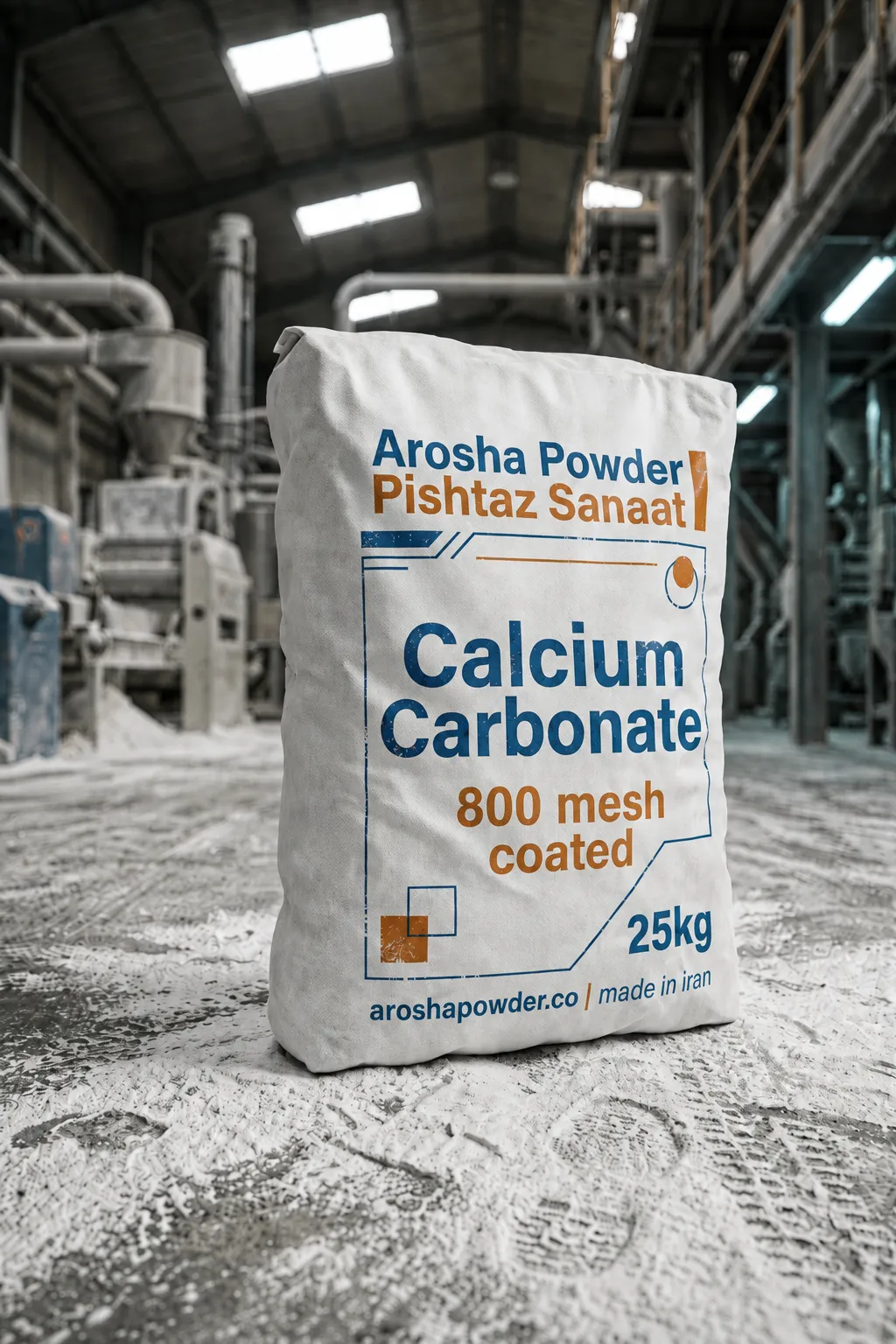
Arosha Powder manufactures and exports coated calcium carbonate powder for industrial formulations that require improved interaction between mineral filler particles and hydrophobic polymer or elastomer systems. Produced from selected natural limestone, the ground calcium carbonate is classified to defined particle-size grades and surface-treated with stearic acid before final quality verification.
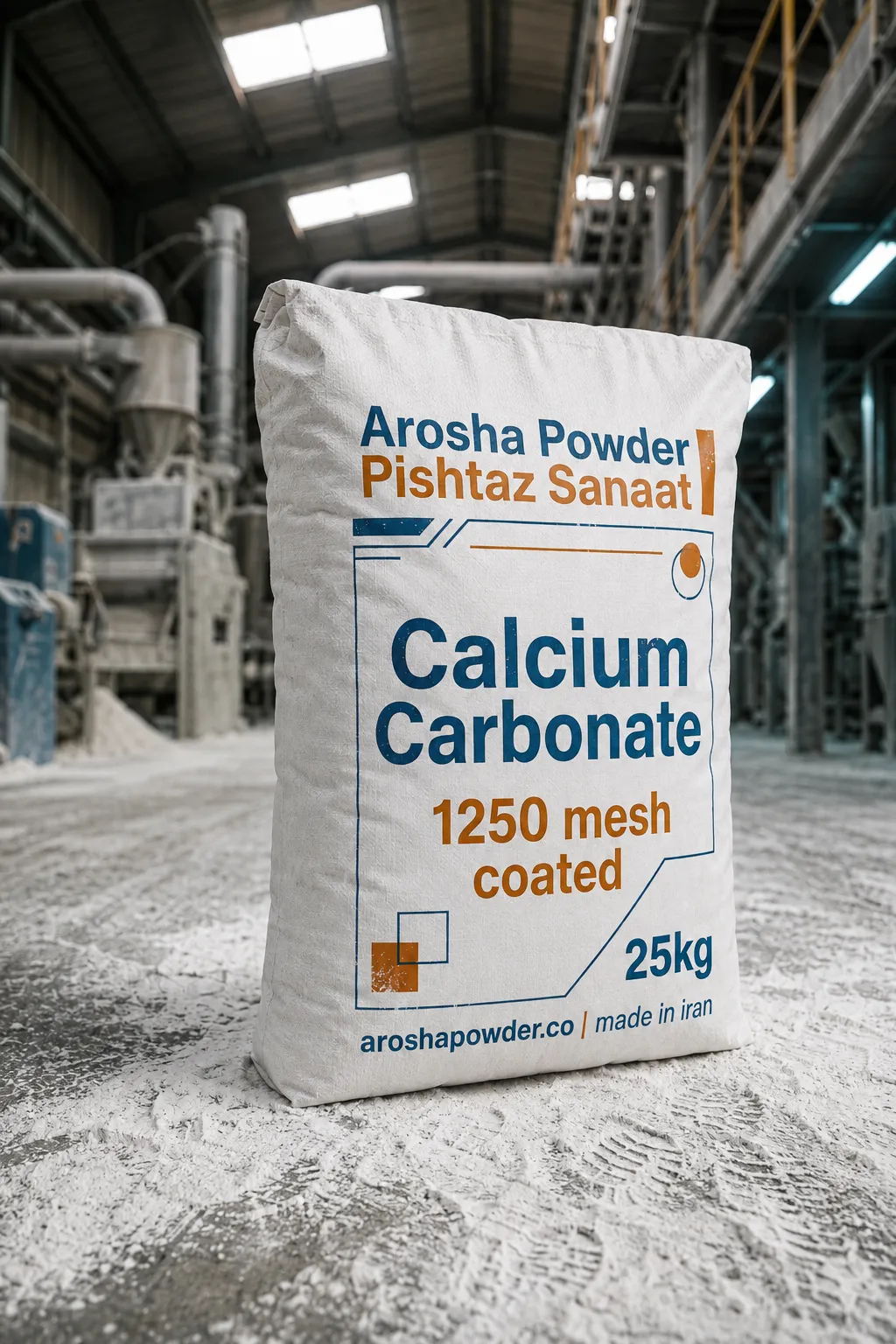
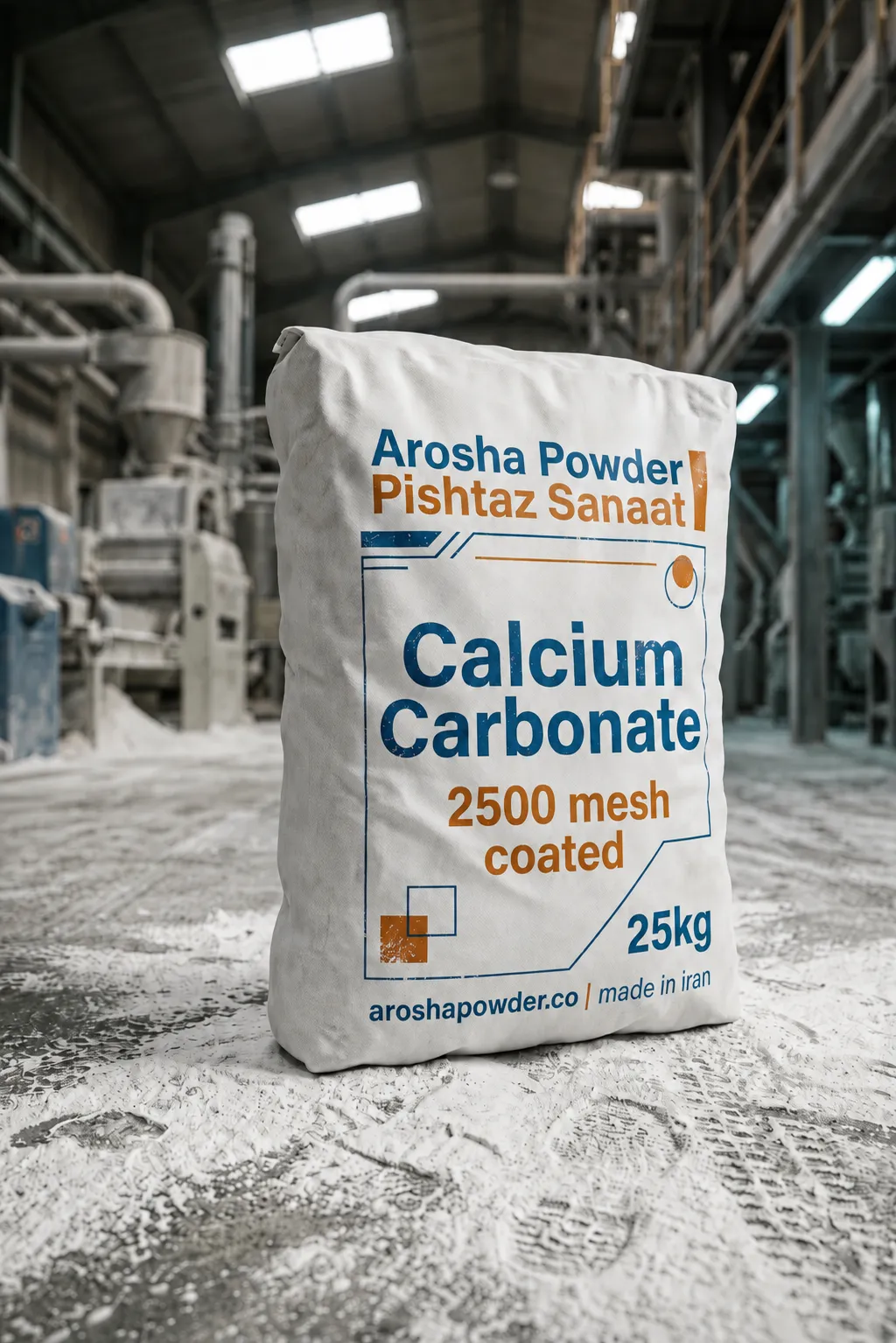
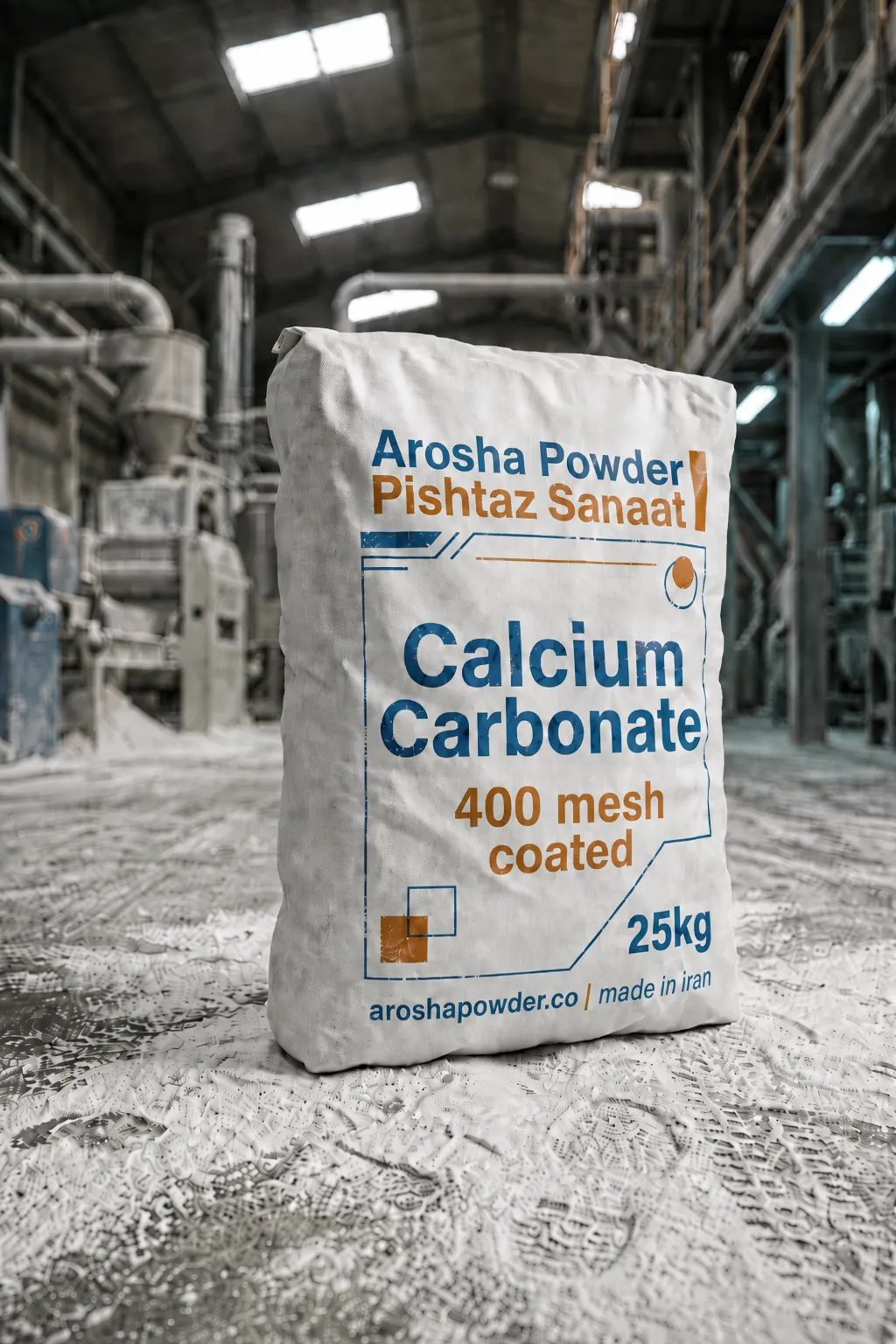
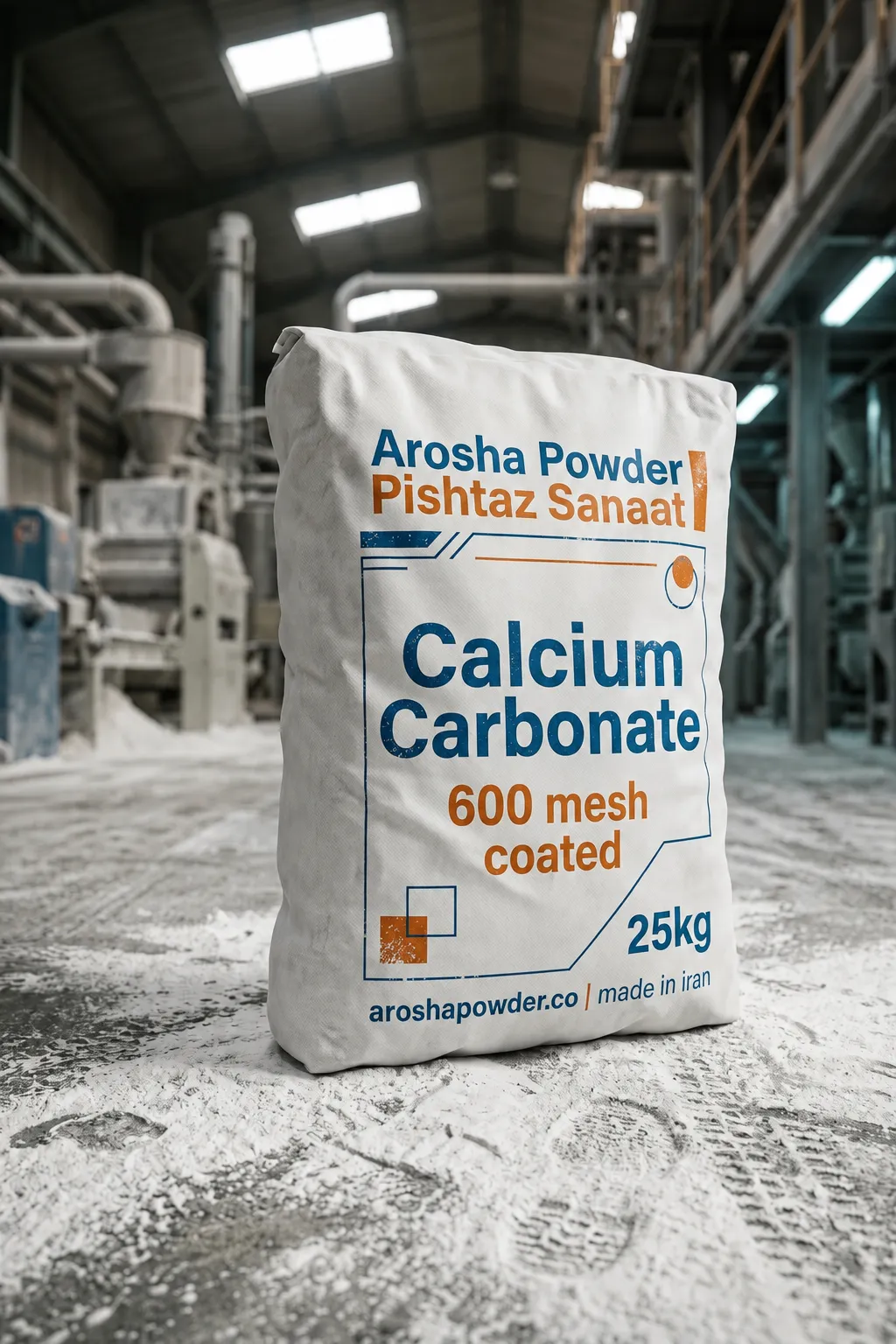
Our coated GCC portfolio includes 400, 600, 800, 1250 and 2500 Mesh grades for PVC compounds, filler masterbatch, polyethylene and polypropylene compounds, cable materials, rubber products, artificial leather and other selected applications. Buyers can compare adjacent grades, request grade-specific technical data sheets, evaluate samples and receive batch documentation for commercial orders.
Find the Right Coated Grade | Request an Export Quote
Coated calcium carbonate is natural ground calcium carbonate (GCC) whose particle surface has been modified with an organic treatment agent, commonly stearic acid. The mineral core remains calcium carbonate; the treatment changes the surface behavior of the particles rather than converting GCC into precipitated calcium carbonate or a different mineral.
Untreated calcium carbonate has a naturally hydrophilic surface. This can limit wetting and dispersion in hydrophobic matrices such as many PVC, PE, PP and rubber systems. A controlled surface treatment makes the particles more organophilic and can improve their interaction with polymer-based formulations.
The word coated is not, by itself, a complete technical specification. Performance depends on the particle-size distribution, coating chemistry, treatment level, surface coverage, moisture, purity, oil absorption and the buyer’s complete formulation. The correct grade should therefore be approved through technical-data review and production testing rather than selected by mesh name alone.
| Category Attribute | Description |
| Product family | Natural ground calcium carbonate with surface treatment |
| Typical treatment | Stearic-acid surface treatment; grade-specific confirmation required |
| Surface behavior | More organophilic / hydrophobic than untreated GCC |
| Primary function | Mineral filler, extender and formulation-cost optimizer |
| Main target systems | PVC, PE, PP, masterbatch, cable compounds, rubber and selected polymer systems |
| Available grades | 400, 600, 800, 1250 and 2500 Mesh |
| Technical approval | Grade-specific TDS, sample testing and batch-specific COA |
| Commercial supply | Industrial and export orders; packaging and terms confirmed in quotation |
A suitable coating can create measurable formulation and processing benefits, but the result is application-dependent. Industrial buyers commonly evaluate coated GCC for the following reasons:
The treated surface can wet more readily in hydrophobic resins and elastomers. Better dispersion may reduce visible agglomerates and support more consistent feeding, mixing and finished appearance.
A hydrophobic surface can reduce the mineral’s affinity for water compared with untreated GCC. This may be valuable in moisture-sensitive compounds, although storage, packaging and process humidity still require control.
Coating quality, oil absorption and particle profile influence compound viscosity, torque, melt flow and extrusion stability. A correctly selected grade can support processing efficiency without implying that every coated grade behaves identically.
Improved polymer-filler interaction may allow a formulator to raise calcium carbonate loading while maintaining acceptable processing and finished properties. The practical limit depends on resin, additives, equipment and end-product requirements.
Finer and well-dispersed treated particles can support smoother surfaces and more consistent visual quality. Particle-size distribution remains as important as the coating itself.
| Buyer decision point Do not approve a coated grade only because it is labeled stearic-acid treated. Request the treatment level or activation result, moisture, oil absorption, particle-size data, purity, whiteness and a batch-specific COA. Then validate the material in the actual formulation. |
Arosha Powder supplies multiple coated mesh grades so buyers can balance particle fineness, surface finish, filler loading, powder handling and material cost. The table below is a starting-point guide and does not replace formulation trials or the approved TDS for each product.
| Grade | Relative Position | Typical Starting Applications | Selection Note |
| 400 Mesh | Coarser / economical | Rigid PVC pipe and profiles, standard filler masterbatch, general rubber and high-volume compounds | Start here when cost and practical loading are more important than a very fine surface. |
| 600 Mesh | Medium | General PVC compounds, profiles, cable compounds, flexible products and balanced masterbatch applications | Useful middle position when 400 Mesh is too coarse but very fine powder is unnecessary. |
| 800 Mesh | Medium-fine | Flexible PVC, artificial leather, cable compounds, smoother masterbatch and selected plastic products | Consider when improved finish and dispersion justify greater fineness. |
| 1250 Mesh | Fine | Finer PE/PP compounds, film-related masterbatch, cable insulation, thin-wall products and premium polymer formulations | Use where top-cut control and smoother surfaces are more critical. |
| 2500 Mesh | Very fine / specialty | Specialty masterbatch, selected coatings, high-surface-finish compounds and demanding polymer systems | Choose only when the application benefits from very fine particles and can handle the associated processing profile. |
CTA: Compare All Coated Grades | CTA: Send Your Current TDS for Grade Matching
Coated GCC is most valuable when the surface treatment solves a real compatibility, dispersion or processing requirement. The grade and filler level should be selected for the final formulation rather than assigned to an industry in isolation.
In rigid PVC compounds, coated calcium carbonate can serve as a cost-effective mineral filler while contributing to dimensional stability, stiffness and processing economics. Coarser to medium grades are common starting points where high filler loading and stable extrusion are important. The optimum loading depends on the resin K-value, stabilizer and lubricant package, wall thickness, impact requirement and extruder configuration.
In polyethylene or polypropylene carrier systems, the treated surface can improve wetting and distribution of calcium carbonate within the polymer. Buyers should evaluate carrier resin, coating quality, top cut, moisture and screen-pack behavior. Standard masterbatch may use medium grades, while thin films or demanding molded products generally require finer and more tightly controlled particles.
Coated GCC can be used in selected injection-molding, extrusion and compound applications to optimize formulation cost and adjust stiffness, opacity, dimensional behavior and processing. Results vary with resin type, product geometry, filler loading and impact requirements; production testing is essential.
PVC and polyolefin cable compounds may benefit from treated calcium carbonate where controlled dispersion, low moisture and consistent electrical or mechanical performance are required. Finer grades are usually the stronger starting point for insulation and thin-wall applications, subject to the complete cable specification.
Flexible PVC sheet, flooring, synthetic leather and related products often require a smoother filler profile than rigid pipe. Coated medium-fine grades can support dispersion and surface uniformity, but plasticizer demand, viscosity, embossing, flexibility and aging should be tested in the finished formulation.
In natural and synthetic rubber compounds, coated calcium carbonate can act as a mineral extender in hoses, footwear, mats, seals, gaskets and molded products. The treatment may support mixing and filler distribution, while the required grade depends on surface finish, hardness, elongation, tear performance and cure behavior.
Some solvent-based, reactive or polymer-rich adhesive and sealant systems may benefit from a hydrophobic treated filler. Suitability depends on binder chemistry, rheology, adhesion, storage stability and cure. Water-based or cementitious systems should also be compared with uncoated GCC because surface treatment is not automatically advantageous.
| Application | Category Fit | Typical Starting Range | Qualification Note |
| Rigid PVC pipe / profile | High | 400–600 Mesh | Prioritize loading, extrusion stability and impact balance |
| Filler masterbatch | High | 400–1250 Mesh | Match top cut to downstream film or molded application |
| Flexible PVC / artificial leather | High | 600–1250 Mesh | Validate plasticizer demand, viscosity and finish |
| PE / PP compounds | Medium to high | 800–2500 Mesh | Application geometry and impact requirements control selection |
| Cable compounds | Medium to high | 800–2500 Mesh | Control moisture, dispersion and product-specific limits |
| General rubber goods | Medium to high | 400–1250 Mesh | Test cure, hardness, elongation and surface |
| Water-based paint / dry mortar | Conditional | Compare with uncoated | Coating may not create a useful benefit |
| Food / feed / pharmaceutical | Not standard | Separate compliant grade required | Industrial category must not imply regulatory approval |
Coated calcium carbonate is not automatically superior to uncoated GCC. Surface treatment should be selected when it produces a measurable benefit in the buyer’s matrix. Using a coated grade in a water-based or cementitious product can add cost without improving performance, while using an untreated grade in a hydrophobic polymer can create dispersion or moisture-related limitations.
| Decision Factor | Coated GCC | Uncoated GCC |
| Surface character | Organophilic / more hydrophobic | Naturally hydrophilic |
| Common starting systems | PVC, PE, PP, masterbatch, rubber, polymer-rich compounds | Water-based, cementitious, ceramic and general mineral-filled systems |
| Dispersion in hydrophobic polymers | Generally more favorable when coating is well controlled | May require more mixing energy or lower loading |
| Moisture affinity | Typically lower than comparable untreated GCC | Higher natural affinity for water |
| Cost | Includes surface-treatment value and processing cost | Usually lower purchase cost for the same particle grade |
| Selection rule | Use when polymer compatibility or process stability benefits are demonstrated | Use when the natural mineral surface is technically compatible |
CTA: Compare Uncoated Calcium Carbonate Grades
A mesh label alone cannot predict compound performance. Before approving a coated calcium carbonate supplier, review the complete specification and test methods.
A high-quality coated GCC should demonstrate consistent treatment and predictable behavior rather than simply containing a declared percentage of stearic acid. Buyers may compare activation index or flotation behavior, moisture, oil absorption, agglomeration, dispersion, torque, pressure, screen residue and finished-product properties. The most meaningful acceptance method is a combination of supplier test data and a repeatable customer production trial.
Arosha Powder controls the supply chain from selected limestone resources through grinding, classification, surface treatment, packaging and export preparation. Order-critical properties should be defined before production and confirmed through the technical and commercial documents for the selected grade.
A Technical Data Sheet describes the standard target profile of a grade. A Certificate of Analysis reports the test results of an identified production batch. Buyers should compare the batch COA with the approved purchase specification instead of treating a generic downloadable certificate as proof for every shipment.
For new formulations, request a representative sample and test it under the intended processing conditions. Where a customer requires tighter particle-size, optical, moisture or coating limits, feasibility should be reviewed before the order is confirmed.
CTA: View Technical Data Sheets | CTA: Review Arosha Powder Quality Control
Coated calcium carbonate can be supplied in industrial packaging selected according to grade, order volume, destination, handling equipment and customer requirements. Bag weight, inner liner, jumbo-bag configuration, palletizing, labeling, private branding and container loading must be confirmed in the commercial quotation.
Store the product in a dry, covered area and protect opened or damaged bags from humidity and contamination. Although the surface treatment reduces affinity for moisture, poor storage can still affect powder flow, feeding and process consistency.
For an accurate export quotation, send the required grade, current supplier TDS, monthly consumption, packaging preference, destination country and port, and the Incoterm requested by your purchasing team.
Our objective is to help the buyer qualify a coated calcium carbonate grade that supports stable processing and the required finished-product properties—not simply to sell the finest or most expensive powder.
Send the following information so Arosha Powder’s sales and technical teams can identify the most relevant coated grade and prepare a technically accurate quotation:
Primary CTA: Request an Export Quote | Secondary CTA: Contact Sales on WhatsApp
Coated calcium carbonate is natural ground calcium carbonate whose particle surface has been treated with an organic agent, commonly stearic acid, to improve compatibility with many hydrophobic polymer and elastomer systems.
No. Coated GCC is produced from natural limestone by grinding, classification and surface treatment. Precipitated calcium carbonate is created through a chemical precipitation process and can have different particle shapes and properties.
Stearic acid is commonly used to make the mineral surface more organophilic and hydrophobic. In suitable formulations, this can support polymer wetting, dispersion, lower moisture affinity and more predictable processing.
Choose the grade by surface treatment, D50, D97 or top cut, sieve residue, moisture, oil absorption, required finish, filler loading and processing conditions. The finest grade is not automatically the best or most economical choice.
The 1250 Mesh grade is finer and is generally evaluated for smoother or more demanding polymer applications. The 400 Mesh grade is a more economical starting point for high-volume compounds such as rigid PVC and standard filler masterbatch. Compare the approved TDS and run production trials.
Yes. Coated GCC is widely evaluated in rigid and flexible PVC compounds, profiles, pipes, cable materials, flooring and artificial leather. The grade and loading must be matched to the formulation and equipment.
Yes, subject to particle-size and coating requirements. The downstream film or molded application determines whether a medium, fine or very fine grade is required.
It may be technically usable, but surface treatment is not automatically beneficial in water-based or cementitious systems. Compare the formulation with an uncoated GCC grade before approving the added treatment cost.
Review the treatment specification, activation or flotation result, moisture, oil absorption and batch COA, then evaluate dispersion and processing in your actual formulation.
Grade-specific TDS documents can be provided for evaluation. A COA should be issued for the identified production batch and compared with the approved purchasing specification.
Sample availability can be confirmed according to the selected grade, intended application, destination and required quantity.
Not by default. Standard industrial coated GCC must not be presented as food, feed or pharmaceutical grade without separate regulatory and analytical documentation.