
Send Your Request
Fill in the form below and our team will get back to you shortly.
Your message has been received.
Our team will respond to your request as soon as possible.
Tell us what you need and our team will contact you shortly.
Get instant purchase consultation and product guidance directly on WhatsApp.
D97: 37 Micron · Oil Absorption ≤ 25 g/100g · Whiteness ≥ 96% · Stearic Acid Coated
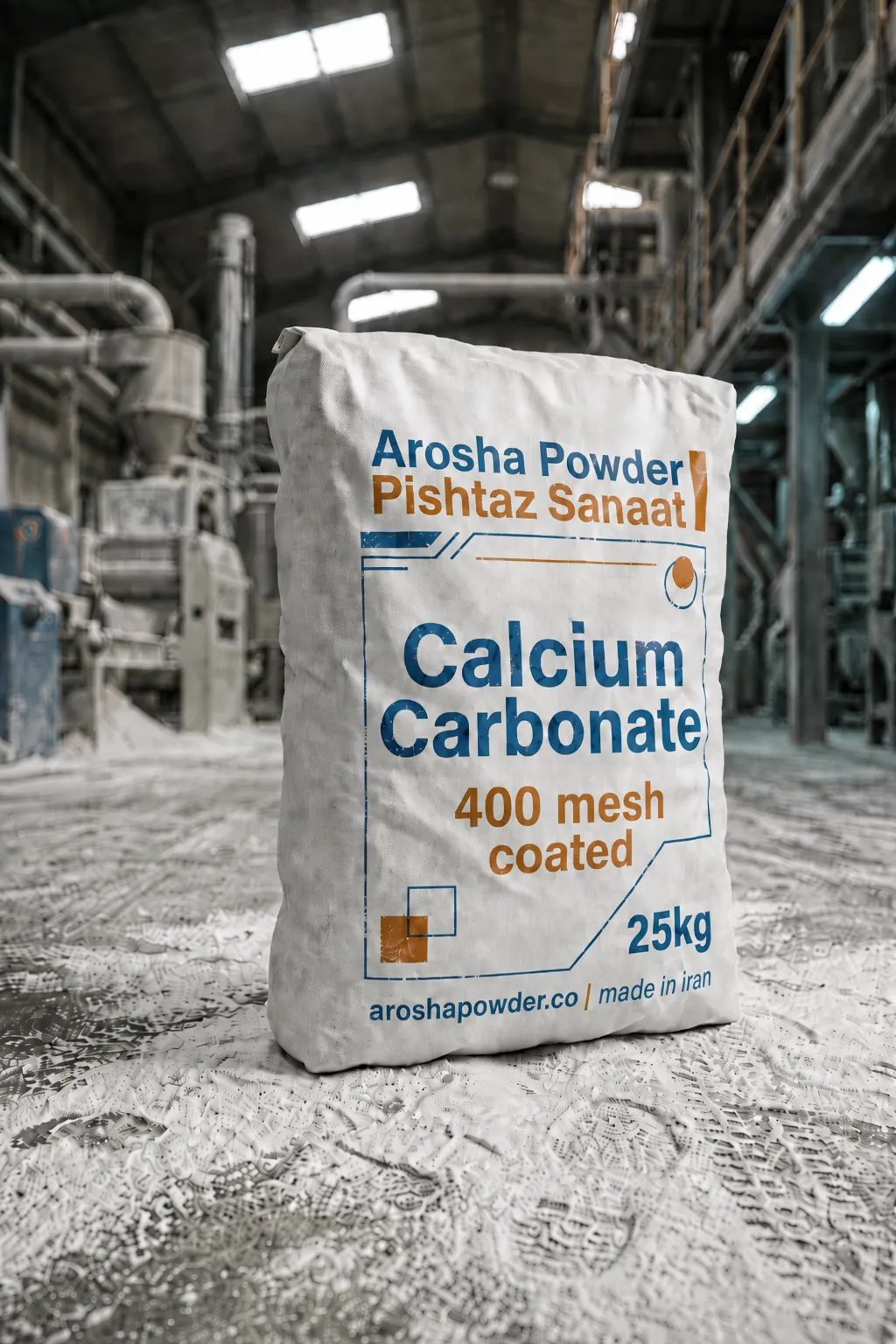
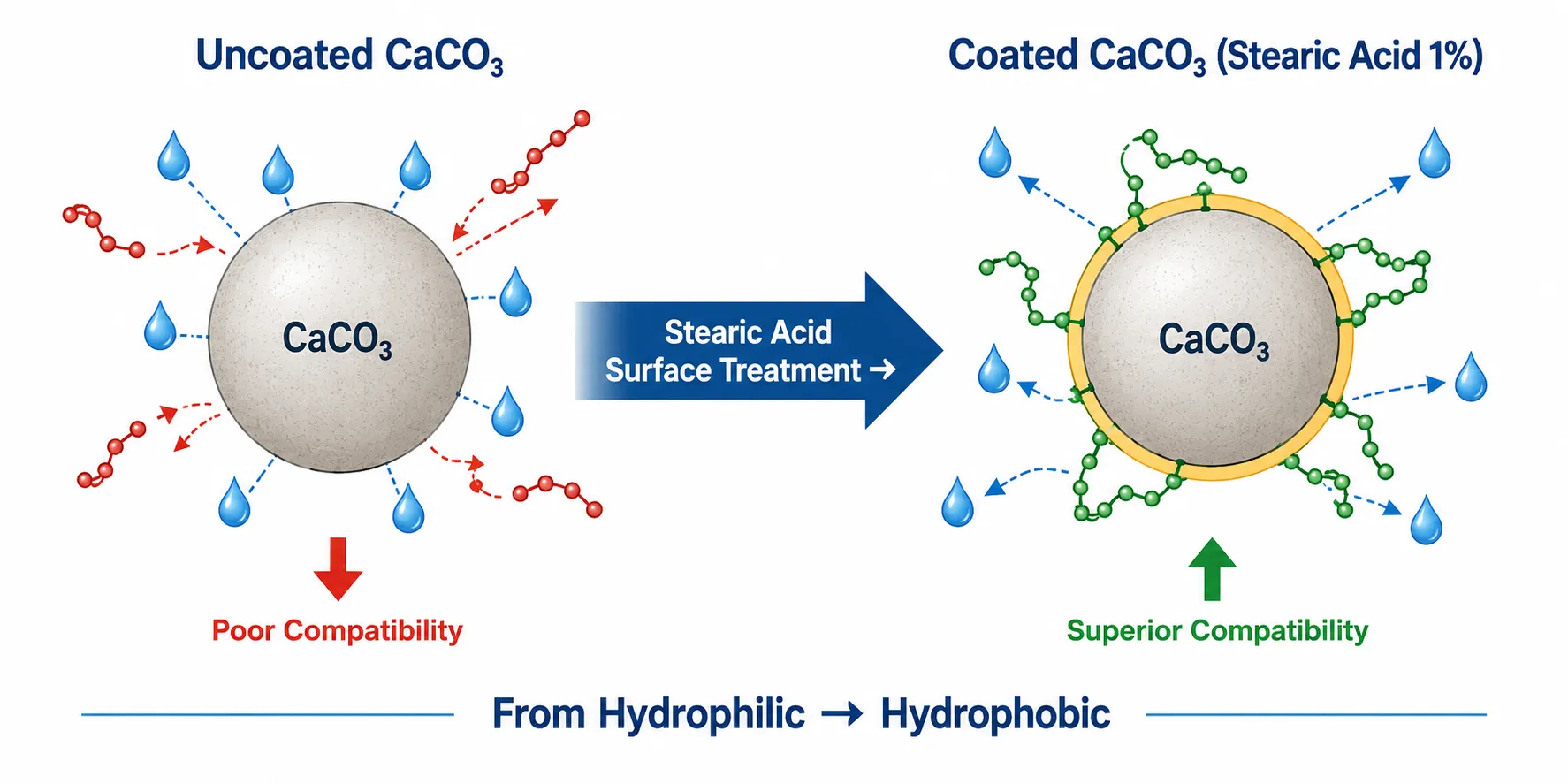
Established in 2005, Arosha Powder is a direct-from-mine manufacturer of Coated Calcium Carbonate 400 Mesh — surface-treated with pharmaceutical-grade stearic acid for superior hydrophobicity, low oil absorption, and exceptional compatibility with PVC, polyethylene, polypropylene, and rubber polymer systems. Operating four exclusive limestone mines with unrestricted supply capacity, and ISO 9001:2015 certified production facilities, every metric ton is tested to specification before leaving our plant. Trusted by industrial manufacturers across 20+ countries. Export-ready from Iran.
The 400 mesh designation in coated calcium carbonate is not arbitrary — it defines a specific performance profile that makes this grade irreplaceable in a distinct set of industrial applications.
With a D97 of approximately 37 microns and a D50 of 5–6 microns, the 400 mesh grade sits at a critical balance point in the particle size spectrum:
This combination makes 400 mesh the standard workhorse grade for high-volume, cost-sensitive polymer processing operations — where the goal is maximum filler loading at minimum processing cost, without sacrificing surface quality.
| Specification | 400 Mesh ← شما اینجایید | 800 Mesh | 1250 Mesh | 2500 Mesh |
|---|---|---|---|---|
| D97 (Top Cut) | 37 μm | 19 μm | 12 μm | 6 μm |
| D50 (Mean Size) | 5–6 μm | 3–4 μm | 2–3 μm | 1–2 μm |
| Whiteness | ≥ 96% | ≥ 96% | ≥ 97% | ≥ 97% |
| Oil Absorption | ≤ 25 g/100g | ≤ 22 g/100g | ≤ 20 g/100g | ≤ 18 g/100g |
| Bulk Density | 0.75–0.90 g/cm³ | 0.65–0.80 | 0.55–0.70 | 0.45–0.60 |
| Max Loading (PVC) | up to 40 phr | up to 35 phr | up to 30 phr | up to 25 phr |
| Surface Finish | Good | Better | Excellent | Premium |
| Processing Cost | Lowest | Low | Medium | High |
| Best For | PVC Pipe · Filler MB · Rubber | Flexible PVC · Films | Cable · Premium MB | Coatings · Specialty |
The following specifications apply exclusively to Arosha Powder’s Coated Calcium Carbonate 400 Mesh. Full COA issued with every shipment.
| Parameter | Specification | Test Method |
|---|---|---|
| CaCO₃ Content | ≥ 98.5% | Acid Digestion |
| MgCO₃ | ≤ 0.45% | XRF |
| SiO₂ | ≤ 0.50% | XRF |
| Fe₂O₃ | ≤ 0.06% | XRF |
| Whiteness (Hunter) | ≥ 96% | Spectrophotometry |
| Brightness (ISO 2469) | ≥ 95% | Spectrophotometry |
| pH (10% suspension) | 8.5 – 9.5 | pH meter |
| Moisture Content | ≤ 0.30% | Loss on Drying |
| D50 (Mean Particle Size) | 5 – 6 micron | Laser Diffraction |
| D97 (Top Cut) | ~37 micron | Laser Diffraction |
| Bulk Density | 0.75 – 0.90 g/cm³ | Tap Density |
| True Density | 2.70 g/cm³ | Pycnometry |
| Oil Absorption | ≤ 25 g/100g | ASTM D281 |
| Coating Agent | Stearic Acid | — |
| Coating Level | 1.0% by weight | Thermogravimetry |
| Activation Index | ≥ 98% | Flotation Test |
| HS Code | 2836.50 | — |
| CAS Number | 471-34-1 | — |
In rigid PVC pipe manufacturing, 400 mesh is the most widely specified coated calcium carbonate grade worldwide — and for good reason.
At 10–40 phr loading, the 37-micron top-cut particle size:
Why not 800 or 1250 mesh for rigid PVC pipe? Finer grades increase cost without proportional performance gain in rigid pipe. The 400 mesh D97 of 37 microns is fully compatible with the wall thickness tolerances of standard PVC pipe — where the performance bottleneck is homogeneity, not particle fineness.
“For rigid PVC pipe applications, calcium carbonate grades in the 10–40 micron D97 range provide the optimal combination of processing efficiency and mechanical performance at high filler loadings.” PVC Formulation Technology, Hanser Publishers
400 mesh is the backbone grade for filler masterbatch production. At loadings of 60–80% CaCO₃ by weight in LDPE or HDPE carrier:
Why not 1250 or 2500 mesh for standard filler masterbatch? Finer grades are justified only when the downstream application demands ultra-smooth film or very thin-wall injection parts. For standard filler masterbatch sold into packaging film or injection molding, 400 mesh delivers the required performance at 20–35% lower raw material cost per ton.
In natural rubber (NR) and styrene-butadiene rubber (SBR) compounds used for industrial hoses, gaskets, flooring, and automotive seals:
Why not 800 or 1250 mesh for rubber? In rubber applications where surface finish is not the primary driver (hoses, gaskets, industrial mounts), 400 mesh delivers equivalent mechanical performance at significantly lower cost. 800+ mesh is specified only for thin-walled rubber products or high-gloss rubber surfaces.
In cement-based tile adhesives, polymer-modified mortars, and construction sealants, 400 mesh coated calcium carbonate functions as a functional rheology modifier:
Why 400 mesh for construction adhesives, not finer? In cementitious systems, particles below 10 microns (1250+mesh) increase water demand significantly, reducing workability. The 400 mesh D97 of 37 microns is the optimal upper boundary for cementitious filler applications.
Choose 400 Mesh if:
Consider 800 Mesh instead if:
Consider 1250 Mesh instead if:
Consider 2500 Mesh instead if:
400 mesh refers to the particle size classification of the powder: 99% of particles pass through a 400-mesh screen, which has openings of approximately 37 microns. In Arosha Powder’s 400 mesh coated grade, the D97 (top-cut particle size) is ~37 microns and the D50 (mean particle size) is 5–6 microns. This is a medium-fine grade, coarser than 800, 1250, or 2500 mesh grades, and is optimized for high-loading polymer applications.
Yes — 400 mesh is the most widely used coated calcium carbonate grade for rigid PVC pipe globally. It is specified at 10–40 phr loading in pipe compounds and delivers consistent melt processing behavior, good mechanical performance, and significant formulation cost reduction vs. pure resin compounds.
400 mesh is not the recommended grade for blown PE film applications. In breathable film and thin-gauge packaging film, a finer particle size (typically 800–1250 mesh, D97 ≤ 19 microns) is required to prevent film defects and pinhole formation during biaxial stretching. We recommend reviewing our [Coated 1250 Mesh] grade for film applications.
The key difference is particle size: 400 mesh has a D97 of ~37 microns while 800 mesh has a D97 of ~19 microns. The practical implications are: 400 mesh supports higher filler loading in rigid PVC and masterbatch; 800 mesh provides a finer surface finish and is preferred for flexible PVC and film applications. 400 mesh is also lower cost per ton than 800 mesh.
In rigid PVC pipe and profile compounds, 400 mesh coated calcium carbonate is typically loaded at 10–40 phr (parts per hundred resin). The upper limit depends on your specific PVC formulation, stabilizer system, and processing equipment. Our technical team can advise on the optimum loading level for your application.
Contact our export team via WhatsApp at +98 912 751 6759 or email info@aroshapowder.co. Sample orders start from 1 metric ton and are dispatched within 5–7 business days with full COA and MSDS documentation.