Calcium Carbonate Powder Supplier & Manufacturer
Owned Mines. Controlled Quality. Regional Reach.
Exporting to Middle East, Asia
Own Mines
100 to 2500 Mesh
Export
Quality Controlled
Manufacturing Strength You Can Verify
Direct manufacturing, controlled raw materials and export-ready calcium carbonate supply for industrial buyers.
- Direct Calcium Carbonate Manufacturer
- 4 Exclusive Limestone Mines
- 2005 Established
- 2 Types Coated & Uncoated GCC
- 100–2500 Mesh Grade Range
- ISO 9001:2015 Quality Management System
- 20+ Export Markets Served
Arosha Powder manufactures and exports industrial ground calcium carbonate for manufacturers, compounders, distributors and raw-material buyers across Asia, the Middle East, CIS markets and Europe.
Our portfolio includes coated and uncoated calcium carbonate powder for plastics, PVC compounds, filler masterbatch, paints and coatings, rubber, paper, adhesives, sealants and construction materials.
From limestone selection and grinding to classification, surface treatment, quality verification, packaging and export preparation, we help industrial buyers qualify the right calcium carbonate grade for reliable repeat supply.
Talk Directly With Our Export Sales Team
Request product guidance, technical documents, samples and export quotations directly through WhatsApp.
Direct from Mine Calcium Carbonate Manufacturer in Asia
Arosha Powder is an industrial calcium carbonate manufacturer with direct control over critical stages of the supply chain, from the selection of limestone raw materials to production, quality verification, packaging and export preparation.
Working directly with a manufacturer can help industrial buyers reduce dependence on intermediaries, establish clearer purchasing specifications and improve consistency across repeat shipments. Instead of purchasing a generic powder based only on a mesh name, buyers can evaluate the selected grade according to its surface treatment, particle-size distribution, chemical composition, optical properties, moisture and batch documentation.
Our manufacturing portfolio is focused on natural ground calcium carbonate, commonly known as GCC, supplied in coated and uncoated grades. Each product family serves different formulation requirements, and the most suitable grade should be selected according to the buyer’s application, production conditions and finished-product targets.
Arosha Powder supports purchasing teams, technical managers and production specialists throughout the qualification process by providing relevant technical documents, product samples and commercial information for the selected grade.
A Stable Export Mineral Powder Supplier for Long Term Industrial Buyers
International manufacturers need more than an attractive initial price. They need a stable export mineral powder supplier capable of maintaining agreed specifications, preparing appropriate documentation and supporting repeat supply according to production schedules.
Arosha Powder works with industrial buyers that require coated or uncoated calcium carbonate for continuous manufacturing operations. Before commercial supply begins, the buyer’s application, technical limits, required volume, packaging preference, destination and inspection requirements can be reviewed.
For repeat orders, the approved product specification should become the commercial reference used to evaluate subsequent production batches. This approach provides a clearer basis for purchasing control than relying only on a general description such as “400 Mesh” or “1250 Mesh.”
Our export support can include, subject to the selected product and commercial agreement:
- Grade-specific Technical Data Sheet
- Safety Data Sheet
- Representative product sample
- Batch-specific Certificate of Analysis
- Packaging and labeling information
- Container-loading details
- Pre-shipment inspection arrangements
- Commercial export documentation
- Destination-specific quotation and Incoterm
Arosha Powder serves buyers across neighboring markets, the Middle East, Central Asia, South Asia, CIS countries and wider international destinations.
Coated and Uncoated Calcium Carbonate Powder
Arosha Powder supplies two main ground calcium carbonate product families. The correct selection depends on the formulation, processing conditions, required surface behavior and commercial targets.
Coated Calcium Carbonate Powder
Coated calcium carbonate is surface-treated, commonly with stearic acid, to modify the natural mineral surface and improve compatibility with many hydrophobic polymer and elastomer systems.
Coated grades are commonly evaluated for:
- Rigid and flexible PVC compounds
- Filler masterbatch
- Polyethylene compounds
- Polypropylene compounds
- Plastic pipes and profiles
- Cable compounds
- Rubber formulations
- Artificial leather
- Selected adhesives and sealants
Surface treatment may support improved mineral wetting, dispersion, moisture behavior and processing consistency, but actual performance depends on the complete formulation and production process.
A buyer should review the particle-size distribution, coating specification, activation result, moisture, oil absorption, optical properties and batch COA before approving a coated calcium carbonate grade.
Uncoated Calcium Carbonate Powder
Uncoated calcium carbonate retains its natural mineral surface without intentional stearic-acid treatment. Its hydrophilic and polar surface can make it a practical starting point for water-based, cementitious, mineral-rich and general industrial formulations.
Uncoated grades are commonly evaluated for:
- Wall putty and skim coat
- Dry mortar
- Tile adhesives and grout
- Paints and primers
- Paper and paperboard
- Ceramics
- Rubber products
- Adhesives and sealants
- Construction compounds
- Selected plastic formulations
The choice between coated and uncoated GCC should not be based on price alone. The two products should be compared through formulation testing, processing evaluation and finished-product performance.
Calcium Carbonate for Industrial Applications
Calcium carbonate can perform as a mineral filler, functional extender, processing component or formulation-cost optimizer across multiple industries. Its actual effect depends on particle size, surface treatment, purity, whiteness, moisture, filler loading and interaction with other raw materials.
Plastics, PVC and Filler Masterbatch
Coated GCC is commonly evaluated in PVC, polyethylene, polypropylene and filler-masterbatch systems where mineral dispersion and polymer compatibility are important.
Depending on the formulation, calcium carbonate can influence:
- Rigidity and dimensional stability
- Surface appearance
- Processing behavior
- Compound density
- Filler loading
- Raw-material cost
- Extrusion stability
- Finished-product consistency
The most suitable grade must be selected according to the resin, processing equipment, target loading and mechanical-property requirements.
Calcium Carbonate for Plastics and PVC
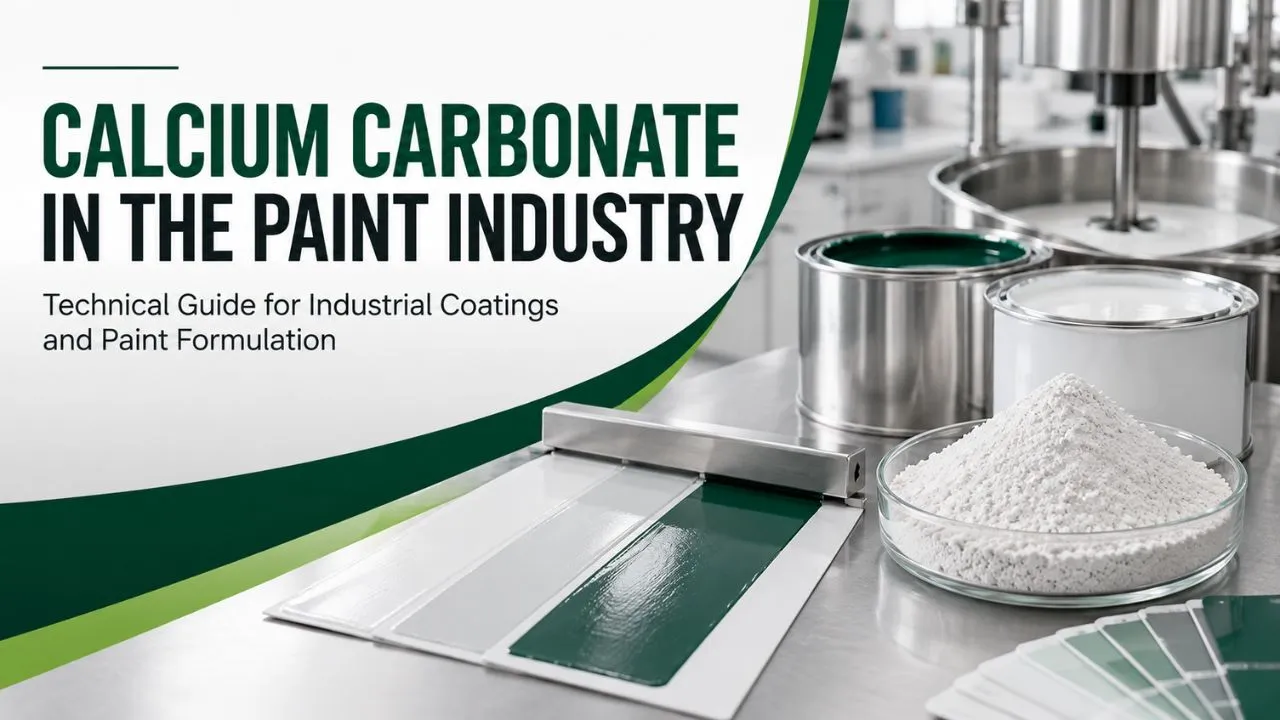
Paints and Coatings
Calcium carbonate is widely used as a mineral extender in primers, putties, decorative paints, textured coatings and selected industrial coating systems.
Product selection may affect:
- Film smoothness
- Rheology
- Whiteness
- Brightness
- Gloss or matt development
- Filler packing
- Sanding behavior
- Binder demand
- Formulation economics
Fine and ultra-fine products are not automatically the best choice. The required particle profile should match the coating type, film thickness, binder system and surface target.
Calcium Carbonate for Paints and Coatings
Rubber and Elastomer Compounds
Calcium carbonate is used in a range of rubber products, including mats, hoses, footwear, flooring, seals, gaskets, cable compounds and general molded components.
Depending on the compound, coated GCC may support improved interaction with hydrophobic elastomer systems, while uncoated grades may remain suitable for less demanding or cost-sensitive formulations.
Qualification should include mixing behavior, dispersion, hardness, tensile properties, elongation, abrasion, compression set and finished-product appearance.
Calcium Carbonate for Rubber
Paper and Paperboard
Ground calcium carbonate can be evaluated as a mineral filler or coating component in selected paper and board systems.
Important purchasing factors may include:
- Brightness and whiteness
- Particle-size distribution
- Coarse residue
- Abrasion
- Slurry behavior
- Retention
- Drainage
- Opacity
- Surface smoothness
- Printing requirements
Paper applications may require specialized dry-ground GCC, wet-ground GCC, slurry products or PCC. The suitability of a standard powder must therefore be confirmed against the paper-making process.
Calcium Carbonate for Paper and Board
Construction Materials
Uncoated calcium carbonate is commonly evaluated in mineral-based construction formulations such as:
- Wall putty
- Skim coat
- Dry mortar
- Tile adhesive
- Grout
- Joint compound
- Repair mortar
- Cementitious fillers
- Textured coatings
The correct grade depends on workability, water demand, particle packing, application thickness, sanding, adhesion, curing behavior and desired surface finish.
Calcium Carbonate for Construction Materials
Adhesives and Sealants
Calcium carbonate can add mineral body and influence rheology, extrusion, slump, surface appearance and formulation cost in compatible adhesive, caulk and sealant systems.
Buyers should evaluate:
- Resin compatibility
- Surface treatment
- Viscosity response
- Oil absorption
- Moisture
- Dispersion
- Extrusion pressure
- Slump resistance
- Cure behavior
- Long-term storage stability
Discuss Your Adhesive or Sealant Application
Quality Controlled Against the Approved Product Specification
Consistent calcium carbonate supply requires more than a product name or nominal mesh designation. The order-critical properties should be agreed between the buyer and supplier and linked to an approved purchasing specification.
Arosha Powder’s quality-control route begins with raw-material selection and continues through production, packaging and shipment preparation.
Raw Material Selection
Selected limestone is evaluated according to properties relevant to the intended product, which may include:
- Calcium carbonate content
- Mineral composition
- Whiteness
- Brightness
- Iron content
- Silica
- Magnesium compounds
- Insoluble matter
- Visible contamination
Production Control
During grinding, classification and optional surface treatment, production conditions should be monitored to maintain the target product profile.
Controls may include:
- Grinding stability
- Classifier performance
- Particle-size distribution
- Coarse residue
- Surface-treatment consistency
- Moisture
- Product appearance
- Packaging integrity
Final Product Verification
Depending on the approved specification, the finished product may be evaluated for:
- CaCO3 purity
- D50
- D97
- Sieve residue
- Whiteness and brightness
- Moisture
- pH
- Oil absorption
- Bulk density
- Chemical impurities
- Surface-treatment status
A batch-specific COA must report the results of an identified production batch. A generic target table or sample certificate is not a replacement for a real shipment certificate.
Review Arosha Powder Quality Control
Request a Sample COA
Technical Data Buyers Can Review Before Ordering
A mesh number alone does not provide a complete description of calcium carbonate performance.
Two products sold under the same nominal mesh grade can have different median particle sizes, coarse tails, residue levels, moisture, brightness and formulation behavior.
Before qualifying a supplier, industrial buyers should review:
- Product type: coated or uncoated
- Nominal mesh grade
- D50 particle size
- D97 particle size
- Sieve passing or maximum residue
- Test and dispersion method
- Calcium carbonate purity
- Whiteness and brightness
- Moisture content
- pH
- Oil absorption
- Bulk density
- Relevant chemical impurities
- Surface-treatment specification
- Approved TDS
- Representative sample
- Batch-specific COA
A finer product is not automatically a better product. The most suitable grade is the one that delivers the required processing behavior and finished-product properties at an acceptable total formulation cost.
View Technical Data Sheets
Compare Calcium Carbonate Grades
Export Packaging and Logistics
Calcium carbonate packaging should be selected according to product fineness, destination, transportation method, handling equipment and buyer requirements.
Subject to commercial confirmation, export options may include:
- Industrial bags
- Bags with inner liners
- Jumbo bags
- Palletized packaging
- Stretch or shrink wrapping
- Customer-specific labeling
- Private-label packaging
- Containerized sea freight
- Road transportation
- Combined transportation
The final quotation should clearly state:
- Net weight per bag
- Bag construction
- Number of bags per pallet
- Net weight per pallet
- Jumbo-bag configuration
- Container-loading quantity
- Minimum order quantity
- Production lead time
- Loading point or port
- Incoterm
- Required documentation
- Inspection arrangements
For an accurate quotation, the buyer should provide the final application, required grade, monthly consumption, packaging preference, destination country and destination port.
Review Packaging and Export Logistics
Request a Container Loading Plan
OEM and Private Label Calcium Carbonate Supply
Arosha Powder can evaluate customer-specific calcium carbonate supply programs for industrial buyers, distributors and private-label partners.
Subject to technical feasibility, production capability and commercial agreement, available options may include:
- Customer-specific purchasing specifications
- Selection of coated or uncoated GCC
- Agreed particle-size limits
- Agreed chemical and optical limits
- Private-label bags
- Customer branding
- Destination-specific labeling
- Custom palletizing
- Grade-specific TDS
- Batch-specific COA
- Sample approval
- Repeat-order specification control
Before an OEM or private-label program is confirmed, the buyer should provide:
- Intended application
- Current product specification or supplier TDS
- Required annual or monthly volume
- Required mesh, D50 and D97
- Surface-treatment requirement
- Packaging design
- Destination market
- Required documents
- Inspection conditions
Custom limits must be reviewed and approved before they are included in a quotation, sales contract or technical document.
Discuss an OEM or Private-Label Program
Why Industrial Buyers Work With Arosha Powder
Direct Manufacturer Communication
Industrial buyers communicate directly with the manufacturing and export team instead of relying only on a multi-layer trading chain.
Access to Selected Limestone Resources
Control over raw-material selection supports clearer quality management and reduces dependence on inconsistent third-party mineral sources.
Coated and Uncoated Product Families
Buyers can compare both surface-treatment options instead of being directed toward only one product type.
Multiple Mesh Grades
The portfolio allows buyers to compare coarser, fine, micronized and ultra-fine products according to their application requirements.
Specification Based Supply
Repeat orders can be evaluated against an approved purchasing specification and batch-specific documentation.
Technical Qualification Support
Buyers may request relevant technical documents, samples and product information before confirming a commercial order.
Export Oriented Service
Packaging, labeling, documentation, shipment terms and destination requirements can be reviewed during the quotation process.
Application Based Grade Selection
The objective is not simply to sell the finest or most expensive grade. The objective is to identify a practical starting grade for the buyer’s formulation and qualification process.
From Product Inquiry to Export Shipment
1. Share Your Requirements
Send your application, required product properties, current supplier TDS, consumption, packaging and destination.
2. Receive a Grade Recommendation
The sales and technical teams review the information and identify the most relevant coated or uncoated grade for initial evaluation.
3. Review Technical Documents
The available TDS, SDS, specification information and commercial conditions are shared for review.
4. Qualify a Product Sample
Where applicable, a representative sample can be evaluated in the buyer’s laboratory or production process.
5. Approve the Commercial Specification
The agreed product limits, packaging, quantity, destination, Incoterm and documentation requirements are confirmed.
6. Production and Batch Verification
The order is produced and the identified batch is evaluated against the approved commercial specification.
7. Packaging and Export Preparation
The product is packed, labeled and prepared according to the confirmed shipment requirements.
8. Shipment Documentation
The applicable commercial, technical and shipping documents are prepared for the order.
Start Your Product Qualification
Request a Calcium Carbonate Sample or Export Quote
To help our team recommend a suitable product and prepare an accurate quotation, please provide:
- Company name
- Destination country
- Destination port
- Final application
- Coated or uncoated preference
- Required mesh or particle size
- Current supplier TDS
- Required purity
- Required whiteness
- Maximum moisture
- Monthly or annual consumption
- Packaging preference
- Required Incoterm
- Need for a sample
- Need for TDS
- Need for SDS
- Need for batch COA
- Inspection requirements
Request an Export Quote
Request a Product Sample
Contact Export Sales on WhatsApp
Frequently Asked Questions
Is Arosha Powder a calcium carbonate manufacturer or a trading company?
Arosha Powder operates as a manufacturer and exporter of industrial ground calcium carbonate. The company’s portfolio includes coated and uncoated GCC grades for multiple industrial applications.
What is the difference between GCC and PCC?
Ground calcium carbonate, or GCC, is produced by grinding and classifying natural calcium carbonate minerals such as limestone or marble. Precipitated calcium carbonate, or PCC, is produced through a controlled chemical precipitation process.
Arosha Powder’s main calcium carbonate portfolio is based on natural GCC.
What is the difference between coated and uncoated calcium carbonate?
Uncoated GCC retains its natural hydrophilic mineral surface. Coated GCC receives an intentional surface treatment, commonly with stearic acid, to improve compatibility with many hydrophobic polymer and elastomer systems.
The correct selection depends on the formulation, filler loading, moisture sensitivity, dispersion requirements and processing conditions.
Which calcium carbonate mesh grade should I buy?
The correct grade should be selected according to more than its mesh name. Buyers should compare D50, D97, sieve residue, surface treatment, purity, whiteness, moisture, oil absorption and the final application.
A finer grade is not automatically the best or most economical choice.
Does Arosha Powder supply calcium carbonate for PVC and masterbatch?
Coated calcium carbonate grades can be evaluated for rigid PVC, flexible PVC, filler masterbatch, polyethylene and polypropylene compounds.
The final grade and filler loading should be confirmed through formulation and production testing.
Does Arosha Powder supply calcium carbonate for paint and construction materials?
Uncoated and selected coated grades can be evaluated for paints, primers, wall putty, skim coat, dry mortar, tile adhesives, grout and other construction formulations.
The most suitable grade depends on the required finish, water demand, viscosity, particle packing and application thickness.
Can I request a product sample before placing an order?
Sample availability can be confirmed according to the selected product, required quantity, destination and intended application.
A sample should be identified and compared with the approved commercial specification before repeat supply begins.
Do you provide TDS, SDS and COA documents?
Available documentation may include a grade-specific TDS, SDS and batch-specific COA.
A COA is valid only for the identified production batch and should be compared with the approved purchasing specification.
Do you offer private label packaging?
Private-label or customer-specific packaging may be available subject to order volume, bag design, labeling requirements and production approval.
Which countries does Arosha Powder export to?
Arosha Powder supports industrial buyers across the Middle East, Asia, CIS markets and selected international destinations. Shipment feasibility, route, Incoterm and documentation must be confirmed for each destination.
What information is needed to receive a quotation?
Send your application, required grade or current TDS, monthly volume, particle-size limits, surface-treatment requirement, packaging preference, destination country and port.
This information allows the team to prepare a more technically accurate and commercially relevant quotation.
Build a More Reliable Calcium Carbonate Supply Chain
Whether you are qualifying a new mineral filler, comparing suppliers or developing a long-term sourcing program, Arosha Powder can help you evaluate coated and uncoated calcium carbonate grades according to your application and purchasing requirements.
Share your technical specification, monthly consumption, packaging preference and destination. Our sales and technical teams will review your request and recommend the most relevant starting grade for evaluation.