
Calcium Carbonate Selection Starts with the Formulation, Not the Mesh Number
Selecting calcium carbonate for filler masterbatch is not simply a matter of choosing a fine powder or comparing mesh numbers between suppliers. For a compounder, the mineral becomes part of a complete formulation in which the carrier resin, additives, calcium carbonate characteristics, mixing conditions and extrusion process interact with one another.
Thank you for reading this post, don't forget to subscribe!Two ground calcium carbonate products offered under the same nominal mesh grade may therefore behave differently during masterbatch production. Differences in D50, D97, particle size distribution, moisture, surface treatment and agglomeration can influence feeding, dispersion, melt behavior and the consistency of the finished masterbatch.
The useful question is not simply, “Which calcium carbonate mesh should I buy?” The better question is, “Which calcium carbonate specification is compatible with my carrier resin, formulation, processing conditions and final product requirements?”
This application based approach is important because calcium carbonate fineness alone cannot predict masterbatch performance. Filler concentration, particle characteristics, surface condition and the additive package can all change how the compound behaves during processing and how the final material performs.
“The elongation at break decreased exponentially with filler loading irrespective of whether the filler was surface coated or not.”
The value of this research is not that it provides a universal loading recommendation. The researchers evaluated a defined calcium carbonate and linear low density polyethylene system under specific experimental conditions. The broader lesson for compounders is that changing mineral content changes the formulation itself. A loading level that performs acceptably in one polymer system, processing line or final product should not automatically be transferred to another.
This is also why Arosha Powder's industrial calcium carbonate application guide approaches grade selection from the final application backward toward the required technical specification. The intended production process and product requirements should be defined before a calcium carbonate grade is approved.
Define the Formulation
Identify the carrier resin, additives, processing method and final application before comparing calcium carbonate grades.
Compare the Full Specification
Review D50, D97, particle size distribution, moisture, purity, surface treatment and other parameters relevant to the formulation.
Confirm Through Testing
Evaluate the selected grade in the actual formulation before commercial approval instead of relying on a nominal mesh designation alone.
For a masterbatch producer evaluating a new GCC source, the technical purchasing process should therefore move beyond the commercial grade name. The relevant calcium carbonate technical data sheets should be reviewed first, followed by sample evaluation and formulation testing where required.
As a direct calcium carbonate manufacturer and supplier , Arosha Powder produces coated and uncoated GCC grades for industrial applications including polyethylene, polypropylene and filler masterbatch systems. This guide does not prescribe one universal mesh or loading rate. Instead, it explains how compounders can evaluate the technical characteristics that matter before a calcium carbonate grade enters production qualification.
What Does Calcium Carbonate Actually Do in Filler Masterbatch?
Calcium carbonate is often introduced as a material used to reduce polymer consumption, but that description is incomplete for a compounder. Once GCC becomes a significant part of a masterbatch formulation, it is no longer only an economic filler. It becomes a mineral phase that can influence processing behavior, compound structure, appearance and the balance of properties in the final product.
The exact effect depends on the calcium carbonate grade, its concentration, the carrier resin, the additive package, the quality of dispersion and the conditions used during compounding. For this reason, the same GCC grade should not be expected to produce identical results across different polyethylene or polypropylene formulations.
It Becomes a Structural Part of the Compound
Calcium carbonate particles occupy a substantial volume within highly filled formulations. Their particle size distribution, surface characteristics and level of dispersion therefore influence how the mineral phase is distributed throughout the polymer matrix.
A well selected mineral grade should be evaluated together with the carrier resin and processing system. Simply increasing mineral content without considering this interaction can change the balance between stiffness, deformation behavior and other mechanical requirements.
It Changes the Economics of the Formulation
One commercial reason for producing filler masterbatch is to replace part of a higher cost polymer phase with a mineral raw material. However, the lowest calcium carbonate price does not necessarily create the lowest effective production cost.
Poor dispersion, unstable feeding, excessive rejects, inconsistent pellets or unsuitable finished product performance can eliminate the apparent saving achieved through a cheaper mineral source.
It Becomes a Processing Variable
As calcium carbonate content changes, the material moving through the compounding line also changes. Mineral loading, surface condition, particle characteristics and the additive system can influence mixing behavior, melt response, extrusion load and the ability of the process to distribute particles consistently.
This is why formulation development should consider the GCC specification together with screw configuration, mixing efficiency, temperature profile, throughput and the characteristics of the carrier resin.
It Can Influence the Appearance of the Final Compound
Mineral purity, whiteness, particle distribution and dispersion quality can become relevant when the masterbatch is intended for products where visual consistency or surface quality matters.
Whiteness alone should not be used as a universal quality ranking. Its importance depends on the end product, pigment system, let down formulation and visual requirements defined by the customer.
In filler masterbatch production, calcium carbonate should be treated as both a raw material and a formulation variable. Its value is determined by how reliably it performs inside the complete compound, not by mineral price, whiteness or mesh number in isolation.
This distinction also explains why basic mineral identity and application grade selection are two different questions. Calcium carbonate is a naturally occurring mineral with established physical and chemical characteristics, but industrial GCC products can differ considerably after grinding, classification and surface treatment. Readers who need the mineral science background can first review what calcium carbonate is and how industrial GCC is produced .
For the compounder, however, the more important task begins after that definition. The supplier must be evaluated on whether the proposed calcium carbonate grade provides the particle profile, surface condition, moisture control and production consistency required by the intended masterbatch formulation.
Key Calcium Carbonate Specifications for Filler Masterbatch
A calcium carbonate grade should not be qualified for filler masterbatch production from a commercial mesh designation alone. Compounders need a broader technical picture because particle size, the coarse fraction, moisture, surface condition and mineral consistency can each affect a different part of formulation development or processing.
The most useful specification is therefore not the one with the largest number of laboratory values. It is the one that identifies the parameters relevant to the actual formulation, reports them using understood test methods and can be checked consistently during future production.
| Parameter | What It Describes | Why a Compounder Should Review It | Qualification Note |
|---|---|---|---|
| D50 | The median particle size of the measured distribution. | Useful for comparing the central particle size of candidate GCC grades. | Compare values only when the analytical method, distribution basis and sample preparation are understood. |
| D97 | A particle size value representing the coarse region of the measured distribution. | Helps reveal larger particles that may not be apparent from D50 alone. | Particularly useful when coarse particles, agglomerates or surface quality are important to the application. |
| Particle Size Distribution | The distribution of particles across the measured size range. | Gives a more complete view of the powder than one percentile or nominal mesh designation. | Two grades with similar D50 values can still have different distributions. |
| Moisture | The measured moisture associated with the supplied powder. | Relevant where moisture may influence handling, storage or moisture sensitive processing. | Acceptance limits should be defined according to the formulation and processing requirements. |
| CaCO3 Purity | The calcium carbonate content and associated mineral composition. | Helps assess mineral consistency and whether the material meets the purchasing specification. | Purity should be interpreted together with relevant chemical impurities where the application requires them. |
| Whiteness and Brightness | Optical characteristics of the mineral. | Relevant when the filler contributes to the visual appearance of the masterbatch or finished product. | Higher whiteness is not automatically a better technical choice for every formulation. |
| Oil Absorption | A laboratory property related to the interaction between the powder and a defined liquid system. | Can provide supplementary information when comparing mineral grades and formulation behavior. | It should not be used by itself to predict polymer processing performance. |
| Surface Treatment | Whether the calcium carbonate surface is untreated or modified with an applicable coating system. | Surface condition can influence interaction with the polymer matrix, wetting and dispersion behavior. | Coated material should not be selected automatically without considering the carrier resin and formulation. |
| Bulk Density | The mass of powder occupying a defined bulk volume under the applicable test condition. | May be relevant to storage, dosing and feeding behavior in the compounding process. | Compare values using equivalent test procedures. |
| Sieve Residue | Material retained under a defined sieve test. | Provides an additional check on coarse material where applicable. | Sieve results and laser diffraction values describe particle size differently and should not be treated as interchangeable. |
Never compare one supplier's mesh number directly with another supplier's D50 or D97 value and assume the products are equivalent. Technical comparison should use equivalent parameters produced under sufficiently comparable analytical conditions.
Why D50 and D97 Should Be Reviewed Together
D50 describes the middle of a measured particle size distribution, but it does not show what is happening toward the coarse end. A powder can have an acceptable median particle size while still containing a broader coarse fraction than another candidate grade.
For masterbatch producers, this distinction can become relevant when particle dispersion, surface quality or processing consistency are sensitive to the larger particles in the powder. Compounders who want a deeper explanation of the relationship between mesh, micron values and particle size percentiles can review Arosha Powder's guide to calcium carbonate particle size, D50 and D97 .
Particle size values are only meaningful when the measurement method is understood. Laser diffraction, sieve analysis and other techniques are based on different physical principles, so results obtained by different methods should not automatically be expected to match.
ISO 13320:2020 Particle Size Analysis by Laser DiffractionISO 13320 provides guidance for particle size distribution measurement using laser diffraction and notes that results can differ from techniques based on other physical principles. This is one reason a supplier comparison should include the reported test method rather than relying only on the numerical result.
Surface Condition Is a Separate Qualification Decision
Particle size and surface treatment should also be evaluated as separate specification variables. Two products may have similar particle size data while one is untreated and the other has undergone surface modification. Their interaction with a polymer formulation may therefore be different.
The choice should be based on the carrier system and application requirements rather than the assumption that coated GCC is universally superior. The technical differences are covered in more detail in the coated versus uncoated calcium carbonate selection guide .
Review the relevant product specific technical values and test methods.
Avoid comparing nominal grade names with laboratory values measured on a different basis.
Confirm suitability in the intended carrier resin and formulation before full commercial approval.
Establish which properties need to remain within the agreed purchasing specification during repeat supply.
Arosha Powder offers multiple coated and uncoated calcium carbonate powder grades for industrial evaluation. Product selection for filler masterbatch should begin with the required technical profile and continue through TDS review, sample testing and formulation trials rather than being based on grade name alone.
Coated vs Uncoated Calcium Carbonate for Filler Masterbatch
Choosing between coated and uncoated calcium carbonate is one of the most important qualification decisions in filler masterbatch production. The difference is not the calcium carbonate chemistry itself. The difference is the condition of the particle surface and how that surface interacts with the carrier resin, additives and surrounding polymer phase.
Untreated GCC retains the natural mineral surface. Coated GCC undergoes an additional surface modification step, commonly using stearic acid or another suitable treatment agent. This modification changes the surface characteristics of the particles and can make the mineral more suitable for evaluation in hydrophobic polymer systems.
“CaCO3 is often treated with stearic acid to decrease its polarity.”
That principle explains why coated calcium carbonate is frequently considered for polyethylene and polypropylene compounds. However, the word coated should never be treated as a complete technical specification. The treatment chemistry, degree of surface modification, particle size distribution and coating consistency can all affect how a coated grade behaves in the actual compound.
| Selection Factor | Uncoated GCC | Coated GCC | What the Compounder Should Check |
|---|---|---|---|
| Particle Surface | Natural mineral surface remains exposed. | Mineral surface is intentionally modified. | Confirm the actual treatment system rather than relying only on the word coated. |
| Polymer Interaction | Interaction depends on the untreated mineral surface and formulation chemistry. | Surface modification can alter interaction with hydrophobic polymer systems. | Evaluate compatibility with the specific carrier resin and additive package. |
| Dispersion | Performance depends strongly on particle size, agglomeration and mixing conditions. | Suitable surface treatment can support improved particle distribution in polymer systems. | Confirm dispersion in the actual formulation instead of assuming coating guarantees good dispersion. |
| Moisture Interaction | The untreated mineral surface remains more polar. | Suitable treatment can reduce the polarity of the calcium carbonate surface. | Review measured moisture and processing behavior separately from the coating designation. |
| Particle Size | D50, D97 and PSD remain critical. | D50, D97 and PSD remain equally critical. | Surface treatment cannot correct an unsuitable particle size distribution. |
| Qualification | Requires formulation and processing evaluation. | Requires formulation and processing evaluation. | Neither product family should be approved solely from its commercial grade name. |
Coated calcium carbonate is not automatically a higher quality calcium carbonate. It is a calcium carbonate with a different surface condition. The better choice is the grade whose particle profile, surface treatment and consistency match the intended formulation.
Why Surface Treatment Can Matter in PE and PP Systems
Calcium carbonate has a naturally polar mineral surface, while common polyolefins such as polyethylene and polypropylene are comparatively nonpolar. This difference can make particle wetting and distribution more challenging, particularly as particle size becomes finer and particle to particle interactions become more significant.
Surface treatment can reduce the polarity of the calcium carbonate surface and alter the interaction between the filler and polymer phase. Research on calcium carbonate filled thermoplastics has reported improved particle dispersion after appropriate surface modification, while particle aggregates have been associated with poorer composite performance. The practical lesson is not that every coated grade will behave well, but that surface chemistry and dispersion must be considered together. :contentReference[oaicite:1]{index=1}
Two suppliers may both describe their product as stearic acid coated calcium carbonate while providing materials with different particle size distributions, treatment processes, surface coverage, moisture levels and production consistency.
Coating Quality Matters as Much as Coating Presence
Surface modification is a manufacturing process, not simply a yes or no specification. Research comparing different stearic acid treatment methods has shown that the method of treatment can influence filler distribution and the interfacial structure of thermoplastic composites. This means compounders should evaluate the consistency and suitability of the treated material rather than assuming all coated GCC products are technically interchangeable. :contentReference[oaicite:2]{index=2}
A useful supplier qualification process should therefore consider the coated grade together with its D50, D97, particle size distribution, moisture, treatment specification and sample performance. Where the final application is sensitive to dispersion or processing consistency, formulation trials remain essential.
Determine whether the masterbatch uses LDPE, LLDPE, HDPE, PP or another carrier system.
Decide whether modifying the mineral surface is technically relevant to the formulation.
Evaluate particle size, moisture, surface treatment and other relevant technical parameters together.
Confirm dispersion, processing behavior and final product requirements using the actual compound.
For a broader technical comparison of mineral surface behavior, treatment mechanisms and application selection, compounders can review Arosha Powder's coated vs uncoated calcium carbonate selection guide . The guide examines why surface condition should be evaluated together with particle size distribution, formulation chemistry and processing requirements rather than treated as an isolated product feature.
Arosha Powder's calcium carbonate product portfolio includes both coated and uncoated GCC grades for industrial evaluation. For filler masterbatch production, the final grade should be selected after reviewing the technical data and testing the material in the intended carrier resin and formulation.
Matching Calcium Carbonate to PE and PP Carrier Systems
Calcium carbonate should not be selected independently from the carrier resin used to produce the filler masterbatch. LDPE, LLDPE, HDPE and PP differ in molecular structure, melt behavior and processing characteristics, so the same GCC grade may not produce the same dispersion or processing response in every carrier system.
For the compounder, this means that carrier resin selection and calcium carbonate qualification should be treated as connected decisions. Particle size distribution, surface treatment, moisture and agglomeration behavior must be evaluated together with the melt characteristics of the resin and the mixing capability of the compounding line.
A calcium carbonate grade is not technically suitable because it works in polyethylene or polypropylene in general. It is suitable when its specification and surface behavior can be validated in the specific carrier resin, additive package, processing system and final application.
LDPE Carrier Systems
LDPE is commonly considered where good melt processability and flexible carrier behavior are required. When GCC is introduced, the compounder should evaluate whether the selected particle profile and surface condition allow the mineral to wet and distribute consistently during mixing.
- Review dispersion of the mineral phase.
- Check feeding consistency and moisture behavior.
- Compare the GCC specification with the melt characteristics of the selected LDPE grade.
- Confirm pellet quality through a formulation trial.
LLDPE Carrier Systems
LLDPE based formulations should also be evaluated as complete systems rather than by transferring a GCC specification from another polyethylene formulation. Mineral concentration and additive selection can change the rheological and mechanical response of the compound.
- Monitor changes in melt behavior during formulation development.
- Evaluate the coarse particle fraction as well as median particle size.
- Check whether surface treatment provides the required compatibility.
- Validate the selected grade using the intended processing conditions.
HDPE Carrier Systems
HDPE formulations can present a different processing environment because resin viscosity, crystallinity and end product requirements may differ from LDPE or LLDPE systems. A GCC grade already approved in another polyethylene carrier should therefore not be assumed to be directly transferable.
- Evaluate mixing and mineral distribution under the actual processing conditions.
- Check whether the particle size profile is appropriate for the intended product.
- Review moisture and surface treatment together.
- Confirm processing stability before commercial approval.
Polypropylene Carrier Systems
PP deserves separate qualification because filler interaction, dispersion and interfacial behavior can influence the resulting compound. Research on calcium carbonate filled polypropylene has shown that particle size, surface treatment and dispersion can materially change mechanical behavior.
- Assess surface treatment in relation to the PP matrix.
- Check for particle aggregates during trial compounding.
- Evaluate dispersion rather than assuming finer GCC will automatically perform better.
- Test the complete formulation before defining the approved purchasing specification.
“Surface treatment improved the dispersion and distribution of the CaCO3 particles within the iPP matrix.”
The important point is not that surface treatment will always improve every property. In the cited polypropylene research, modifying the particle surface improved dispersion, but different mechanical properties responded differently. This is exactly why compounders should avoid treating coated GCC as a universal performance upgrade.
Another polypropylene study found that aggregates of calcium carbonate particles were detrimental to impact behavior, while particle size, surface treatment and the molecular characteristics of the PP matrix all influenced the final result. The study reinforces an important formulation principle: mineral performance depends on the interaction between the filler and the polymer system, not on one GCC specification in isolation.
What Should Be Checked Before Matching GCC to a Carrier Resin?
Identify the exact polymer family and resin grade used in the masterbatch.
Review D50, D97 and the full particle size distribution.
Determine whether coated or uncoated GCC is technically appropriate.
Consider waxes, processing aids and other formulation components together with the filler.
Evaluate feeding, mixing, extrusion load and dispersion under realistic conditions.
Approve the combination only after confirming the requirements of the finished product.
Compounders considering surface modified material can compare the technical differences in Arosha Powder's coated and uncoated calcium carbonate guide . Product specific values should then be checked against the relevant calcium carbonate technical data sheets before requesting a sample for formulation testing.
If the carrier resin, polymer grade, additive package, filler concentration, equipment or final application changes, the previously approved calcium carbonate grade should be reconsidered under the new formulation conditions.
How Calcium Carbonate Influences Compounding and Processing
A calcium carbonate grade can look acceptable on a technical data sheet and still behave differently once it enters a compounding line. Filler masterbatch production combines powder handling, polymer melting, distributive and dispersive mixing, extrusion and pelletizing. The GCC therefore has to perform consistently through every stage of that sequence.
Particle size distribution, surface condition, moisture, mineral concentration and additive selection can all influence processing behavior. The practical objective is not to achieve the finest possible powder or the highest possible mineral content. It is to create a stable compound that the available equipment can feed, mix, disperse, extrude and pellet consistently.
Can the powder enter the process consistently?
Can the polymer and additives wet and distribute the mineral?
Are agglomerates sufficiently broken and distributed?
Does the compound run within a stable processing window?
Is the finished masterbatch consistent enough for downstream use?
Feeding and Dosing Come Before Dispersion
Dispersion problems do not always begin inside the screw. If powder flow is unstable, the actual mineral input can fluctuate before effective mixing has even started. Bulk behavior, moisture, agglomeration and powder handling conditions can therefore influence dosing consistency and the stability of the formulation entering the extruder.
This is one reason compounders should avoid evaluating GCC only from chemical purity or particle size. A technically acceptable mineral must also be manageable within the actual feeding and conveying system used by the plant.
When mineral concentration appears inconsistent in the finished pellets, do not begin by changing the formulation immediately. First confirm powder feeding, dosing calibration, material condition and the consistency of the incoming GCC.
Dispersion Is Not the Same as Particle Size
Fine primary particles do not guarantee fine dispersion inside a polymer. Calcium carbonate particles can exist as agglomerates, and the compounding system must generate sufficient mixing and interfacial interaction to distribute the mineral throughout the carrier phase.
Surface treatment, particle size distribution, additive selection and mixer design can all influence this process. A finer grade with poor agglomerate control may therefore produce a less uniform compound than a technically better matched grade with a controlled particle profile.
Compounders who need to compare the underlying particle data should evaluate the complete distribution rather than nominal mesh alone. Arosha Powder's technical guide to calcium carbonate particle size, D50 and D97 explains how these parameters describe different parts of the particle population.
Mineral Loading Changes Melt Rheology
Introducing a large mineral phase changes the flow behavior of the compound. The effect depends on filler concentration, particle characteristics, surface condition, carrier resin and the lubricant or processing aid system. As a result, an increase in GCC concentration cannot be evaluated independently from the rest of the formulation.
“In the absence of additives, the melt viscosity at 60 wt% filler exceeded that of the neat polymer by a factor of three.”
That number belongs to the specific LLDPE formulation and experimental conditions evaluated in the study. It should not be used as a universal prediction for another masterbatch. Its importance is the underlying principle: filler concentration and additive selection can materially change melt viscosity, so the entire formulation has to be developed as one processing system.
Extruder Torque and Pressure Are Process Signals
Torque, melt pressure and motor load can provide useful information during formulation trials because they reflect how the compound is behaving inside the equipment. Unexpected increases may be associated with several factors, including mineral concentration, resin viscosity, insufficient lubrication, poor dispersion or changes in material feeding.
These signals should be interpreted together rather than used to diagnose the GCC from one number alone. Screw design, throughput, temperature profile, equipment condition and formulation chemistry can all influence the observed processing load.
| Process Observation | Possible GCC Related Factors | What to Check First |
|---|---|---|
| Unstable Feeding | Powder condition, moisture, agglomeration or bulk behavior | Feeder calibration, powder flow and incoming material consistency |
| Poor Dispersion | Agglomeration, unsuitable particle profile or surface condition | GCC specification, coating, mixing intensity and additive package |
| Higher Than Expected Torque | Mineral concentration, melt viscosity or poor incorporation | Formulation, throughput, temperature profile and processing aids |
| Pressure Instability | Inconsistent feeding, dispersion or compound viscosity | Material feed rate, melt condition and screen condition |
| Visible Specks or Agglomerates | Coarse particles, agglomerates or incomplete dispersion | D97, PSD, sample microscopy and mixing performance |
| Variable Pellet Quality | Formulation inconsistency, moisture or unstable mineral feeding | Batch data, process records and incoming raw material consistency |
Pellet Appearance Is Useful, but It Is Not Final Proof
Uniform pellets without obvious surface defects are a useful processing indicator, but visual appearance alone cannot confirm successful qualification. A masterbatch may pellet smoothly while still containing a particle distribution or dispersion state that becomes problematic after dilution into the final product.
Proper qualification should therefore continue into the intended downstream application. The compounder should evaluate the properties that matter to that product rather than approving the GCC only because extrusion and pelletizing were stable.
Mineral addition remains controlled during the production run.
The mineral is distributed without unacceptable agglomeration.
Torque, pressure and melt behavior remain inside the validated operating window.
Pellets and downstream performance remain sufficiently repeatable between approved batches.
For this reason, supplier qualification should connect laboratory specifications with actual process observations. Relevant values from the calcium carbonate technical data sheets can be used to shortlist candidate grades, but final approval should still be based on the compounder's own formulation trial and defined production acceptance criteria.
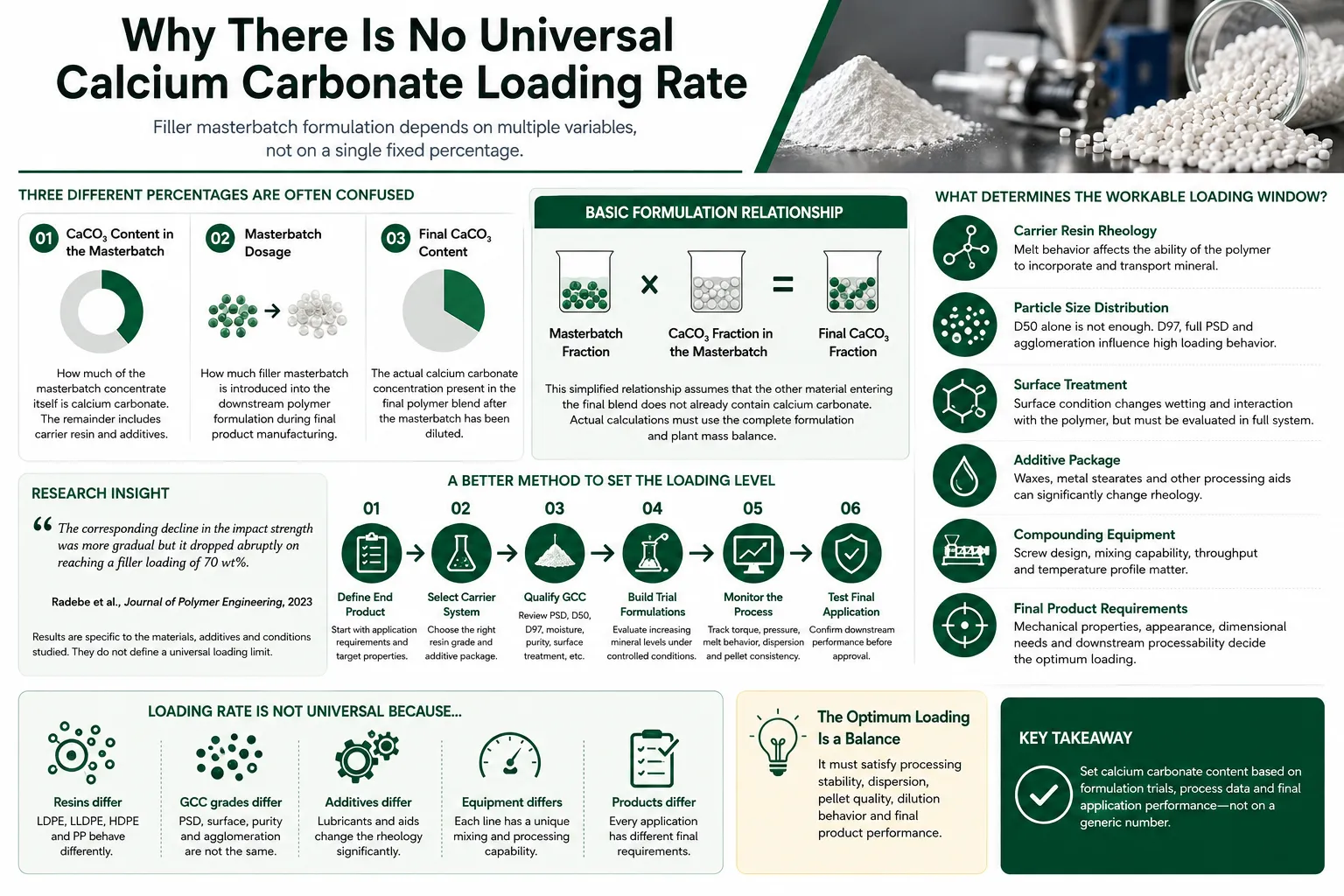
Why There Is No Universal Calcium Carbonate Loading Rate
One of the most common mistakes in filler masterbatch formulation is searching for a single calcium carbonate loading percentage that can be applied to every product. There is no technically universal value. The acceptable mineral concentration depends on the carrier resin, calcium carbonate grade, particle size distribution, surface condition, additive package, compounding equipment and the performance requirements of the final product.
A formulation that processes successfully at a certain mineral concentration in one LLDPE system does not automatically establish a suitable concentration for another polyethylene grade, polypropylene formulation or downstream application. Even when the same polymer family is used, changes in resin rheology, GCC specification or processing conditions can shift the workable formulation window.
The highest mineral concentration that an extruder can process is not necessarily the concentration that produces the best commercial masterbatch. The optimum formulation must also satisfy dispersion, pellet consistency, dilution behavior, downstream processing and final product requirements.
Three Different Percentages Are Often Confused
Discussions about filler loading can become misleading because the word loading may refer to different stages of the masterbatch system. Compounders and buyers should distinguish these values before comparing formulations or supplier recommendations.
CaCO3 Content in the Masterbatch
This describes how much of the masterbatch concentrate itself consists of calcium carbonate. The remainder can include carrier resin and formulation additives.
Masterbatch Dosage
This describes how much filler masterbatch is introduced into the downstream polymer formulation during final product manufacturing.
Final CaCO3 Content
This is the actual calcium carbonate concentration present in the final polymer blend after the masterbatch has been diluted into the production resin.
This simplified relationship assumes that the other material entering the final blend does not already contain calcium carbonate. Actual production calculations should be based on the complete formulation and the plant's own mass balance.
This distinction is important when comparing commercial claims. A supplier may describe a masterbatch using its concentrate mineral content, while the converter may be concerned with the dosage used in film, injection molding, sheet or another finished application. These numbers answer different questions and should not be treated as interchangeable.
What Actually Determines the Workable Loading Window?
Melt behavior affects the ability of the polymer phase to incorporate and transport a high concentration of mineral.
D50 alone is not sufficient. D97, the broader distribution and agglomeration state can influence how the mineral behaves inside a highly filled system.
Particle surface condition can alter wetting and interaction with the polymer, but coating should still be evaluated as part of the complete formulation.
Waxes, metal stearates and other processing aids can materially change the rheological behavior of highly filled compounds.
Screw configuration, feeding system, mixing capability, throughput and temperature profile determine the processing environment available to the formulation.
Mechanical behavior, appearance, dimensional requirements and downstream processability ultimately determine whether a formulation is commercially acceptable.
“The corresponding decline in the impact strength was more gradual but it dropped abruptly on reaching a filler loading of 70 wt%.”
The reported value belongs to the specific LLDPE compounds, calcium carbonate materials, additives and experimental conditions examined by the researchers. It does not establish 70 wt% as a universal threshold for filler masterbatch. The useful lesson is that changing mineral concentration can change mechanical and rheological behavior significantly, sometimes nonlinearly.
The same study also demonstrated the importance of the additive system. At a defined high filler concentration, the researchers observed a large increase in melt viscosity when processing aids were absent, while the addition of selected wax and metal stearate combinations changed the rheological response substantially. This means a supplier cannot responsibly recommend a calcium carbonate percentage without understanding what surrounds the mineral in the formulation.
A Better Method for Setting Calcium Carbonate Content
Start with the downstream application and the properties that must remain within specification.
Establish the resin grade and additive package before optimizing mineral concentration.
Review PSD, D50, D97, moisture, surface treatment and other relevant technical properties.
Evaluate increasing mineral concentrations under controlled compounding conditions.
Record feeding behavior, torque, pressure, melt response, dispersion and pellet consistency.
Confirm downstream processing and product performance before defining the approved commercial formulation.
A calcium carbonate technical data sheet can help identify whether a GCC grade is a suitable candidate, but it cannot determine the optimum loading for every masterbatch producer. The approved concentration should be established using the customer's own formulation, equipment and acceptance criteria.
The final application must also remain part of the decision. Calcium carbonate requirements for film, raffia, injection molding or sheet applications may differ because the downstream polymer system is expected to perform differently. The broader calcium carbonate applications guide provides the parent framework for evaluating GCC according to the requirements of each industrial use.
Common Filler Masterbatch Problems and What to Check
When filler masterbatch production becomes unstable, calcium carbonate is often blamed first. That can be a mistake. Poor dispersion, high torque, surface defects or inconsistent pellets may involve the GCC grade, but they can also originate from feeding, carrier resin selection, additive balance, temperature settings, screw configuration or downstream processing.
A useful troubleshooting process should therefore separate the observed symptom from its possible causes. Compounders should compare raw material data, process records and product observations before changing the calcium carbonate grade or formulation.
Do not change several formulation variables at the same time. Confirm the incoming material, process conditions and one suspected cause at a time so the effect of each change can be understood.
| Observed Problem | Possible Calcium Carbonate Factors | Other Factors to Check | Recommended Diagnostic Action |
|---|---|---|---|
| Poor Dispersion | Agglomeration, unsuitable particle size distribution, inadequate surface treatment or variation between supplied batches. | Mixing intensity, screw configuration, carrier resin viscosity, additive package and throughput. | Compare the approved GCC specification with the current batch, inspect dispersion and review the actual compounding conditions. |
| Visible Specks or Coarse Particles | Elevated coarse fraction, agglomerates, inappropriate D97 or contamination. | Screen condition, handling contamination, incomplete mixing or degradation of another formulation component. | Review D97, PSD and sieve residue, then inspect the material and process stream for contamination or incomplete dispersion. |
| High Extruder Torque | Mineral concentration, particle interaction, poor incorporation or an unsuitable surface condition. | Resin viscosity, additive balance, throughput, temperature profile and screw configuration. | Compare torque with the validated formulation baseline before changing the GCC grade. |
| Unstable Feeding | Powder condition, moisture, bulk behavior or agglomeration. | Feeder calibration, hopper design, conveying system and environmental conditions. | Check the incoming powder condition, feeder output and actual mineral mass flow before adjusting the formulation. |
| Moisture Related Processing Problems | Higher than expected moisture or unsuitable storage conditions before use. | Moisture in the carrier resin, additives, packaging integrity or plant storage conditions. | Measure the relevant raw materials separately and compare the GCC result with the approved purchasing specification. |
| Inconsistent Pellet Appearance | Variation in feeding, dispersion, moisture or mineral consistency. | Melt temperature, pelletizer settings, resin variation and unstable process conditions. | Compare pellet appearance with process data and incoming batch records instead of judging the mineral from appearance alone. |
| Unexpected Surface Defects in the Final Product | Coarse particles, agglomerates, unsuitable dispersion or particle profile. | Pigments, contamination, die condition, downstream temperature and processing instability. | Inspect the final defect, evaluate particle distribution and compare the current formulation with an approved reference sample. |
| Unexpected Change in Mechanical Behavior | Change in mineral concentration, particle profile, dispersion or surface treatment. | Resin grade, masterbatch dosage, additive changes, processing history and final product geometry. | Verify the complete formulation and test the final application before assigning the change to calcium carbonate alone. |
| Batch to Batch Variation | Variation in PSD, moisture, purity, surface treatment or other controlled properties. | Resin variation, additive lots, operating conditions and measurement repeatability. | Compare TDS requirements, batch COA data and production records using equivalent test methods. |
Start with the Evidence, Not the Assumption
If a formulation worked consistently with previous deliveries and suddenly changes, the first useful step is to compare the current raw material and process data with the approved reference condition. This comparison should include the calcium carbonate batch, carrier resin lot, additives, dosing records and operating parameters.
For particle related symptoms, compounders should review the relationship between D50, D97 and the broader PSD rather than checking nominal mesh alone. The calcium carbonate particle size guide explains why the coarse region of the distribution can reveal information that the median particle size does not show.
Record exactly what changed in processing or final product quality.
Check the GCC batch, resin and additives against the approved reference materials.
Compare temperature, torque, pressure, feed rate, throughput and equipment conditions.
Look for coarse particles, visible aggregates or changes in mineral distribution.
Run a controlled comparison before modifying several formulation components.
Validate that the corrective action also solves the downstream product requirement.
When Should the Calcium Carbonate Supplier Be Involved?
Supplier involvement becomes particularly useful when the observed problem coincides with a change in powder behavior, particle size data, moisture, surface treatment or batch consistency. The compounder should provide the formulation context and process observation rather than reporting only that the masterbatch is not working.
Useful supplier discussions include the relevant product technical data sheet , batch specific COA information when available, particle size results, surface treatment details and a description of the actual processing conditions.
“Your calcium carbonate is causing high torque. What mesh should we use instead?”
“Torque increased after this raw material change. Our carrier resin, GCC dosage and processing conditions are listed below. Can we compare the current D50, D97, moisture and treatment data with the approved batch?”
This approach reduces unnecessary grade changes and helps both the compounder and the supplier distinguish a calcium carbonate issue from a broader formulation or process issue. It also creates a more reliable qualification record for repeat industrial supply.
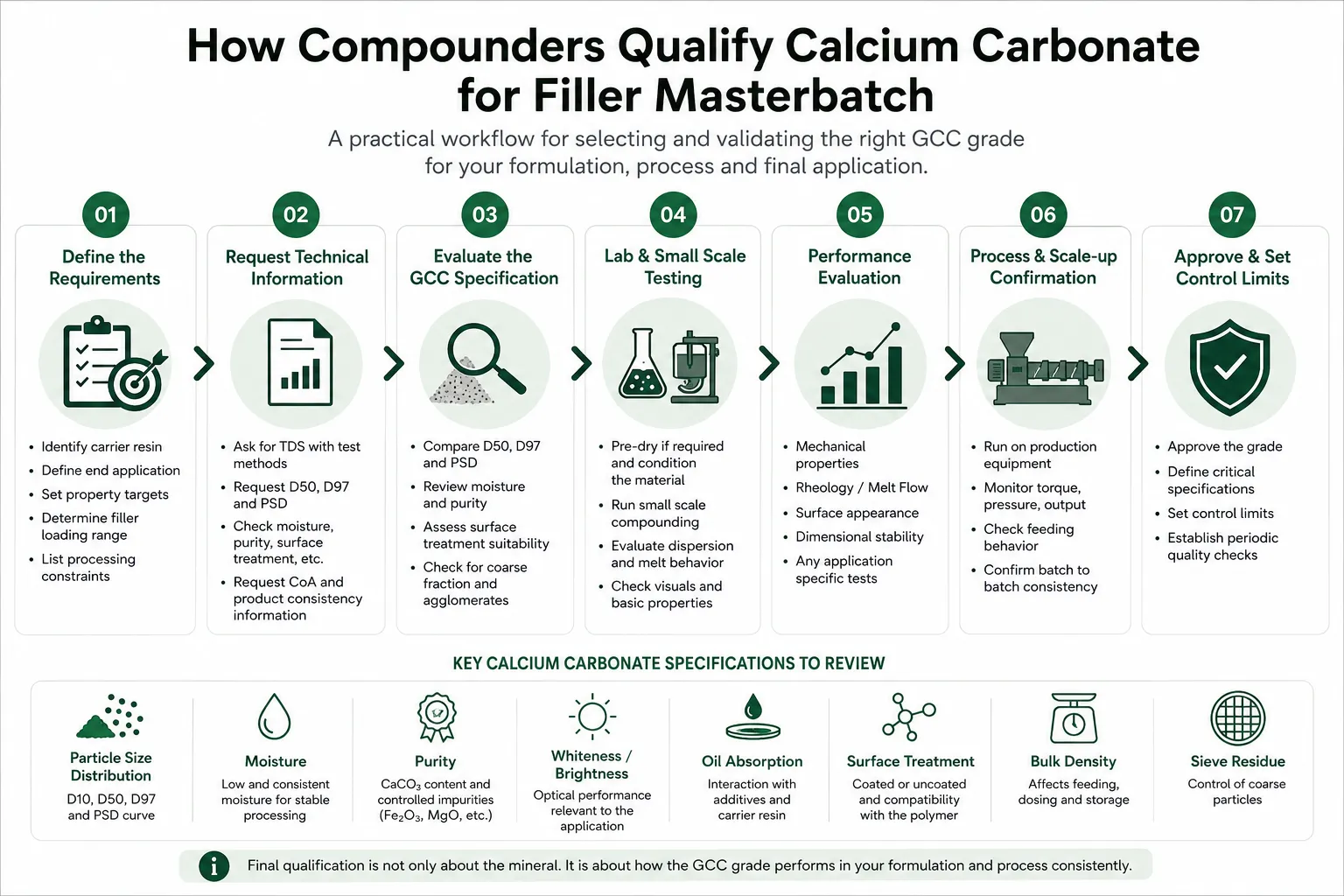
Calcium Carbonate Grade Selection Workflow for Filler Masterbatch
Selecting calcium carbonate for filler masterbatch should follow a structured qualification process. The compounder should begin with the final application and formulation requirements, then work backward toward the GCC specification. Starting with a supplier grade name or mesh number reverses that logic and can lead to unnecessary trials or technically unsuitable material.
The objective is not to find the finest calcium carbonate available. It is to identify a grade whose particle profile, surface condition, moisture, mineral consistency and processing behavior can be validated within the intended masterbatch formulation.
Final application first, formulation second, calcium carbonate specification third. Commercial grade selection should come only after these requirements are understood.
Define the Final Application
Begin with what the masterbatch will eventually be used to manufacture. Film, injection molded products, sheet, raffia and other applications can place different requirements on processing, appearance and mechanical behavior.
Identify the Carrier Resin and Formulation System
Record the exact carrier resin rather than using polyethylene or polypropylene as a general description. The resin grade, melt behavior and additive package form the processing environment in which the calcium carbonate must perform.
Choose the Required Surface Condition
Determine whether untreated GCC or a surface treated grade is the more appropriate candidate for the formulation. This decision should be based on polymer compatibility, dispersion requirements and processing behavior rather than assuming that coated material is automatically superior.
Compare the Complete GCC Specification
Once suitable product families have been identified, compare the laboratory data that actually matter to the compound. D50 should not be reviewed without D97 and the broader particle size distribution. Moisture, purity, whiteness, oil absorption, bulk density and surface treatment should be included when relevant to the application.
Arosha Powder's calcium carbonate technical data sheet library provides grade level documents for comparing coated and uncoated GCC products before sample qualification.
Request and Test a Representative Sample
A TDS can identify technically relevant candidate grades, but it cannot reproduce the customer's formulation. The next step is to evaluate a representative sample under controlled laboratory or production conditions.
The trial should reproduce the real carrier resin, additives and processing conditions as closely as practical. The objective is to determine whether the proposed calcium carbonate behaves acceptably inside the complete compound.
Validate the Masterbatch in the Final Application
Successful pellet production is not the end of qualification. The masterbatch should also be evaluated after dilution into the intended downstream polymer system. Some problems become visible only during film production, molding, extrusion or final product testing.
Define the Approved Purchasing Specification
Once the trial is successful, the compounder should document which calcium carbonate properties are critical for repeat supply. This converts a successful test into a purchasing and quality control specification that can be used for future batches.
Verify Commercial Batches with the COA
A Technical Data Sheet describes the grade specification, while the Certificate of Analysis is connected to an identified production batch or commercial lot. These documents should not be treated as interchangeable.
The batch COA can be compared with the approved purchasing specification to support incoming quality control and repeat supply verification.
TDS, Sample Trial and COA Serve Different Purposes
Used to understand the technical specification and compare potential calcium carbonate grades before testing.
Used to determine whether the selected GCC actually performs in the customer's resin, formulation and equipment.
Used to compare actual batch test results with the specification accepted during supplier qualification.
Technical documentation is essential for shortlisting and quality control, but commercial approval should combine document review with sample testing and formulation validation.
Buyers who are still comparing possible materials can review Arosha Powder's coated and uncoated calcium carbonate grades and then use the technical documentation for the selected candidates before requesting material for formulation trials.
What Compounders Should Request From a Calcium Carbonate Supplier
A calcium carbonate supplier should be evaluated on more than price, mesh designation and a single laboratory value. For filler masterbatch production, the buyer needs enough technical information to determine whether a proposed GCC grade can be compared, tested and controlled consistently during repeat supply.
The most useful supplier is not necessarily the one that provides the longest specification sheet. It is the one that can clearly identify the product grade, explain how key properties are measured, provide material for formulation testing and support batch verification after commercial approval.
Supplier approval should answer three questions: What exactly is the grade? Can it perform in our formulation? Can the supplier reproduce the approved quality during future commercial deliveries?
Grade Specific Technical Data Sheet
Request the TDS for the exact coated or uncoated grade being proposed. A general company catalogue is useful for screening products, but supplier qualification should use product specific technical information.
Review:- D50 and D97 where reported
- Particle size distribution information
- Moisture
- CaCO3 purity
- Whiteness or brightness when relevant
- Oil absorption where applicable
- Bulk density
- Surface treatment status
Test Methods and Measurement Basis
A number without a measurement method can be difficult to compare. Ask how important specification values are generated, particularly particle size, moisture, whiteness and other properties used in the purchasing specification.
Why it matters:Two suppliers may report similar values that were obtained using different analytical methods or sample preparation procedures.
Surface Treatment Information
When evaluating coated GCC, ask for confirmation that the proposed material is surface treated and request the available technical information about the treatment system.
Do not assume:The word coated does not establish equivalent coating quality, particle distribution or processing behavior between suppliers.
Representative Product Sample
Request material for laboratory or production testing before full commercial approval. The sample should represent the grade that the supplier intends to deliver commercially.
Test in:- The actual carrier resin
- The intended additive package
- The real formulation range
- Relevant compounding conditions
- The final downstream application
Safety Data Sheet
The SDS supports workplace safety, material handling, storage and compliance review. It serves a different purpose from the Technical Data Sheet and should be included in the supplier documentation package.
Batch Specific Certificate of Analysis
After a grade has been technically approved, the COA can be used to review analytical results associated with an identified commercial batch or lot.
Use it to:Compare actual batch results with the purchasing specification established during supplier qualification.
Packaging and Handling Information
Packaging is part of raw material control. Confirm the available packaging format, material protection, storage requirements and any conditions that may influence powder moisture or handling before the material reaches the feeder.
Commercial Supply Consistency
Ask how the supplier controls the properties that are important to your formulation during repeat production. A successful sample is useful only if the approved grade can be supplied consistently at commercial scale.
Discuss:- Critical quality parameters
- Batch verification
- Production consistency
- Documentation availability
- Packaging requirements
TDS, SDS and COA Should Not Be Used Interchangeably
| Document | Main Purpose | When the Compounder Uses It |
|---|---|---|
| TDS | Describes the technical characteristics and specification of a defined calcium carbonate grade. | Grade comparison and technical screening before sampling or purchase. |
| SDS | Provides safety, handling, storage and exposure related information. | HSE, workplace safety and material handling review. |
| COA | Reports actual analytical results associated with an identified production batch or commercial lot. | Batch verification and incoming quality control after grade approval. |
Arosha Powder maintains technical documentation for coated and uncoated calcium carbonate grades , including grade specific TDS documents, product family safety documentation and batch related COA requests. Compounders can use these documents to shortlist candidate grades before requesting material for testing.
Exact product grade identified
TDS reviewed
Relevant test methods understood
Sample tested in the real formulation
Final application evaluated
Critical purchasing limits defined
SDS reviewed by the relevant team
Batch COA process agreed
Send Your Existing Specification When Grade Matching
If a compounder is replacing an existing calcium carbonate source, the most efficient starting point is often the current purchasing specification or supplier TDS. This allows candidate GCC grades to be compared against known requirements instead of selecting a replacement from mesh number alone.
The comparison should still be followed by a formulation trial because similar specification values do not guarantee identical processing behavior. Particle distribution, surface condition and interactions with the existing resin and additives may differ between mineral sources.
Buyers can also review Arosha Powder's coated and uncoated calcium carbonate product range before moving to product specific technical documentation and sample qualification.
A technically responsible calcium carbonate supplier can provide product information, documentation and samples, but the final approval criteria must be connected to the compounder's own formulation, process and finished product requirements.
How Arosha Powder Supports Filler Masterbatch Producers
Filler masterbatch producers usually need more than a calcium carbonate price and a nominal mesh number. Technical sourcing requires access to product specifications, representative samples and sufficient batch information to compare candidate materials before commercial approval.
Arosha Powder supplies coated and uncoated ground calcium carbonate grades for industrial applications and supports technical evaluation through product documentation, sample qualification and batch related quality information. The objective is to help compounders identify suitable candidate grades for testing rather than prescribe one universal calcium carbonate grade for every formulation.
Grade Specific Technical Documentation
Compounders can review product specific technical data before selecting a material for laboratory or production trials.
Review Calcium Carbonate Data SheetsCoated and Uncoated GCC Options
Candidate grades can be compared according to particle size, surface condition and the technical requirements of the intended formulation.
Explore Calcium Carbonate GradesSample Based Qualification
Buyers can request material for evaluation in their own carrier resin, additive package, compounding process and final application before commercial approval.
Batch Related Quality Information
After technical approval, batch specific COA information can support comparison between commercial production lots and the agreed purchasing specification.
A supplier can help identify candidate materials and provide relevant documentation, but the compounder remains responsible for validating the calcium carbonate grade inside the actual formulation and final product.
For International Filler Masterbatch Buyers
Commercial qualification also includes packaging, logistics and repeat supply requirements. Buyers sourcing calcium carbonate for masterbatch production outside Iran can review Arosha Powder's calcium carbonate export information when evaluating shipment options alongside the technical grade selection process.
This separation is important. A technically suitable calcium carbonate grade still needs an appropriate commercial supply route, while an attractive export offer cannot compensate for a material that has not passed the customer's formulation trial.
Carrier resin, process, final product and existing specification if available.
Compare relevant coated or uncoated GCC specifications.
Test selected material in the actual formulation.
Define purchasing limits and batch verification requirements.
Frequently Asked Questions About Calcium Carbonate for Filler Masterbatch
The questions below address the most common technical and purchasing issues compounders face when selecting calcium carbonate for filler masterbatch production.
What is the best calcium carbonate for filler masterbatch?
There is no single calcium carbonate grade that is best for every filler masterbatch formulation. The appropriate grade depends on the carrier resin, final application, particle size distribution, D50, D97, moisture, surface condition, additive package and processing conditions.
A compounder should shortlist candidate grades from technical data, then confirm suitability through a formulation trial before commercial approval.
Is coated calcium carbonate better for filler masterbatch?
Coated calcium carbonate can be useful in hydrophobic polymer systems because surface treatment changes the interaction between the mineral and polymer phase. However, coated does not automatically mean better.
The quality of the surface treatment, particle size distribution, carrier resin and processing conditions still need to be evaluated together. For a deeper comparison, see the coated vs uncoated calcium carbonate guide .
Which mesh size is suitable for filler masterbatch?
Mesh size alone is not sufficient for selecting calcium carbonate for filler masterbatch. Two products with the same nominal mesh designation can have different D50 values, D97 values, particle size distributions and coarse particle fractions.
Compounders should compare the complete particle profile and relevant TDS values instead of approving a grade from mesh number alone. The calcium carbonate particle size guide explains the relationship between mesh, micron, D50 and D97 in more detail.
What D50 and D97 values should filler masterbatch producers use?
There is no universal D50 or D97 specification for all filler masterbatch applications. The required particle profile depends on the polymer system, processing equipment, desired dispersion and final product requirements.
D50 should be reviewed together with D97 and the broader particle size distribution. A formulation trial is still required to confirm whether the selected grade performs acceptably in the intended application.
How much calcium carbonate should be used in filler masterbatch?
A universal calcium carbonate loading rate should not be used. The workable mineral concentration depends on carrier resin rheology, GCC properties, surface treatment, additives, compounding equipment and the requirements of the final product.
Compounders should also distinguish between calcium carbonate content in the masterbatch, masterbatch dosage in the final formulation and the actual final calcium carbonate concentration in the finished polymer.
Why is moisture important in calcium carbonate for masterbatch?
Moisture can become relevant to powder handling, storage and moisture sensitive processing. Unexpected moisture can also complicate troubleshooting when the formulation shows unstable feeding, volatile related defects or inconsistent processing behavior.
The acceptable moisture level should be defined according to the formulation, equipment and purchasing specification rather than copied from an unrelated application.
Can the same calcium carbonate grade be used in PE and PP masterbatch?
A grade that performs well in one polymer system should not automatically be assumed to perform identically in another. LDPE, LLDPE, HDPE and PP differ in melt behavior and formulation requirements.
The same GCC grade can be evaluated in different carrier systems, but each formulation should be validated separately under its actual processing conditions.
What documents should a filler masterbatch producer request from a calcium carbonate supplier?
The minimum technical package should normally include a grade specific TDS and the relevant SDS. A representative sample should then be tested in the intended formulation.
After commercial approval, a batch specific COA can support incoming quality control and comparison with the agreed purchasing specification. Arosha Powder's calcium carbonate data sheet library provides technical documentation for coated and uncoated grades.
How should a compounder compare two calcium carbonate suppliers?
Compare equivalent technical parameters rather than only price and mesh number. Review particle size data, moisture, purity, surface treatment, relevant test methods, documentation quality, sample performance and repeat supply consistency.
If replacing an existing supplier, provide the current purchasing specification or TDS and compare candidate materials under the same formulation and processing conditions.
Does finer calcium carbonate always improve filler masterbatch quality?
No. A finer primary particle size does not automatically guarantee better dispersion or better final product performance. Very fine particles can also form agglomerates, and the result depends on surface condition, mixing efficiency, carrier resin and the complete particle size distribution.
The better grade is the one that performs consistently in the actual formulation, not simply the grade with the smallest reported particle size.
If the carrier resin, application, equipment or existing specification is known, the calcium carbonate selection process can be narrowed using TDS comparison and sample testing instead of relying on generic grade recommendations.
Final Technical Recommendation for Filler Masterbatch Compounders
Calcium carbonate for filler masterbatch should be selected as part of a complete formulation system, not as an isolated powder. Mesh number, price or whiteness can help describe a product, but none of them can confirm whether a GCC grade will feed consistently, disperse properly, process within the available extrusion window and meet the requirements of the final polymer product.
A technically sound qualification process begins with the end application and carrier resin. The compounder can then define the required particle profile, evaluate coated or uncoated material, review moisture and other relevant properties, compare technical documentation and select candidate grades for testing.
Do not ask which calcium carbonate grade is best in general. Ask which calcium carbonate grade can be consistently validated in your formulation, equipment and final application.
Start with the Application
Define the final polymer product, processing method and critical acceptance requirements before comparing GCC grades.
Evaluate More Than Mesh
Review D50, D97, the broader particle size distribution, moisture, purity and relevant surface characteristics.
Match the Surface to the Formulation
Select coated or uncoated GCC according to the carrier resin, dispersion requirements and formulation behavior rather than product labels alone.
Validate Through Processing
Observe feeding, dispersion, torque, pressure, melt behavior and pellet consistency under representative production conditions.
Test the Final Product
Successful masterbatch pellet production does not replace downstream application testing. Qualification should continue into the intended final polymer system.
Control Repeat Supply
Once a grade is approved, define the relevant purchasing specification and use appropriate batch information to support consistency during commercial supply.
The Best Grade Is the One You Can Reproduce
An excellent laboratory trial has limited commercial value if the same material characteristics cannot be maintained during repeat production. For an industrial compounder, consistency between approved samples and future deliveries is therefore part of calcium carbonate performance.
This is why technical evaluation should connect the supplier's calcium carbonate data sheets with customer formulation trials and an agreed quality control process. Documentation helps define the candidate material, testing establishes whether it works, and repeat batch control helps protect the approved formulation.
Compounders who follow this process can compare calcium carbonate suppliers on technical fit rather than nominal grade names alone. It also creates a clearer basis for formulation development, troubleshooting, supplier qualification and long term purchasing decisions.